

A universally affecting, timeless tale of love and loss by masters of the puppetry form.
PUNO: Sewing Memories is, in many ways, a ghost story. Or perhaps more precisely, it is the story of a ghost, though not in the way we might expect. From the very outset of the show, which played as part of the Esplanade’s 2026 Pesta Raya – Malay Festival of Arts, we are introduced us to something otherworldly: a spirit-like figure with dot eyes and reddish aura, hovering gently in the space. It does not haunt or threaten. Instead, it watches and observes, curious, almost tender in its gaze. Soon, it is joined by others: white, jellyfish-like forms drifting across the stage, their gauzy bodies and tendrils trailing behind them, tinged faintly with rust, as if worn by time.
There is no fear here, nor any dread. Naught but a quiet fascination. These are not ghosts that come to terrify the living, but presences that linger, soft, patient, and strangely warm. And as they slowly disappear from view, it becomes clear that what follows is not a story about being haunted, but about what remains after someone is gone.

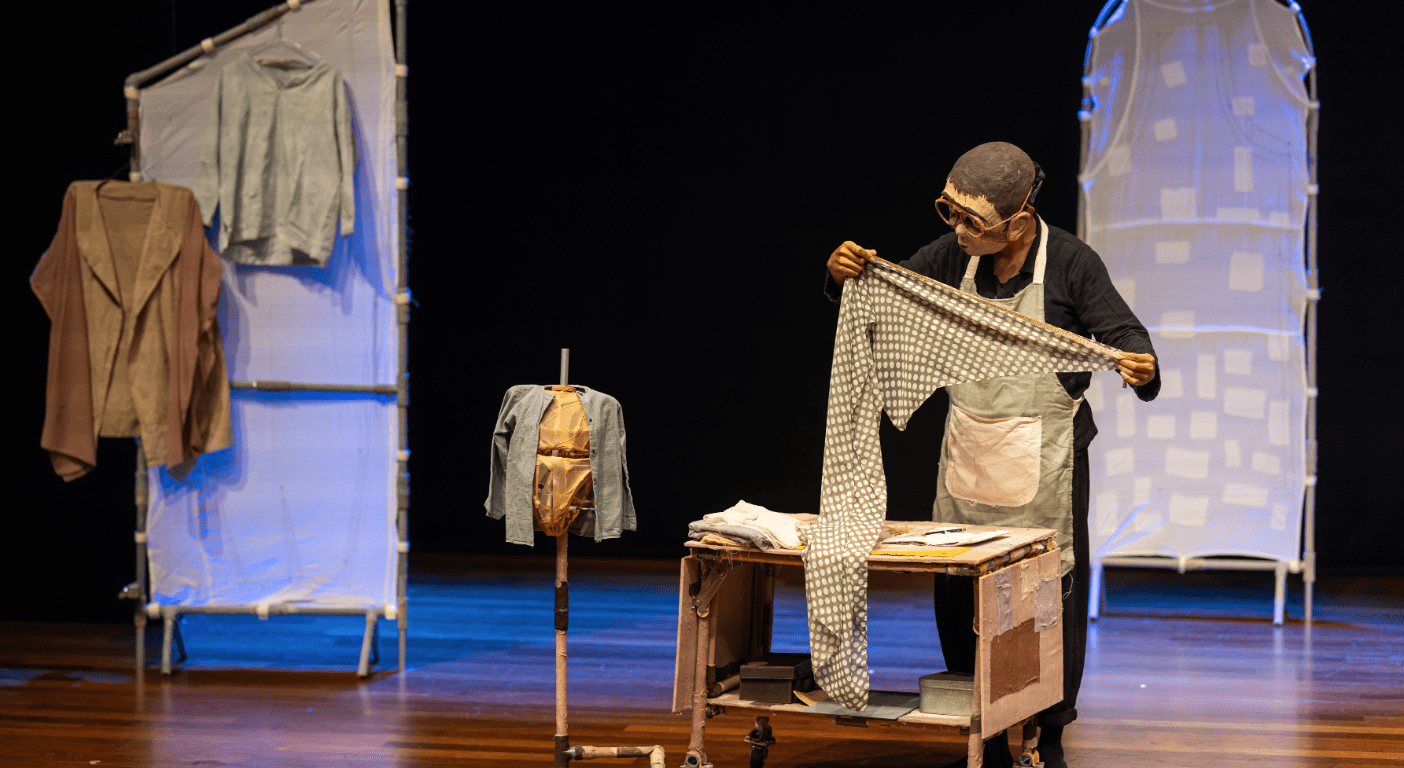
Conceived and produced by Papermoon Puppet Theatre, this latest iteration of director and playwright Maria Tri Sulistyani’s long-evolving work arrives not just as a performance, but as something closer to a ritual, a shared space in which audiences are invited to confront the fragile, inescapable truths of love, memory and loss. Following its mysterious opening scene, what follows is relatively lighthearted. We meet Puno, a tailor, hunched over his sewing machine, going about his daily routine. In this opening segment, he is embodied by a masked puppeteer, largely silent, communicating through gesture and occasional bursts of unintelligible sound. There is humour here, even playfulness, as he interacts with customers and the audience, drawing easy laughter.
But the tone shifts the moment Tala enters, as the performance settles into something softer and more intimate. The relationship between father and daughter unfolds with remarkable tenderness, with small gestures, shared rhythms, and quiet acts of care. It is in these moments that the production reveals its emotional core: a portrait of a single father doing everything he can to prepare his child for a future he may not be part of. We understand his loneliness, and how Tala remains the most important person to keep him going.

This theme is not incidental. The work itself is rooted in personal loss, with Maria’s own experience of losing both her parents at a young age, and the sudden passing of a close collaborator, Filipino puppetry artist Don Salubayba, whose death first shaped the piece’s earliest incarnation in 2014. Over time, and across multiple versions, PUNO has transformed from a meditation on grief into something more expansive: an exploration of how we “stitch” memories to keep our loved ones alive.
That metaphor finds literal expression in Puno’s profession. No longer a postman or illustrator, as in earlier versions, his job as a tailor, one who mends, patches, and preserves, echoes the Japanese practice of sashiko, where the act of sewing becomes symbolic: an attempt to hold together what has already been broken, to create continuity in the face of absence.

As Puno and Tala play, the world around them begins to shift. The domestic gives way to the dreamlike, and this is where Papermoon’s mastery of form becomes undeniable. The characters transform into exquisitely crafted puppets, manipulated in a style inspired by Japanese bunraku and kuruma ningyo. The effect is astonishing. Puppeteers glide on wheeled stools, giving the illusion of effortless motion, or slow their movements to render each step deliberate, weighted, almost painfully human.
There is an intelligence and sensitivity to this choreography that borders on the uncanny. These are not simply objects in motion, but feel alive as they breathe, hesitate, reach for each other. In one particularly striking sequence, Puno and Tala find themselves adrift in a boat, fascinated by flocks of giant flying paper cranes. When they are suddenly thrown apart, the stage erupts into motion, as spinning frames encircle them like a vortex, and for a moment, it feels as though they have been separated forever. Puno’s frantic attempts to call out to Tala are deeply affecting. The eventual reunion offers relief, but also an unspoken forewarning that this will not last, and danger is still imminent.

The emotional climax arrives with devastating clarity; Puno lies on a flatbed, Tala by his side. He calls out to her, but there is no response. Then, slowly, inexorably, he is lifted, as if by an unseen force. He clutches at the air, at the edges of the world he is about to leave behind. And in a single, piercing cry, the realisation lands – he is dead. It is here that the production cuts deepest. Children in the audience may watch with curiosity, even amusement, but among the adults, something shifts. There are audible sobs, as shoulders shake and tissues are passed from one friend to another. Because what Papermoon understands, and renders with devastating precision, is that grief is something viscerally felt, lived, remembered and recognised.
Having witnessed the depth of Puno and Tala’s bond, the inevitability of their separation becomes almost unbearable. And yet, the work does not end here, in despair. Instead, it moves towards something quieter, more contemplative. In a final, almost ceremonial sequence, the stage is transformed: two platforms are connected by a bridge of fabric, stitched together from scraps left behind by Puno. A smaller version of Tala begins to cross. Each time she falters, Puno, now unseen, but ever-present, catches her.

It is a profoundly moving image, that the idea that those we lose do not simply vanish, but remain with us, embedded in memory, guiding us in ways we cannot always articulate. A presence and a thread that continues on even after death. Particularly significant is how the puppeteers themselves remain visible throughout, their faces solemn, focused, carrying the weight of the story even as their hands give it form. This duality, where they are simultaneously performer and witness, adds another layer of resonance, reinforcing the sense that what unfolds onstage is shared between both them and us, universally felt.
Equally vital is the music. Under the direction of Iwan Effendi, building on compositions by Yennu Ariendra, the score moves seamlessly from the delicate to the soaring, binding the performance together. It breathes with each scene, amplifying every emotional beat, stitching scene to scene with an almost invisible precision. And in its final image, a structure of countless suspended boats fills the stage, like a vast, drifting mobile. Tala looks up, and among the floating forms, Puno is no longer distinct, letting go of his earthly form and becoming one of the same ghostly entities we first encountered. He has let go, and accepted that his role as father and protector is complete. Below, Tala remains. Still aching, but ready, at last, to continue on her own.

PUNO: Sewing Memories is a reminder of what theatre, at its most powerful, can do. In a world that often encourages us to move quickly past grief, whether it’s to scroll, to distract, or to forget, this is a work that asks us to sit, to feel, and to remember. It is exquisitely crafted with love, from its intricate puppets to its fluid integration of movement, shadow, and sound. But more than that, it is a deeply human meditation on the quiet rituals of care, and on the invisible threads that bind us to those we have lost.
By the time the lights fade, you may find yourself in tears, not only for Puno and Tala, but for your own memories, your own ghosts, your own unfinished stitches. And perhaps that is its greatest achievement: to tell a powerful story that doesn’t insist, but reminds us what it means to feel.

Photo Credit: Alvin Ho, courtesy of Esplanade – Theatres on the Bay
PUNO: Sewing Memories played from 17th to 19th April 2026 at the Esplanade Recital Studio. More information available here
Pesta Raya – Malay Festival of Arts 2026 runs from 16th to 19th April 2026 at the Esplanade. More information and tickets available here
Production Credits
| Conceived and Produced by Papermoon Puppet Theatre Artistic Directors Maria Tri Sulistyani and Iwan Effendi Director & Playwright Maria Tri Sulistyani Music Director Iwan Effendi Technical & Set Engineer Anton Fajri Puppet Builders Anton Fajri, Beni Sanjaya, Pambo Priyojati, Hardiansyah Yoga, Iwan Effendi, Maria Tri Sulistyani Puppeteers Pambo Priyojati, Beni Sanjaya, Hardiansyah Yoga, Anton Fajri Costume Maker Retno Intiani Music Composer Yennu Ariendra Music Operator Febrinawan Prestianto Video and Photography Rangga Yudhistira Lighting and Technical Director Andreas Praditya |

