

From rap battles to nightmare squirrels and chocolate waterfalls, this Roald Dahl adaptation is is weird, whimsical, and delightfully emotional.
There is something inherently magical about Charlie and the Chocolate Factory. Whether through Roald Dahl’s original novel, the beloved 1971 film, or the many adaptations that followed, the story has always lived in that strange space between fantasy and cautionary tale; whimsical on the surface, but quietly sharp underneath. So when the international touring production arrived at the Sands Theatre in Singapore, the question became: could this version still capture that sense of wonder?
Charlie and the Chocolate Factory follows young Charlie Bucket, a kind but impoverished boy living with his mother and four grandparents in a crumbling home at the edge of town. When the reclusive and eccentric chocolatier Willy Wonka announces a global contest to find five golden tickets hidden inside his chocolate bars, Charlie (along with four other children from around the world) suddenly finds himself thrust into a once-in-a-lifetime opportunity. Inside Wonka’s surreal chocolate kingdom, each child’s flaw is exposed and punished in increasingly fantastical ways, and what begins as a whimsical factory tour quickly spirals into a series of moral tests disguised as sweet temptations.

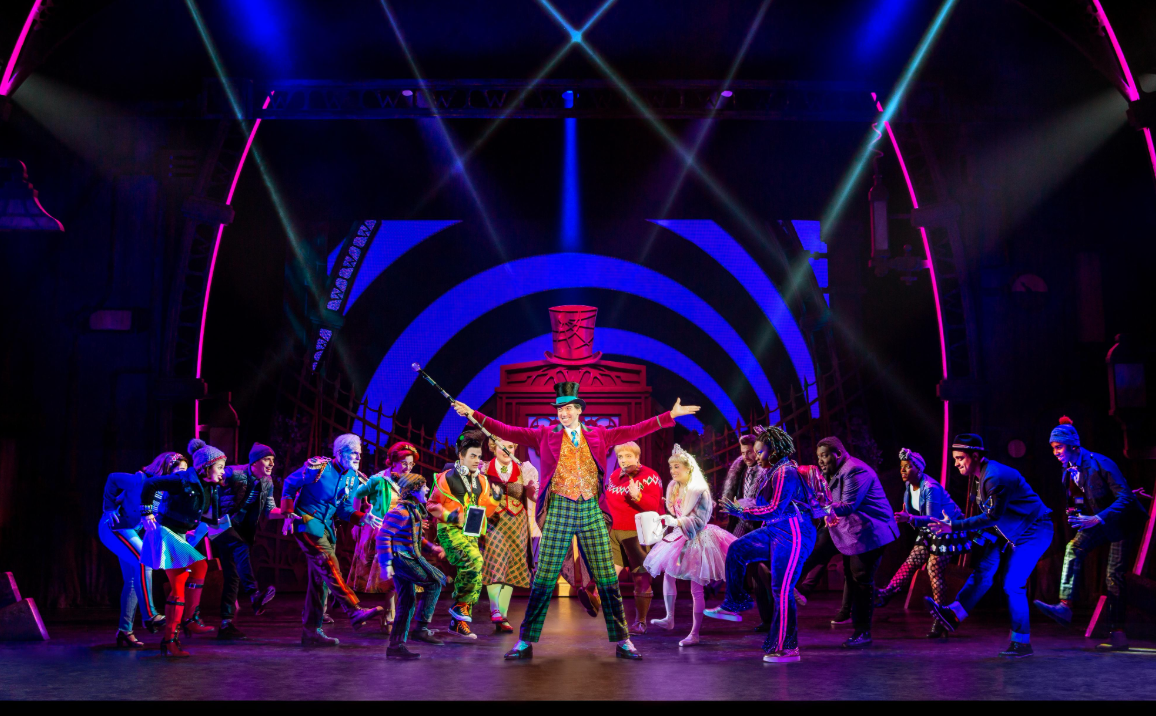
From the very beginning, this production makes it clear that it is a modern touring show. The most noticeable aspect is the heavy reliance on LED screens and digital projections rather than large practical sets. Initially, this does feel like a drawback. Considering the production already invests so much into a full live orchestra, strong sound design, choreography, illusions, and an undeniably talented cast, there are moments where the digital-heavy staging risks making the show feel visually thinner than it should.

But as the evening progresses, the production gradually reveals how intelligently those projections are being used. Rather than simply acting as static backdrops, the sliding LED panels become transitions, environments, moving scenery, and even part of the storytelling itself. Candy shops transform before our eyes, junkyards appear and disappear, television studios emerge out of nowhere, and the factory itself constantly shifts shape. By the second act especially, the screens stop feeling like substitutes for sets and instead become part of the show’s dreamlike language. It may not have the lavish physical spectacle some audiences expect, but there is creativity in how the production adapts itself for touring.

And thankfully, the heart of the show never gets lost beneath the technology. From the opening moments of “The Candy Man,” Daniel Plimpton commands the stage with complete confidence. His Willy Wonka is not portrayed as purely gentle or grandfatherly. Instead, Plimpton leans into the character’s theatrical ego, eccentricity, and self-obsession. This Wonka knows he is extraordinary, and there is an almost rockstar-like quality to the way he carries himself through the factory and around the children.

Vocally, he is excellent throughout the night, but where he truly shines is in “Pure Imagination.” Supported by the lush sound of the live orchestra, the song becomes less of a nostalgic callback and more of an invitation into Wonka’s strange worldview. There is warmth beneath the eccentricity, but also something elusive about him, as though even the audience is never fully allowed to understand him completely.

One of the more interesting choices in this adaptation is how it portrays Charlie Bucket’s poverty. Traditionally, Charlie is often depicted in exaggerated Dickensian misery. Here, Oliver Wong’s Charlie does not outwardly “look poor” in the way audiences might expect, and at first, that feels unusual. This version seems less interested in visual stereotypes and more focused on emotional reality. Charlie’s hardship is not performed through ragged caricature, but through circumstance, longing, and quiet resilience. It subtly suggests that poverty is not always immediately visible, and that people are often far more than what can be judged from appearances alone. The Bucket family lives in modest, worn surroundings, but not in the kind of heightened theatrical “poverty” audiences might expect. At first, this can feel like a softening of the story’s edges. But it also opens up a more modern reading: poverty is not always visually legible, and it does not always announce itself in obvious ways. There is something quietly dignified about the way the Bucket family carries themselves, choosing not to mask their circumstances, but also not being reduced to them. In a strange way, it raises an interesting question within a spectacle-driven show: does struggle have to be visibly performed in order to be understood?

Oliver Wong then, brings an earnestness to Charlie, and delivers a sincere-enough performance that keeps the the larger spectacle around him afloat. Particularly in the scenes shared with Grandpa Joe, we often feel most during scenes between them, such as during “Charlie, You & I,” where their shared love for Willy Wonka feels less like childish obsession and more like a necessary escape from reality. Steve McCoy is wonderfully warm in the role of Grandpa Joe, balancing humour, tenderness, and childlike excitement without becoming overly sentimental. The chemistry between him and Oliver Wong feels natural throughout, making the later “I’ve Got a Golden Ticket” sequence genuinely uplifting.

This adaptation also makes a notable change to the Bucket family dynamic. Rather than Charlie’s father being absent due to unemployment, his father has passed away, leaving Mrs. Bucket as the sole breadwinner working at a laundromat. That adjustment gives the family scenes an added layer of emotional realism, particularly during “If Your Father Were Here.” Jill-Christine Wiley delivers one of the strongest vocal performances of the evening. Her portrayal never feels melodramatic; instead, she captures the exhaustion, protectiveness, and quiet hope of a mother trying to hold everything together. The tenderness between mother and son gives the production much-needed grounding amidst all the theatrical chaos.

Once the Golden Ticket winners begin appearing, the show fully embraces its satirical absurdity and this is where the production becomes especially fun. Augustus Gloop’s entrance during “More Of Him To Love” is hilariously over-the-top, complete with Bavarian blue-and-white aesthetics, sausages, pretzels, yodelling, and Oktoberfest energy. The caricature is broad, but intentionally so, and the audience clearly delights in it. Veruca Salt’s introduction similarly leans into exaggerated privilege, while her father perfectly embodies the endlessly exhausted rich parent willing to buy absolutely anything to satisfy his daughter’s demands.

But perhaps the most entertaining reinvention comes with Violet Beauregarde. Reimagined through “The Queen of Pop” as an aggressively performative, rap-infused social media personality, the number bursts with energy. Giselle Amarisa Watts attacks the role with confidence and charisma, while the choreography surrounding her is sharp, stylish, and impressively paced. Bubblegum props descend from above the audience, projections spill across the theatre walls, and the production actively tries to immerse the audience inside Violet’s hyper-commercialised world.

The choreography throughout the show deserves particular praise. Even when physical staging is minimal, movement constantly keeps the production alive. Large ensemble transitions are handled efficiently, the pacing rarely drags, and the show understands how to keep momentum moving forward. Some adaptations of Charlie and the Chocolate Factory can become bogged down by the episodic structure of the story, but this version keeps scenes flowing quickly without losing clarity.

Still, there are moments where the production could have allowed itself to breathe more. Charlie discovering the Golden Ticket, for instance, feels surprisingly rushed. It is one of the most iconic moments in the story, yet here it arrives and resolves almost immediately. There is little suspense or emotional build-up before Charlie simply reveals the ticket to the crowd. It is perhaps one of the few moments where the production misses an opportunity to create a stronger sense of theatrical magic.

Thankfully, the first act closes strongly once the families gather outside the factory gates. As Wonka finally appears, dramatically emerging through a clever illusion in his signature suit, the show finally taps fully into the sense of anticipation audiences have been waiting for. “It Must Be Believed To Be Seen” becomes a fitting act finale, with the ensemble bringing tremendous energy and theatricality to the sequence.

After intermission, the production fully commits to spectacle. This is where the LED-heavy design finally begins paying off in a major way. During “Pure Imagination,” the projections expand the world far beyond the limitations of a traditional touring set. Rivers of chocolate stretch endlessly, colours explode across the stage, and Wonka’s factory starts feeling genuinely alive. It may not be physical spectacle in the old-school Broadway sense, but the production understands that imagination itself is part of the theatrical contract.

And once the audience accepts that, much of the magic works. The Oompa Loompas are also handled cleverly. Rather than attempting awkward realism, the production stylises them through choreography, projections, ensemble doubling, and visual effects. Their appearances after each child’s downfall become entertaining set-pieces in themselves, each carrying its own strange tone and humour.

The darker elements of Roald Dahl’s world also emerge more strongly in Act II than many might expect. Veruca’s squirrel sequence, in particular, becomes genuinely unsettling. “Veruca’s Nutcracker Sweet” transforms into something resembling a distorted ballet nightmare — fitting for a character initially introduced with poise and elegance. The squirrels themselves are eerie, almost demonic in movement, and the sequence takes on a surprisingly dark atmosphere reminiscent of twisted fairytale imagery. It is bizarre, slightly creepy, and incredibly memorable.

Meanwhile, Mike Teavee’s television sequence embraces pure theatrical absurdity. The illusion work here is genuinely impressive, using staging and projection effects to sell the idea of objects being transported through television screens. The production wisely avoids over-explaining the mechanics and instead trusts the audience to simply enjoy the theatrical trickery.

By the final scenes, the musical ultimately lands where it needs to emotionally. Wonka’s decision to choose Charlie feels earned not simply because Charlie is “good,” but because he still possesses imagination, curiosity, and creativity. One particularly effective moment comes when Charlie begins sketching ideas inside Wonka’s office despite being told not to touch anything. Rather than punishing him outright, Wonka recognises something of himself in the boy, not mere obedience, but possibility and hope.

The final glass elevator sequence tries hard to create theatrical wonder, and while the touring limitations remain visible, the emotional payoff still succeeds. As Charlie places on Wonka’s famous top hat and pauses before stepping into his new future, the production quietly reminds audiences what the story has always really been about. It’s not chocolate, but the importance of holding onto imagination even as the world constantly tries to take it away.

Considering the demands of a touring production, the production’s heavy use of LED screens and projection design is understandably, a production where sets must remain adaptable, transportable, and financially sustainable. In that context, digital staging is not simply aesthetic choice, but logistical reality. While the LED-heavy design can occasionally feel visually limiting, it also reflects the constraints of modern touring theatre, where spectacle must be balanced against mobility, cost, and repetition. The projections, then, become a way of preserving ambition without sacrificing practicality. What results is a subtle tension: a story about excess and imagination is itself shaped by limitation. And in an unintended way, that mirrors Charlie’s own world, where imagination stretches far beyond material conditions. As such, despite occasional visual limitations and an overreliance on the LED screens, this Singapore tour of Charlie and the Chocolate Factory succeeds because of its performances, heart, humour, and sheer theatrical energy. Backed by a strong live orchestra, committed ensemble, inventive choreography, and standout turns from the ensemble, the production ultimately delivers exactly what audiences hope for when they step inside Wonka’s factory – a sweet evening of theatrical magic.
Photo Credit: Jeremy Daniel and Matt Ossowski
Charlie and the Chocolate Factory plays from 19th May 2026 at the Sands Theatre at Marina Bay Sands. Tickets available here
 Bakchormeeboy