
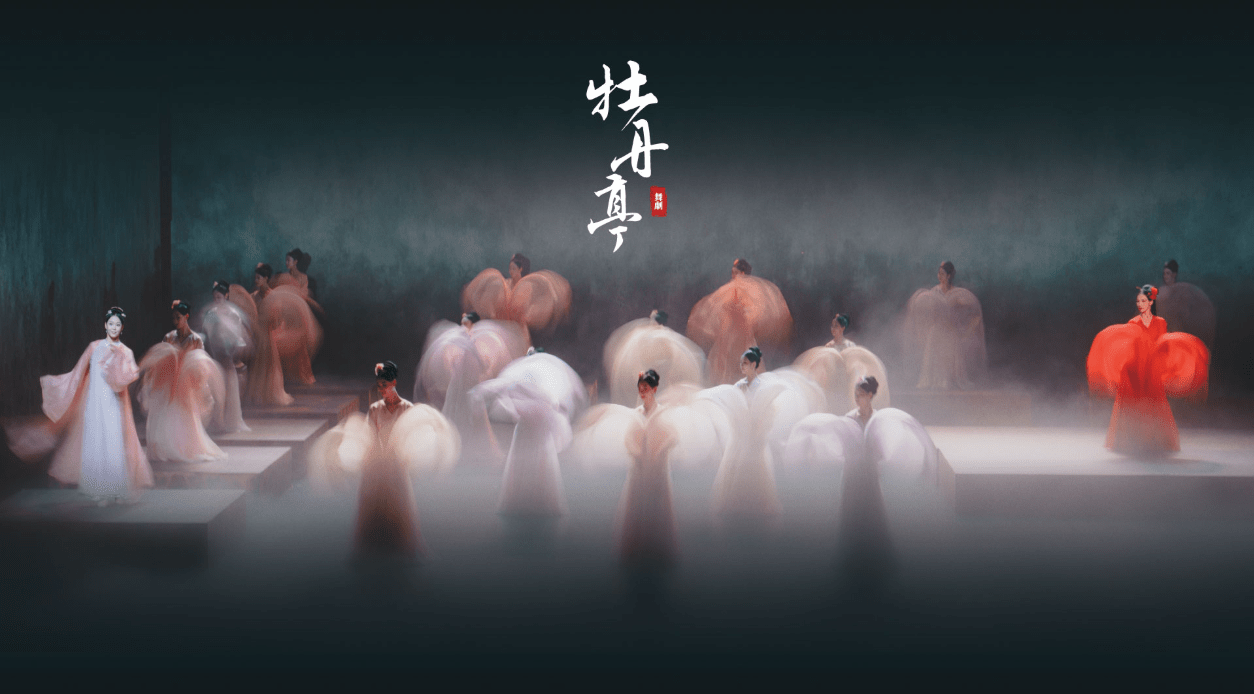
Li Xing’s Dream in The Peony Pavilion transforms theatre into a living, visually stunning poem about love, desire and transcendence.
HONG KONG – Watching Dream in The Peony Pavilion feels less like witnessing a dance production and more like entering a dream that slowly swallows the theatre whole. Before the show even begins, smoke blankets the stage, already creating this dreamscape as though we are somewhere above the clouds. Through the haze, a beautiful figure appears dancing, immediately establishing the production’s ethereal, painterly visual language.
This work is a large-scale dance theatre adaptation of the Ming dynasty masterpiece The Peony Pavilion (1598) by Tang Xianzu, one of China’s most celebrated classical writers. The story, long regarded as a cornerstone of Kun opera and Chinese literary tradition, follows Du Liniang, a magistrate’s daughter who falls in love with a scholar in a dream, dies from longing, and is eventually revived through a love that transcends life and death itself.
In this adaptation, directed and choreographed by Li Xing and Huang Jiayuan, the sprawling original has been distilled into a series of dreamlike “scrolls”. Rather than presenting a linear narrative, the production moves through memory, desire and illusion, constantly blurring the boundaries between them. With a 30-strong cast from the Suzhou Song and Dance Theatre, the work sits within a broader contemporary wave of Chinese dance theatre that reimagines classical literature through large-scale scenography and modern stagecraft.

Inside the palace, the opening scenes already establish this visual logic with striking clarity. Palace workers sway rhythmically across the space, while Du Liniang sits restlessly in her study, bored by lessons and confined propriety. Even in stillness, the stage feels alive, like an atmosphere in motion. Around her, ritual and discipline are constantly in tension with something more emotional, more unspoken. A teacher figure appears here too, gradually emerging as something closer to a jester full of vitality, humour and emotional unpredictability. In a work of this scale, he becomes crucial: not just as a character, but as a bridge between worlds, helping guide the audience through the production’s dream logic and emotional shifts.
Very quickly, it becomes clear that this is a production obsessed with beauty in composition, movement, and the careful construction of every moment on stage. Nothing feels incidental. Every entrance, every shift in light, every emergence from smoke or shadow feels deliberately shaped. The score, with its eerie operatic textures and moments of restraint, allows the stage to breathe, as if the entire theatre is exhaling slowly in rhythm with the performance. Then, suddenly, she appears in a red dress, larger than life, almost mythic in presence. The production understands scale instinctively: it is often maximal, yet never chaotic. Even at its most visually expansive, it retains a strange emotional intimacy, as if every vast image still contains a private thought at its centre.
That balance is made possible through exceptionally precise blocking. Staged within the vast space of the Hong Kong Cultural Centre Grand Theatre, the production shows an acute awareness of architectural scale. Rather than being overwhelmed by the size of the venue, it uses it. Distance becomes narrative. Space becomes emotion. And despite the enormity of the stage, the performers are consistently pulled close to the audience’s perception.
Set design by Ren Dongsheng extends this spatial intelligence further. Doors and openings at the back of the stage function almost like shifting thresholds, sometimes leading outside the palace, sometimes into private inner chambers, and at other moments into something more abstract, like passages between earth and heaven. What could feel confusing is instead rendered entirely legible through careful staging. Lighting and multimedia design by Hu Tianji deepen this sense of transformation, often turning the stage into a living ink painting. Figures appear suspended within shifting landscapes of light and shadow, as if the stage itself is constantly being re-drawn in real time. Movement, design and image merge into a single visual language.
Again and again, the production produces tableaux of extraordinary clarity. One of the most striking sees twelve women encircling the red figure, a moment that feels both ceremonial and psychologically charged. It is here that the choreographic vision of Li Xing and Huang Jiayuan becomes especially apparent: not only in the precision of movement, but in their understanding of how bodies can carry emotion collectively, rather than individually.
Smoke, too, becomes an active component of this language rather than mere atmosphere. Carefully calibrated, it shapes visibility and disappearance with remarkable control. Too much, and the illusion collapses; too little, and the world loses its dreamlike suspension. Instead, it becomes a mechanism of transformation, allowing figures to materialise, dissolve, or reappear without warning. At times, guards emerge through it like terracotta warriors rising from the earth, reinforcing the sense that this world is continuously being conjured.

The introduction of the thrust stage adds another layer of complexity. When performers move into this closer, secondary space, the entire emotional register shifts. Duets become intimate rather than monumental, and at times the dancers resemble figures inside a music box, especially as reflections above mirror and distort their movement, doubling the image in space.
Across the production, there is a persistent tension between classical Chinese visual language and contemporary theatrical execution. Scrolls, flowers, portraits and ritual gestures feel deeply rooted in tradition, yet they are staged with a modern sensibility that makes them feel newly discovered. Even simple gestures such as a figure lying still with a flower carry both historical weight and present-tense immediacy.
As scrolls unfurl and imagery shifts, the production increasingly resembles a moving ink painting. At moments, the stage screen itself feels like a living Chinese landscape. Elsewhere, dancers with black-and-white fans evoke yin and yang symbolism, reinforcing the production’s continuous dialogue between opposing forces of life and death, presence and absence, dream and waking. One of the most haunting sequences features performers in white masks drifting across the stage like spirits. The masks suggest multiplicity and the different selves people carry before the red queen reappears and the ensemble gathers around her in a ritual-like summoning. The effect is both unsettling and magnetic.

The ensemble itself is extraordinary throughout: fully synchronised, deeply responsive, and constantly in dialogue with space, music and each other. Composer Zhao Bo’s score, particularly the use of the erhu, anchors this fluidity with a sound that feels both grounded and emotionally restrained. A particularly memorable moment arrives when Liu Mengmei appears carrying what resembles an olive branch, standing before a symbolic doorway. When he unfurls a portrait scroll and begins to dance with it as though the image itself has come alive, the production briefly tips into pure theatrical magic.
That sense of transformation runs throughout the work. Figures vanish into smoke. Portraits reappear unexpectedly. The master-and-student figures chase shifting apparitions across the stage with a speed and precision that feels almost impossible. Whether illusion or mastery, the effect is consistently astonishing.
As Du Liniang and Liu Mengmei’s relationship deepens, the production finally settles into its emotional core. Their duet is not simply romantic but deeply contemplative about longing, recognition, and acceptance. The erhu underscores this moment with a clarity that is both tender and firm. When she rises through the smoke like a spirit ascending toward heaven, the production reaches one of its most transcendent images. The lovers move together through heavenly gates, suspended between dream and reality, presence and disappearance. By the final scenes, movement becomes cyclical and expansive: bodies repeating in waves of energy while the red queen spins endlessly into the clouds. The image suggests something like eternal motion of emotion without resolution.

Ultimately, the production succeeds in transforming the entire theatre into an unstable, infinite space where heaven, memory, dream and reality coexist without hierarchy. Beyond its visual and choreographic achievement, Dream in The Peony Pavilion draws deeply from its literary origins. Tang Xianzu’s text has always been concerned with the instability between dream and reality, and this adaptation distils that philosophy into pure movement rather than dialogue or narrative explanation. As part of Suzhou Song and Dance Theatre, the production also sits within a broader movement in contemporary Chinese dance theatre, one that fuses classical literature with cinematic staging, large ensemble choreography, and immersive scenography. But what lingers is not its scale or technique. It is the feeling of being fully absorbed into a world that behaves like memory: fluid, fragile, and constantly slipping between states of reality.
What makes Dream in The Peony Pavilion so compelling is its understanding of dance as something beyond narrative function. It becomes a language for what cannot easily be spoken, these undercurrents of emotion, memory and desire that rarely surface in words but remain constantly present in feeling. Even at its most technically intricate, it never abandons that emotional clarity. And at its best, most visually-impressive moments, the theatre stops feeling like a space we sit in, and becomes a world we briefly inhabit, and hesitate to leave.
Photo Credit: This Is Suzhou
Dream In Peony Pavilion ran from 27th to 29th March 2026 at Grand Theatre, Hong Kong Cultural Centre. It will run from 22nd to 24th May 2026 at the Esplanade Theatre in Singapore. Tickets available here
Hong Kong Arts Festival 2026 ran from 27th February to 29th March 2026. For more information about the Hong Kong Arts Festival, visit hk.artsfestival.org.
Production Credits
Cast Hu Jie, Luo Yuwen, Zhang Yin, Li Qian, Yu Jianwei, Li Zheng, Yang Wenyi, Wu Yucheng, Huang Huihui, Wang Shengxi, Ma Chi Performers Suzhou Song and Dance Theatre Co-produced by Suzhou Cultural Investment, HSproduction Original Author Tang Xianzu Directors & Choreographers Li Xing, Huang Jiayuan Playwright Luo Huaizhen Composer Zhao Bo Set & Lighting Designer Ren Dongsheng Multimedia Designer Hu Tianji Costume Designer Li Kun Make-up Designer Jia Lei Dramaturg Cui Lei |

