
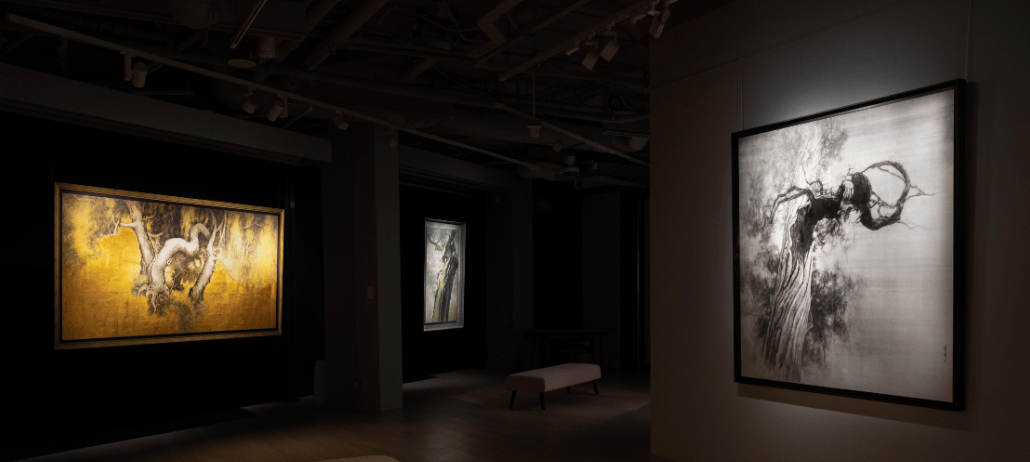

For Li Huayi, landscape is not a record of a place but an expression of an inner world. As his first solo exhibition in Southeast Asia arrives in Singapore, the artist reflects on tradition, freedom, memory and the enduring possibilities of ink.
There are no travellers wandering through Li Huayi’s landscapes. No fishermen, scholars or tiny figures climbing the mountain paths that populate so much of traditional Chinese landscape painting. Instead, there are mountains, trees, mist, rock and vast expanses of silence. And yet, Li believes, people are still there. “You can still feel whether you are inside the painting or outside it,” he says.
It is a revealing idea for an artist whose landscapes have, for more than three decades, been concerned with the relationship between the visible world and the invisible one. Born in Shanghai in 1948 and based in the United States since 1982, Li has developed a distinctive body of work that looks deeply into the traditions of Chinese ink while resisting the idea that tradition and contemporaneity must exist in opposition.
That tension is what lies at the core of Unity of Man and Nature, presented by Kwai Fung Hin Singapore from 23 September to 21 November. The exhibition, Li’s first solo presentation in Southeast Asia, brings together 12 milestone works from 2001 to 2024, from ink and colour on paper to antique gilded screens and paintings incorporating gold leaf.
Taken together, the works trace an artist continually asking the same fundamental question: how can an ancient visual language remain alive in the present? For Li, the answer begins not with scenery but with the mind. “I do not paint from real scenery, whether in China or California,” he has said. “The landscapes I depict exist only in my mind.”

Li’s statement sounds simple, but it marks an important distinction between his approach and that of an artist painting directly from observation. He recalls the Western tradition of landscape painting, where artists might travel to a particular vista and record the mountains, rivers and skies before them. “I’m not like a Western artist who goes to a vista point or Yellowstone and paints what he sees,” he says. “I simply look at nature and find something within my mind.”
His landscapes may draw on places he has encountered across China and the West, but they are not depictions of identifiable locations. Instead, memories, impressions and visual fragments are distilled and recombined. This approach has roots in the philosophical foundations of shan shui—literally “mountains and water”—which Li sees as fundamentally different from the Western concept of landscape. “For the Chinese, shan shui is almost like a genesis,” he explains. “It is like creating your own world.”
He points to the experience of visiting mountains such as Taishan or Huangshan, where the landscape has historically carried a spiritual dimension. People go to see the sunrise, he says, not merely for its visual beauty but because they feel spiritually uplifted by the encounter.
Nature, in this understanding, is not simply scenery. It is a space in which the individual can locate something beyond the self. That idea helps explain why Li’s paintings can feel simultaneously enormous and intimate. His compositions often crop dramatically into mountains, trees and rock, bringing the viewer unusually close to the landscape. The effect can be almost cinematic: instead of presenting a complete vista, he gives us a fragment so concentrated that it suggests something immeasurably larger beyond the frame.
“Monumentality does not necessarily depend on the size of the painting,” Li says. “A painting can be unfinished and still feel monumental. You can feel that it is important even without a huge physical scale.”

The absence of people is therefore not an absence of humanity. In traditional Chinese landscape painting, Li explains, human figures were often included to establish scale. A tiny figure standing beneath a mountain could make the mountain appear impossibly vast. But Li has found other ways to create that relationship. “You want to express how high it is. If you show very little sky, the mountain becomes very high,” he says. “The scale can be understood without putting a person into the painting.”
The tree, too, can become a kind of protagonist. “You can take a tree as the hero,” he says. “You can use the tree to show how high the mountain is.”
The result is a curious reversal. The human being disappears from the picture, yet the viewer becomes more conscious of their own position within it. Standing before one of Li’s landscapes, we are invited to imagine ourselves moving through it, looking up, looking across, or simply existing within its stillness.
For Li, this is part of the reason he avoids painting specific places. “I look at so many mountains and so many places, but when I paint, I don’t paint a specific place,” he says. “I put together my own experience and spirit.”
If that personal spirit can meet the spirit of Chinese landscape painting, he adds, “and show it to people, I think that is more meaningful.”

Li’s artistic language has also been shaped by a life lived between cultures. He left Shanghai for the United States in 1982, at a time when relatively few Chinese artists of his generation had established careers there. His position was unusual: he entered an American contemporary art world while carrying with him the traditions of Chinese ink.
Rather than abandoning the latter, he moved further into it. His understanding of Western and Chinese art remains deliberately comparative. Western landscape, he argues, developed around the representation and expression of nature, while Chinese shan shui encompasses a broader cosmological idea—a way of imagining and constructing a world.
Yet his American experience was equally formative. He recalls encountering artists such as Jackson Pollock and studying in the United States, where one of his teachers offered him an unusually open instruction: “I am not going to teach you a particular style. You can develop your own style. I will just help you make your style work.”
That freedom stayed with him. “I usually prefer freedom,” Li says. It is also one reason he appreciates Southeast Asia as a place to exhibit his work. “I think the reason I came to Southeast Asia now is because I feel that people here respect tradition. If I can bring my experience and show it to more people, that would be very good.”
He is also candid about the complexity of remaining connected to Chinese culture while living abroad. “I am still Chinese,” he says. “I am Chinese inside, and I am proud of that.”
For Li, however, identity is not a matter of reproducing an expected image of Chineseness. His relationship with Chinese tradition is more personal and searching. Perhaps nowhere is this more visible than in his use of materials.

Beginning in 2008, Li began working with antique Japanese gilded screens, treating these not simply as a precious material but as colour, light and symbol. The luminous surface creates a striking counterpoint to the restraint of ink, allowing darkness and radiance to occupy the same field.
Over time, gold leaf became an expressive language in its own right. “At beginning, I just used gold as a colour and as a material,” he says. “But gold is not only a material. After a long time, you begin to feel that gold is something beyond material.”
For Li, gold evokes a relationship between heaven and earth, between yin and yang, between the celestial and the earthly. Silver offers something different. “Silver can give you moonlight,” he says. “It is quieter and closer.”
That distinction is particularly revealing. Where gold can suggest radiance, splendour and the eternal, silver introduces a cooler, more contemplative register. In works such as Flowing Gold on Ancient Tree (2021), ink, charcoal, oil paint and gold leaf converge on silk, allowing the materials themselves to become part of the painting’s atmosphere. The work does not simply depict light. It constructs an encounter with light.

For an artist working so deeply within historical forms, the question of whether his work is “contemporary” might seem unavoidable. Li is less interested in the label. “Tradition is really about how you treat it,” he says. “The most important thing is how you view the issue.”
He believes the mistake is to pursue Chinese tradition only through its visible materials and techniques. The deeper task is to understand its ideas. “We should look at its concepts. What is the idea behind it? What does it mean?”
That requires interpretation rather than imitation. “It is very important to reinterpret tradition,” he says.
At the same time, he does not believe an artist needs to deliberately manufacture novelty in order to be contemporary. “The most important thing is that you must have the feeling of a modern person,” he says. “You have to be honest with yourself and honest with tradition.”
The contemporary, in other words, is already embedded in the experience of living now. “The feeling of a modern person is, by definition, modern,” he says. “So you don’t need to worry too much about whether something is contemporary.”

After more than three decades of developing his visual language, Li says that remarkably little has changed in his fundamental approach. “I think I have changed very little,” he says. “I have kept my original intention.”
Technique remains important. He continues to work with the brush, and he believes that forming an individual style is essential—but not something that can be forced. His evolution has instead come through the accumulation of experience: looking at mountains, travelling, moving between cultures, encountering different artists and materials, and allowing those experiences to enter the imagination.
Perhaps this is why his paintings resist being reduced to either “traditional” or “contemporary”. They exist somewhere between memory and invention, observation and abstraction, China and America, darkness and light. They are landscapes, but not landscapes in the conventional sense.

For all the intellectual and historical references surrounding his work, Li ultimately returns to something much simpler. “I hope people can understand Chinese tradition,” he says of the Singapore exhibition. “That is what I really hope.”
But understanding, for Li, does not necessarily mean decoding every reference or identifying every historical influence. Sometimes it means simply standing in front of a painting long enough for something to emerge. “Sometimes what you want to say cannot be put into words,” he says. “You cannot put your feelings completely into words. But you can see what someone wants to say through the painting. You can feel what they feel inside.”
It is perhaps the most fitting way to approach Li’s landscapes. They ask for neither a particular destination nor a precise interpretation. Instead, they offer a space in which the viewer can wander. Outside, we learn from nature; inside, we create from our hearts. For Li Huayi, the mountain ultimately exists in both places.
Photo Credit: Kwai Fung Hin
Li Huayi: Unity of Man and Nature runs from 23rd September to 21st November 2026 at Kwai Fung Hin Singapore, 30 Beach Road, #01-01, Singapore 189763. More information available here

