
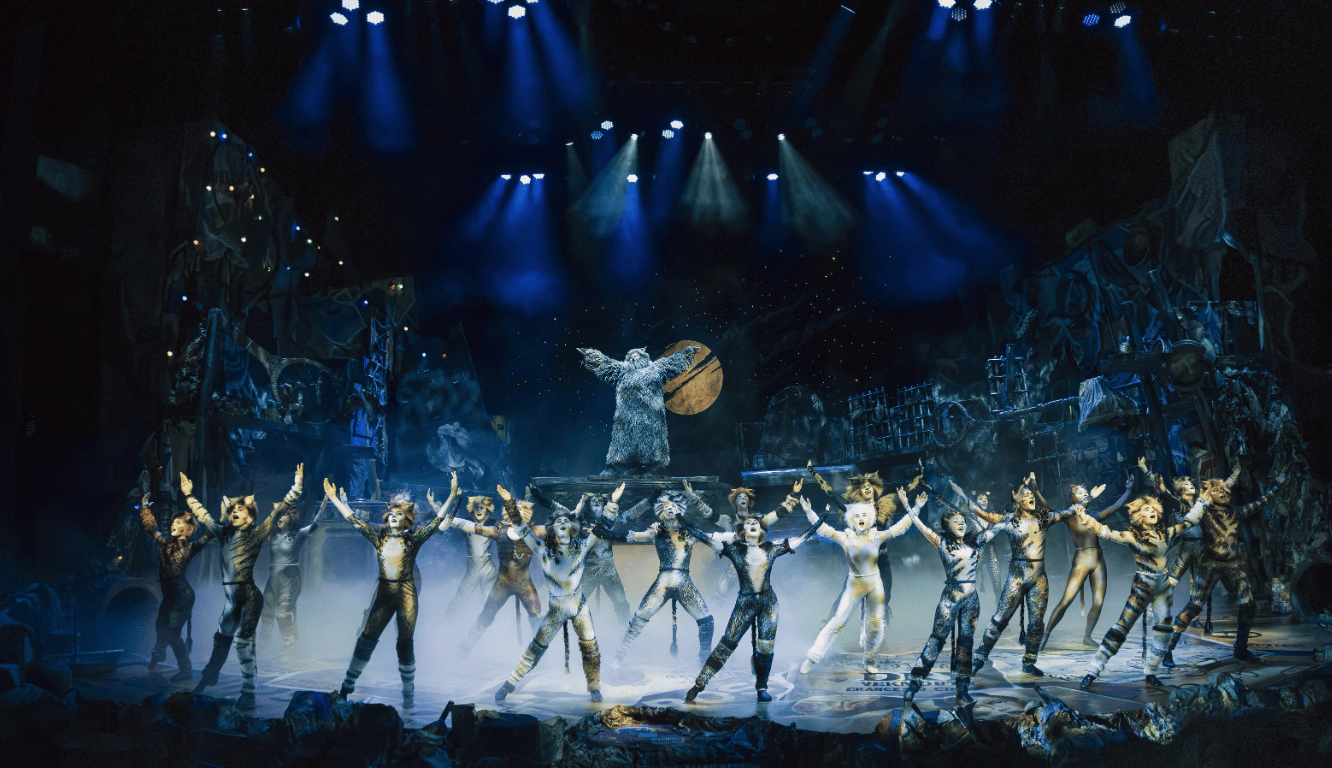
Few musicals occupy quite as peculiar a place in theatre history as Andrew Lloyd Webber’s CATS. With its fantastical feline characters, distinctive choreography and enduring anthem ‘Memory’, the musical has captivated audiences for over four decades, becoming a theatrical phenomenon that continues to intrigue and delight generations of theatregoers. Yet beneath its elaborate costumes, larger-than-life junkyard setting and spectacular ensemble numbers lies a surprisingly human story about identity, rejection, belonging and the possibility of second chances.
Returning to Singapore’s Sands Theatre at Marina Bay Sands from now to 22 November 2026, this latest touring production brings together a new company of performers to inhabit T.S. Eliot’s whimsical world of Jellicle Cats. From the emotional vulnerability of Grizabella to the magical athleticism of Mr Mistoffelees, each character brings a distinct personality and physical vocabulary to the stage, with the ensemble’s intricate choreography demanding an extraordinary balance of discipline, imagination and instinct.

But what does it take to bring these extraordinary feline personalities to life night after night? How do performers find the emotional depth beneath the spectacle, and how does a production that has been performed around the world for decades continue to feel fresh and immediate?
We speak to Cindy-Ann Abrahams (Grizabella), Cassiel Eatock-Winnik (Victoria/The White Cat), Mukeni Nel (Quaxo / Mr Mistoffelees) and associate director and choreographer Chrissie Cartwright about finding their characters, mastering the show’s distinctive physical language, and the enduring magic of CATS.
Cindy-Ann Abrahams — Grizabella

Bakchormeeboy: Grizabella is such an emotionally layered character, and ‘Memory’ is one of musical theatre’s most recognisable songs. How do you make her story and the song feel personal to you?
Cindy-Ann Abrahams: I think the thing that makes Grizabella so relatable is that, at some point in our lives, we’ve all known what it feels like to want to be seen, to be accepted, or to find our way back to somewhere we belong. For me, ‘Memory’ isn’t just about looking back at the past. It’s about longing, regret, and the hope that perhaps there’s still a place for you somewhere. I try not to approach it as a famous song that needs to be sung a certain way, but rather as a woman who has reached a point where she has nothing left to hide. I have to find that place of honesty in myself every night. It’s incredibly vulnerable, and I think that’s where the magic of the song lives.
Bakchormeeboy: The show explores themes of belonging and acceptance through its Jellicle Cats. What do you think Grizabella’s journey says about how we treat people who feel like outsiders?
Cindy-Ann Abrahams: I think Grizabella reminds us how easily we can judge people without knowing their stories. We see someone who is different, someone who has made mistakes or perhaps doesn’t fit into what we consider acceptable, and we forget that there’s a whole human being behind that. What I love about her journey is that she doesn’t suddenly become someone different to deserve acceptance. She is still Grizabella. She still carries her past, her hurt and her scars. And that’s the point. I think we need to be a little kinder to one another. We don’t know what people have lived through or what it has taken for them just to show up. Nobody should have to be perfect to deserve love, compassion or a place to belong.

Bakchormeeboy: What has been the biggest challenge of stepping into this role, and has your understanding of Grizabella changed as you’ve spent more time with her?
Cindy-Ann Abrahams: The biggest challenge has probably been allowing myself to be as vulnerable as the role requires. Grizabella carries so much hurt, but there’s also something incredibly strong and indomitable about her. She keeps showing up, even when the world has made her feel that she no longer belongs. When I first started playing her, I think I was more focused on her sadness and heartbreak. But the more time I’ve spent with her, the more I’ve come to understand her resilience. I’ve realised that this isn’t simply a story about a woman who wants to be forgiven. It’s about a woman who wants to be seen and loved for who she is, despite everything she’s been through. And I think there’s something very powerful about that.
Bakchormeeboy: Is there a particular moment in the show that you hope audiences carry with them after leaving the theatre?
Cindy-Ann Abrahams: I hope they carry Grizabella’s journey with them. Particularly the moment when the other cats finally reach out to her. I think it’s easy to focus on the spectacle of CATS, the costumes, the movement and the music, but underneath all of that is a very simple human story. It’s about what happens when we choose compassion over judgement and make room for someone we’ve perhaps pushed aside. I’d love audiences to leave thinking about the Grizabellas in their own lives. The people who might be standing on the outside, waiting to be welcomed in. And perhaps, just as importantly, to ask themselves whether they’ve ever made someone feel that way.
Cassiel Eatock-Winnik — Victoria / The White Cat

Bakchormeeboy: Victoria relies heavily on movement and physical expression. How did you develop her personality and learn to communicate so much without relying on dialogue?
Cassiel Eatock-Winnik: Chrissie Cartwright gave me three words at the beginning: romantic, uninhibited and innocent. I fell in love with those qualities and kept coming back to them as I discovered Victoria. My acting training at Carnegie Mellon helped me think about what she wants and feels in each moment, and allow that to shape her movement. I also explored Laban’s eight effort actions: glide, float, dab, flick, press, wring, punch and slash. There’s something very Victoria about gliding and floating, with little flicks and dabs of curiosity. Her body becomes her way of speaking.
Bakchormeeboy: When creating a feline character, how do you balance the precision of choreography with the more instinctive movements and behaviours of a real cat?
Cassiel Eatock-Winnik: I think that’s what’s so brilliant about Dame Gillian Lynne’s choreography. So much of it already comes from a cat’s movement. It’s almost as though she imagined a cat rising from all fours onto two legs. You see it in the parallel positions, the gentle bend in the arms and those lovely soft paws. Studying cats helped me understand the life inside those shapes. Through animal work, I explored letting an impulse come from the gut, before the human instinct to question it takes over. The choreography is precise, but there’s room to feel wonderfully alive within it.

Bakchormeeboy: What are some small physical details, a gesture, a way of looking or a particular movement, that you use to make Victoria feel distinct?
Cassiel Eatock-Winnik: My Victoria has a little head movement and a nose wiggle, a bit like the twitch in Bewitched. It’s become a small detail that I’m very fond of. It feels as though she’s caught something interesting in the air and simply has to investigate. Victoria has such beautiful, sweeping movements, so I love finding those tiny, playful moments within them. They let you see the curious little creature underneath all that elegance.
Bakchormeeboy: What has surprised you most about the physical demands of performing CATS, and how do you prepare your body for a show?
Cassiel Eatock-Winnik: I knew the dancing would be demanding, but I hadn’t quite anticipated how much the quieter moments would ask of me. Even when you’re listening or watching, you’re still living in that feline body. Ballet helps me find my placement and feel connected to my legs and feet, while my yoga background helps me pay attention to my breath and where I’m holding tension. Touring has taught me to listen to what my body needs that day and to appreciate recovery. Then I come back to Victoria’s curiosity. I want her world to feel new to me each evening.
Mukeni Nel — Quaxo / Mr Mistoffelees

Bakchormeeboy: Mr Mistoffelees is known for his magical tricks and impressive dancing. What goes into making his performance look effortless, and which part of the role demands the most from you physically?
Mukeni Nel: A lot of preparation goes into making everything look effortless. It’s a combination of strength, stamina, technique and repetition. There’s so much choreography and detail in the role, and you have to build up the physical conditioning to be able to execute it consistently, particularly while singing, acting and maintaining the character.
Physically, I’d say the most demanding part is the combination of jumps, turns and the more acrobatic elements, especially when they’re repeated throughout the show. It’s about knowing your body, understanding your limits and being able to deliver the same level of energy eight shows a week. The real magic is making all that hard work disappear so the audience can simply enjoy the performance.
Bakchormeeboy: How do you build a personality and inner life for a character who is often remembered for his spectacular stage moments?
Mukeni Nel: For me, it’s really important to remember that underneath all the tricks and spectacle, he’s still a character with feelings, relationships and insecurities. I try to find the little moments in between the big dance sequences, thinking about how he interacts with the other cats and how he sees himself within the tribe.
I see Mr Mistoffelees as someone who is a little shy and perhaps doesn’t initially realise just how special he is. There’s a lovely journey of self-discovery in the character, where he gradually finds the confidence to embrace his abilities. I think there’s something quite relatable about that. I want the audience to connect with him emotionally, not just be impressed by what he can do physically.

Bakchormeeboy: You were also part of the Singapore season in 2019. What does it mean to return to Singapore, and how has your journey as a performer evolved since then?
Mukeni Nel: Returning to Singapore feels incredibly special. I have such fond memories of being here in 2019, and it’s quite surreal to think about how much has happened since then. Back then, I was still relatively early in my professional career, finding my feet in the industry and discovering what kind of performer I wanted to be.
Since then, I’ve had the opportunity to work on some amazing productions, travel internationally and experience so many different styles of performance. I’ve grown not only technically but also in confidence, maturity and my understanding of the industry. I’ve also learned so much about myself as a performer and as a person.
To come back to Singapore now, in this role, feels like a lovely full-circle moment as I was 2nd cover Mistoffelees back then. It’s a reminder of how far I’ve come, and I’m really grateful to be able to share this experience with audiences here again.
Bakchormeeboy: What is one thing audiences might not realise about the amount of training, repetition or teamwork behind the show’s most dazzling moments?
Mukeni Nel: I think audiences would be surprised by just how much trust and teamwork goes into making the show happen. Although you see individual performers taking the spotlight, nothing really happens in isolation. Every movement, cue and interaction is carefully timed, and we’re constantly relying on one another to make sure everything runs safely and seamlessly.
There’s also an incredible amount of repetition behind the scenes. Something that might last just a few seconds on stage could have taken hours of rehearsal to perfect. We spend so much time refining the smallest details, building muscle memory and developing that trust with the people around us.
I think that’s one of the beautiful things about CATS: it’s not just a collection of individual performances, but a real ensemble. Everyone has a part to play in creating the magic, and that shared energy is what makes the show so special.
Chrissie Cartwright — Associate Director and Choreographer

Bakchormeeboy: CATS is such an iconic musical, with a distinctive visual style and movement vocabulary. When approaching this production, what was the creative vision, and what do you most want to bring out for audiences today?
Chrissie Cartwright: The vision of this original version of CATS was to create a world in which our surroundings were from a cat’s point of view. It’s important that the actors are able to immerse themselves in this feline world, believing that they really are cats. We find this through their imaginations and with improvisation, so that they get a sense of how it feels to be a cat. At the same time, we try to identify human characteristics and human stories. We want the audiences of today to recognise themselves, people they know and situations they encounter, through a night with the cats.
Bakchormeeboy: The performers must move and behave like cats while still conveying recognisable human emotions and personalities. How did you approach developing this physical language, and what makes it convincing onstage?
Chrissie Cartwright: Our process starts with improvisation. It’s almost like a meditation as we try to lose ourselves as humans and find ourselves as cats. We crawl, we sit still, we focus on how it feels to be in the body of a cat and we create various scenarios, to help us discover how to respond in a feline way. Again, we have to believe and for that, we have to trust each other. So some of the exercises that we do are in order to find the trust amongst us, in the room.

Bakchormeeboy: The choreography is central to the show’s identity, from the individual cats’ mannerisms to the large ensemble numbers. How do you balance the precision of the choreography with the instinctive, unpredictable quality of feline movement?
Chrissie Cartwright: This is always challenging but a very important question. The choreography requires a lot of rehearsal and needs to be drilled, in order to work it into the dancers’ bodies. At the same time, we’re not looking for a military precision. We want to capture the unpredictability – the quick changes of thought and direction. The cats have to be able to move quickly between sensual and savage. It’s important to focus on being in the moment, so that we see the speed of changes of thought and therefore quick changes of movement.
Bakchormeeboy: CATS is filled with colourful characters, but it also explores themes of rejection, belonging and second chances. How do you ensure the emotional stories remain at the heart of the production amid all the spectacle?
Chrissie Cartwright: The emotional heart of the show is the top priority. We talk in depth, particularly about the theme of Grizabella. It’s a story which has such relevance in today’s world. We find out how each of the cats respond to this character and how, through listening and looking for the good in each other, they learn, through acceptance, to welcome back into the fold, this cat who has fallen on hard times.

Bakchormeeboy: What do you hope audiences in Singapore will take away from this production, particularly those who may be experiencing CATS for the first time?
Chrissie Cartwright: I hope that Singapore audiences will fall in love with CATS. It’s a beautiful and very important story, told through brilliantly witty poetry and spectacular singing and dancing. Oh and there’s magic too!
M

An eccentric, otherworldly musical that embraces its own peculiarities, this latest production of CATS is a mesmerising showcase of theatrical imagination, feline physicality and musical grandeur.
Duration: 150 minutes, including a 20 minute intermission
There is perhaps no other musical quite like Cats. Even by the standards of Andrew Lloyd Webber, it is an unusual beast, with a premise that is difficult to explain, a narrative that barely resembles a conventional story, and a collection of songs that most audiences would struggle to name beyond its most famous number, ‘Memory’. Based on T.S. Eliot’s Old Possum’s Book of Practical Cats, the musical has always occupied a rather peculiar place in the theatrical canon. It is one of the longest-running and most celebrated musicals in history, yet its appeal remains strangely divisive, with audiences seemingly falling into two camps: those who adore its eccentricities, and those who simply cannot understand what all the fuss is about.
And eccentricities there are aplenty. Cats is essentially a gathering of ‘Jellicle Cats’, who congregate once a year beneath a full moon for their Jellicle Ball. One by one, the cats introduce themselves, sharing their personalities, peculiarities and talents before one is ultimately chosen to ascend to the Heaviside Layer and be reborn into a new life. It is a premise that sounds rather more like an elaborate fever dream than the foundation for a musical, and yet, in the hands of this latest touring production, it becomes an extraordinary theatrical experience. There is a sense of deliberate artistry in virtually every detail, from the physicality of the performers to the imaginative staging and seamless choreography, making this an oddity that is all the more enchanting for refusing to conform to convention.

A considerable part of this magic begins with the set, designed by Sami Fendall, with the original design by John Napier providing the foundation for this distinctive theatrical world. The stage is transformed into an enormous junkyard, populated with oversized everyday objects that immediately establish the environment from a feline perspective. Old tennis rackets, discarded magazines, pipes and various other pieces of detritus are scattered across the stage, their exaggerated proportions making the entire space feel like a playground for its feline inhabitants. Yet, rather than simply presenting an enormous rubbish heap, the production elevates this otherwise mundane setting into something considerably more mystical. A gigantic moon hangs overhead, partially obscured by wisps of clouds that appear to have torn across its surface, bathing the junkyard in an almost spiritual atmosphere. It is a curious juxtaposition, turning what should be an ordinary dumping ground into a fantastical realm where something rather extraordinary is about to unfold.

And unfold it does. The opening overture is an immediate visual and auditory spectacle, with glowing yellow and green feline eyes gradually appearing throughout the set, glinting from the darkness as though the entire junkyard is slowly coming alive. Before long, the cats themselves emerge, racing through the auditorium with glowing green goggles and darting movements that lend the proceedings a slightly wilder, almost steampunk sensibility. There is an infectious sense of anticipation as they prowl through the aisles, establishing the idea that this is not simply a performance taking place on a stage, but an invitation into an entirely different world. The atmosphere is wonderfully strange, and the production wastes no time in making it clear that audiences are expected to surrender themselves to its peculiarities.

The costumes, also designed by Fendall, are particularly effective in giving each feline a distinct identity. While the overall aesthetic remains faithful to the familiar stylised cat costumes, there is a greater clarity to the individual designs, with the performers’ physical forms and feline characteristics coming through particularly well. Grizabella’s coat, for instance, looks genuinely ragged and unkempt, almost as though it has been fashioned from matted cat hair, immediately communicating her status as an outcast. The bodysuits fit snugly, with tails subtly integrated into the designs, while the variety of collars, accessories and other adornments suggests a fascinating mix of strays and domesticated cats. Some even sport spiked collars and other accessories that lend the costumes an unexpectedly contemporary edge, occasionally evoking elements of kink and furry subculture. It is an interesting visual language that feels surprisingly current, while still remaining entirely in keeping with the show’s fantastical world.

Of course, Cats is ultimately a musical that thrives on physicality, and this production is particularly accomplished in that regard. With direction and choreography by Drew McOnie, alongside the work of resident director and choreographer Josh Baker and associate director and choreographer Ebony Molina, the ensemble moves with an extraordinary degree of fluidity and precision. Much of the choreography draws directly from feline behaviour, with performers constantly crawling, rolling, stretching, prowling and darting across the stage in ways that are instantly recognisable to anyone who has spent time observing actual cats. There are moments when the illusion becomes remarkably convincing, as the performers seem to shed their human qualities entirely, transforming into creatures driven by instinct and curiosity. Even the smallest movements are carefully considered, whether it is a flick of the tail, an arching of the back or the way a cat might suddenly become distracted by something in its surroundings. It is this attention to detail that makes the ensemble so compelling, allowing the entire company to function as a cohesive, living organism rather than simply a collection of performers executing choreography.
The lighting design by Jessica Hung Han Yun is another particularly effective component of the production, doing much to sustain the show’s otherworldly atmosphere while adapting seamlessly to the changing character of each performance. There is a constant sense of mysticism in the way the junkyard is illuminated, with shifting hues, pockets of shadow and carefully placed spotlights creating an environment that feels almost detached from reality. Yet the lighting is equally adept at embracing the variety-show nature of the musical, adjusting its intensity, colour palette and theatrical flourishes to complement the personality of each cat and their respective numbers. Whether bathing the stage in an eerie glow or illuminating the ensemble in a more exuberant display of colour, it ensures that the visual landscape remains constantly engaging without ever losing the distinctive atmosphere of the Jellicle world.

Indeed, the structure of Cats is perhaps best understood as a sung-through circus, with an opening number introducing the Jellicle Cats before each named character takes their turn in the spotlight. There is very little conventional narrative progression, and the individual numbers often feel like self-contained performances strung together by the gathering itself. At times, it can be difficult to discern exactly what is happening, particularly when the musical’s fantastical terminology and unconventional storytelling begin to take hold. Yet once audiences accept that this is not a show particularly interested in telling a straightforward story, its rhythm becomes considerably easier to appreciate. The direction ensures that each number flows naturally into the next, with transitions so fluid that there are few obvious divisions between individual performances. The result is a production that feels remarkably sleek and feline in its movements, with the entire evening unfolding as one continuous spectacle.
Among the evening’s standout performances is, naturally, Cindy-Ann Abrahams as Grizabella. The former Glamour Cat, now aged and dishevelled, remains the emotional centre of the musical, and Abrahams brings a particularly compelling interpretation to the role. Her rendition of ‘Memory’ is a highlight, carrying a palpable sense of loss and longing, but also a greater undercurrent of anger and bitterness at the passing of her youth. There is an ache beneath her vocals that makes the character’s yearning all the more affecting, with the weight of her history and her rejection by the other cats coming through in her performance. It is a role that has become synonymous with the musical itself, and Abrahams gives it the emotional gravity it deserves.
Tshepo Ncokoane is equally delightful as Gus the Theatre Cat, an ageing thespian whose theatrical past is brought to life through a wonderfully eccentric performance. Hunched over and initially appearing rather dishevelled, his ragged coat cleverly transforms inside out to reveal a considerably more elaborate theatrical appearance, allowing the character’s former grandeur to emerge almost instantaneously. Ncokoane captures the voice and mannerisms of an eccentric old performer particularly well, creating a character who feels like a rather peculiar old coot, yet remains strangely enthralling. There is something wonderfully self-referential about Gus, too, as a performer whose glory days may have passed but whose love for the theatre remains undiminished. In many ways, he feels like a fitting embodiment of Cats itself: an old theatrical institution that continues to command attention through sheer personality and showmanship. His number is further elevated by the ensemble, who execute an impressively swift costume and accessory change, transforming into the various figures required for Gus’s recollections of his theatrical past, including a particularly entertaining wartime sequence. It is a clever piece of theatrical ingenuity that demonstrates just how much can be achieved through coordinated movement and imaginative staging.
Adding a gentler presence to this sequence is Cassiel Eatock-Winnik as Victoria, the White Cat, whose introduction to Gus’s story carries a distinctly maternal and soothing quality. Her calm, almost nurturing presence provides a lovely contrast to the more flamboyant personalities surrounding her, and she brings a quiet grace to the proceedings that is immediately appealing.
King B also makes a strong impression as Old Deuteronomy, the wise and venerable leader of the Jellicle Cats. With an imposing physical presence and an almost regal bearing, he commands the stage whenever he appears, embodying the authority and importance of the character without ever seeming overly imposing. His rich, operatic vocals lend the role an additional sense of grandeur, while his movements convey the weight of age without suggesting frailty. There is a wonderful sense of dignity about his interpretation, making him feel like an elder whose wisdom and experience are genuinely respected by the rest of the tribe.

The double act of Mungojerrie and Rumpleteazer, played by Austin Tshikosi and Tannah Levick respectively, is another enjoyable highlight. The two mischievous feline thieves are wonderfully synchronised, with their tightly coordinated movements and playful exchanges making for an especially slick performance. Their number is physically demanding, requiring both performers to maintain an impressive degree of precision while executing their increasingly elaborate choreography, and the pair make it look remarkably effortless.
One of the most visually spectacular performances belongs to Mukeni Nel as Quaxo, better known as Mr. Mistoffelees. A largely non-singing role, the character instead relies on physical prowess and stage presence, and Nel delivers in spectacular fashion. His seemingly endless spins, intricate turns and extraordinary ballet technique are a marvel to behold, with the choreography demanding an almost superhuman degree of control. What makes the number particularly impressive is the way the entire ensemble contributes to its visual impact. While Nel takes centre stage, every performer around him is engaged in some form of movement, creating a magnificent sense of controlled chaos as the stage becomes increasingly animated. It is one of those sequences where the sheer coordination of the company becomes just as impressive as the individual star performer, resulting in an energetic, beautifully orchestrated spectacle.
The evening’s undisputed MVP, however, is Dylan Janse van Rensburg as Rum Tum Tugger. From the moment he appears, there is an almost irresistible magnetism to his performance, with van Rensburg embracing the character’s flamboyant rock-star persona with absolute conviction. Every movement is imbued with an almost excessive degree of sensuality, from the way he plays with his ruffled costume to his exaggerated air-guitar gestures and the confident swagger with which he carries himself across the stage. There is an unmistakable rock-and-roll sexuality to his interpretation, verging on the provocative without ever tipping into vulgarity. His vocals complement the character’s flamboyant personality perfectly, giving him the swagger of a larger-than-life rock god, while his theatricality ensures that every moment he occupies the stage is utterly captivating. It is an exceptionally charismatic performance, and one that makes it difficult to look away whenever he appears.

While the first half can occasionally feel leisurely, particularly as the musical takes its time introducing its many feline inhabitants, the second act builds considerably more momentum. The choreography becomes increasingly elaborate, the ensemble numbers grow in scale, and the production demonstrates just how much visual spectacle can be wrung from its relatively simple premise. The sheer synchronisation of the company is particularly impressive, with large-scale sequences featuring tightly coordinated movements, impressive acrobatics and multiple performers executing flips and aerial-style manoeuvres in unison. There is an infectious energy to these moments, with the ensemble displaying an extraordinary level of physical conditioning and control while maintaining the illusion that everything is happening as naturally as a group of cats at play.
All of this culminates in the musical’s final sequence, as Grizabella is finally chosen to ascend to the Heaviside Layer. The appearance of the enormous levitating tyre, which rises dramatically to carry her away, is one of those wonderfully absurd theatrical moments that feels almost impossible to anticipate, even for audiences familiar with the show. It is simultaneously ridiculous and magnificent, a fitting conclusion to a production that has never been particularly interested in playing by conventional theatrical rules. As Grizabella rises into the heavens, the entire ensemble comes together to bring the evening to a suitably grand close, with the final spectacle serving as a reminder of just how much imagination and theatrical ingenuity have gone into making this strange world come alive.
There is something rather remarkable about Cats as a musical. It feels like a product of a very particular era in theatrical history, and perhaps even a show that would be difficult to conceive in quite the same way today. Its unusual premise, abstract storytelling and unapologetically theatrical sensibilities make it something of an anomaly, yet this touring production demonstrates that there is still plenty of life left in its peculiar little world. More importantly, it proves that even a musical as established as this can continue to surprise when approached with sufficient care and intentionality. The performances are polished, the choreography is exceptional, and the creative team has clearly paid attention to the smallest details, allowing the production to feel immediate and alive rather than simply recreating a familiar theatrical institution.

Today, Cats remains a musical that audiences will either love or find utterly bewildering. It is strange, occasionally nonsensical and frequently extravagant, but that is precisely where its charm lies. This production understands that its greatest strength is not in trying to explain its eccentricities, but in embracing them wholeheartedly. A feline fever dream of theatrical imagination, musical grandeur and extraordinary physicality, Cats is an oddity that continues to captivate more than four decades after its debut. Some musicals leave audiences humming their favourite tunes; this one leaves them wondering exactly what they have just witnessed, while somehow making them wish they could experience it all over again.
Photo Credit: Hanan Assor
CATS The Musical runs from 29th October to 22nd November 2026 at Sands Theatre, Marina Bay Sands. Tickets are available through Marina Bay Sands, SISTIC and Klook
Read our 2019 review of CATS The Musical here. Read our 2026 review of CATS The Musical here

