
By D.Y.
A plate; a platform; a being – of creation. The live Singaporean premiere of T.H.E’s award-winning production examines what it means to create and collaborate in a world fraught with seemingly irreconcilable differences.
Pán《盤》carries a myriad of definitions: from the dinnerware we eat out of everyday to the mythic Pan Gu 《盤古》, who supposedly created our world from his own body millennia ago. How then do we begin to define the duality of Pán in both its expansiveness and its singularity?
This is the question T.H.E’s newest production tackles, closing out their 2026 season in the SCCC auditorium, which it is no stranger to. Choreographed in two acts by Kuik Swee Boon and Kim Jae Duk, this production marks its return to the venue after its digital premiere five years ago – a fact that emcees, Tung Ka Wai and Wheelsmith (Danial Bawthan), reference in their opening speeches. Humble and no-frills – they take turns introducing the performance in multilingual banter, code-switching between English, Mandarin and Malay to inform audiences of the production history. Most importantly, they delve into the multilingual interpretations of the production’s title, ranging from bàn: a table in Vietnamese to Pansori: a Korean traditional musical storytelling form, heralding in the first act: Pán: SeungMu.
Choreographed by Kim (who also composes and arranges the music), his SeungMu is a re-imagination of the Korean buddhist monk dance which lends it its name. A slow start – he forces us to meditate on the minute movements of a dark, hooded ensemble (Fiona Thng, Klievert Jon Mendoza, Chang En, Carmelita Nuelle Buay, Priscilla Chan, Ng Zu You), tuning into the percussive monotony of a wooden drum; akin to the bubgo (Korean drum) of traditional Seungmu. Traversing through the space and in between one another, the dancers carry a blurry, dissolving presence, drifting in and out of stage with both restraint and lightness. Before long, they remove their hoods alongside an increasingly rhythmic beat, pushing their movements in scale but holding on to moderation. Here, Kim invites the audience into a personal ritual, leaving us on the precipice of discovery but never quite revealing what exactly is being created.
Then, finally liberating themselves from their robes, the dancers, clad in all-black vests, explode in silence: executing tight, angular choreography timed to nothing but their collective breaths. A clear winner of the production, it is no doubt an impressive showing from the largely-synchronous ensemble, demonstrating a shared openness to listening. Set between the hoods planted downstage and the robes hung upstage, Kim’s SeungMu reminds us of a ritual set between traditions, prompting us to examine how we may pay our respects to tradition in the art of re-creation. His music (and most pertinently, lack thereof in this new creation stage) therefore becomes integral in pointing out the vulnerabilities of creation: the silos we find ourselves in and the doubt that infiltrates our every move when we stray from rigid structure. Nonetheless, like the dancers, we press on; choosing instead to listen to the ever-delicate breaths we call our instincts. It is with this sentiment that the dancers end the act, peeling away from one another, each taking up their own space in various poses of contemplation and meditation – a crevice for Kuik’s own creation.
Picking up the conversation, Kuik’s Pán: The Notion of Transculturation then confronts creation as a sum of cultural differences interacting. Through the perspective of Ng Zu You, the dancers take on different histories within him, emerging from his still body as conflicting shadows reaching out of Ng. As a composite figure, Ng leads the ensemble as a symbol of the contemporary person: full of contradictions and colour but also vastly contained. As our attention shifts to a duet (performed by Mendoza and Chang), that same difference is echoed in contrasting fluidity and strength. Kuik never paints this process as easy. Amidst fleeting moments of connection and mutual flow, the dancers pull against each other as if two ends of the same rope; reflecting the difficulties of mixing differences. Yet, as the dancers meet again and again, there is an unmissable and constant intentionality in their efforts. Thus, as we strive towards the ideal of integrating transculturation, Kuik not only underlines the tenacity required of collaborative practice, but also points out a compulsory openness in our engagement – one that goes beyond our words and actions; one that is sustained and felt.
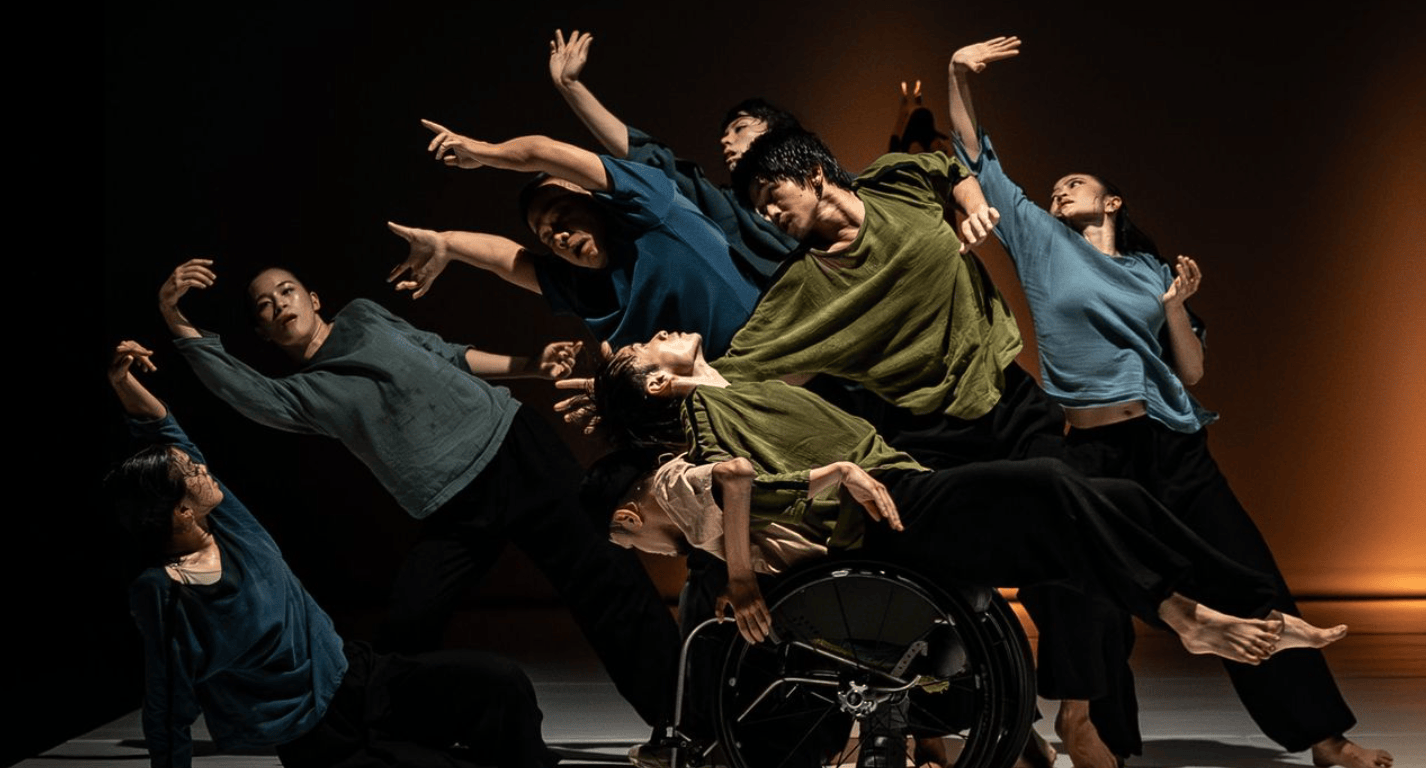
As we enter the epilogue, the ensemble, now whole and connected, encounter Tung and Wheelsmith, who are both performers with physical disabilities. As a new ensemble, they are then tasked not to incorporate, but to coexist physically. It is an immediately confrontational conversation: Tung and Wheelsmith are circled, separated and examined as foreign. Equally, the dancers are met with resistance, including Wheelsmith executing an intimidating wheelie. But, as hearts soften, so do their movements. As they slowly synchronise, the different colours of their costumes resist melding, instead merely cooperating to form a bigger collage. Reflecting this, the production’s final image sees the dancers in a fractured line, heads bowed down. In this way, choreographers, Kuik and Kim, never profess perfection in collaboration, instead settling for humility in connection.
Ultimately, Pán never tries to escape the simplicity of its name. As a platform for collaboration and creation, it presents an extended and cohesive meta-conversation on what it means to create in spite of it all. Blurring the lines between the internal and external state, difference, conflict and space are at once, embodied and abstract – leaving the audience never quite at ease with the resolutions presented. Yet, if anything, Pán reflects creation as ongoing, situating the audience in an ever-evolving world of liminality and prompting us to look upon our own bodies for the values we hold steadfast. Then, we might come to realise that we too are liminal creations with our own boundless definitions; in which case, we are all Pán.
Photos Courtesy of T.H.E Dance Company
Pán《盤》played from 6th to 7th November 2026 at the Singapore Chinese Cultural Centre Auditorium. Tickets available from BookMyShow.
Read our 2021 review of Pán《盤》here

