
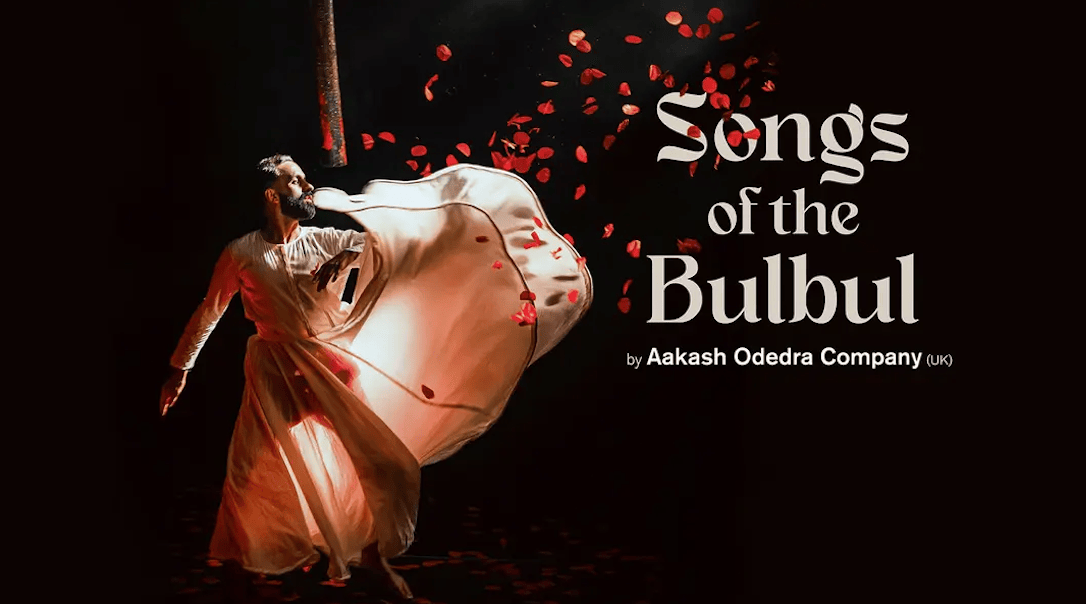
Birdsong is fleeting, its beauty existing only in the moment before disappearing into silence. Yet, in Persian and Sufi traditions, the bulbul, or nightingale, carries a deeper significance: a symbol of the soul yearning for the divine, its song an expression of longing, devotion and the pursuit of spiritual liberation. It is this ancient symbolism that lies at the heart of Songs of the Bulbul, a dance work by internationally acclaimed British dancer and choreographer Aakash Odedra, with choreography by Rani Khanam and music by Rushil Ranjan. Drawing on an ancient Sufi myth of a bird trapped in captivity, the production follows its final moments as its song grows increasingly beautiful, transforming suffering and sacrifice into an ultimate expression of freedom.
Presented at Kalaa Utsavam 2026 at Esplanade – Theatres on the Bay, Singapore, on 20 November, Songs of the Bulbul brings together the expressive vocabulary of Kathak, the spiritual traditions of Sufi storytelling, classical Indian music and orchestral composition. A dancer whose practice has been shaped by decades of training in Kathak and Bharatanatyam, as well as collaborations with some of the world’s leading choreographers and artists, Odedra approaches the work as an exploration of the body as a vessel for something beyond itself. In this conversation with Bakchormeeboy, he reflects on the sacrifices inherent in artistic creation, the relationship between dance and spirituality, the collaborative process behind the production, and how the bulbul’s final song might inspire us to find freedom beyond the limitations that bind us.

Bakchormeeboy: Songs of the Bulbul draws on an ancient Sufi myth about a bird whose song grows sweeter as it approaches death. What drew you to this story, and how do you interpret the bulbul’s relationship with captivity, sacrifice and liberation through your performance?
Aakash Odedra: As artists, we yearn for a sense of perfection, and to find it, you have to give up a lot. You can’t live a normal life. We live in a world that is isolated, away from normality, because most of the time we are rehearsing, thinking, procrastinating and finding ways to improve what we’ve done. This process of refinement feels never-ending. It feels like you have to shed your whole skin to find a new sense of yourself. Death is a constant in the world of an artist, because through death there is rebirth, a new life, and every new life demands sacrifices.
Something in this story spoke to me: the bird wanting to be free of captivity, of the cage that is the body, so that the soul can find its voice. In my own quest to let my soul fly free, I found a sense of liberation. Every performance for me is an effort not only to liberate myself, but also to take the audience on that journey with me.
Bakchormeeboy: The work explores the Sufi idea of the soul yearning for unity with the divine. As a dancer, how do you translate something as intangible as spiritual longing into physical movement, and how does this process affect you personally?
Aakash Odedra: I think dance is one of the few forms that can create architecture in space that doesn’t exist. It can express through gesture and through the face. It can also bring in physicalities that don’t make sense in the world we live in, which lets you, as an audience member, transport yourself and become one with that new physicality.
For me, the body is an instrument that can incarnate itself in different forms on stage. The essence of all these incarnations is to reunite with the source. Personally, that source is something my soul naturally yearns to become one with when I dance. You might call it God, or a higher force. Subconsciously, my body plays out the yearning the soul feels as it moves closer to the intangible, the unseen.
The bulbul, through its restriction and the tests it goes through, shows you a physical body moving through space. But eventually, you see the soul move beyond the body, and at the end, it becomes one with the ether, the environment, the air around us.

Bakchormeeboy: The production brings together the expressive intensity of Kathak and the spiritual traditions of Sufi storytelling. How have you used the vocabulary of Kathak to embody the bulbul’s anguish, yearning and eventual release, and did this work challenge your understanding of the form?
Aakash Odedra: I’ve been associated with Kathak longer than any other medium. I’ve been doing this for 35 years of my life, so it has become another language for me. Kathak, in essence, is a form of storytelling, and the old masters and gurus used it to tell stories about animals: deer, birds, fish and elephants. So the embodiment of animal behaviour is naturally present in the Kathak repertoire. It’s refined so you don’t see it in the obvious, but when you strip back the layers, you find a relationship to nature. Kathak has a very strong relationship to nature, and I wanted to explore that.
Kathak’s foundation is the time cycle, and the time cycle always comes back to zero. Everything in life balances out. Where there is birth, there is death; where there is life, there is destruction. One is not the beginning and the other is not the end; both are part of one cycle. We used these philosophies to give the animal side of Kathak prominence. Because it’s a natural storytelling form, that gave birth to the anguish, the yearning and all the emotions the bird may have felt.
Essentially, the piece is performed through the medium of Kathak and doesn’t stray from it. But we stayed open: where expression had to go beyond the form as it exists, we explored that avenue. Sufism and Sufi poetry feel circular, not linear, and Sufi storytelling has multiple layers. We drew on those layers to create circularities, a sense of the circle of life, and made that the foundation of Songs of the Bulbul. That allowed me to fully embody the bulbul, whether it was in a place of ecstasy or anguish.
Bakchormeeboy: How did your conversations and creative exchanges with your collaborators, Rani Khanam and Rushil Ranjan, shape the work? Was there a particular moment when its artistic direction became clear to you?
Aakash Odedra: I’ve been in conversation with Rani Khanam since 2015–16, and the piece premiered in 2024, so it took a long time. I met Rushil Ranjan in 2021. I like to get to know my collaborators really well, because a personal connection forms an incredible, unbreakable professional connection. Those connections shape the work because they allow one key element that often isn’t possible without them: honesty. All three of us, Rushil, Rani and I, worked with great honesty. We knew what needed to be done.
When Rani and I started talking about working together, we had no idea what we wanted to make. I just knew I wanted something in the Sufi world. After many sessions without a clear narrative, Rani mentioned the story of the bulbul as we were sitting together, and it instantly touched my heart. I shared it with Rushil, who didn’t know Rani at that point, and asked whether he’d make the music. He said yes. Then I asked Rani if she would work with Rushil, and she instantly said yes.
Everyone brought their own bulbul to the work. We were all looking at the same bird, the same production, but each of us brought a different interpretation. It was a very natural process of osmosis. A confluence of ideas came together, and our individual voices combined harmoniously into a work that functions as a whole.
Bakchormeeboy: The score combines classical Indian music, Sufi poetry and orchestral elements. How does Rushil Ranjan’s musical landscape influence your movement and emotional interpretation, particularly in conveying the bulbul’s final song?
Aakash Odedra: Rushil Ranjan is a brilliant composer. His music is so moving that it makes me want to move. It takes my imagination to a place where only dreams exist, and being in that world naturally gives birth to creativity and movement.
His musical landscape was a cushion to land on and a place to take off from. It created and decorated this piece in a way that has gone beyond my imagination.

Bakchormeeboy: The caged bird can be read as a metaphor for the limitations imposed by society, identity or our own desires. What does captivity mean to you in the context of this work, and do you see liberation as an escape from the world or a transformation in how we experience it?
Aakash Odedra: Liberation varies from person to person. My own idea of liberation is to work with honesty. It’s to create worlds that don’t only liberate oneself, but give others the chance to liberate themselves through inspiration. Inspiration is also a form of liberation.
This piece does talk about being caged, but I leave that to the audience to interpret. It could be being caged by society, or by your own thoughts and limitations. Ultimately, the piece is not about escape. It’s about raising yourself, your own thinking and your own vibrations, beyond what you have been bound by.
Bakchormeeboy: Your training in both Kathak and Bharatanatyam, alongside your collaborations with artists across different disciplines, has shaped a distinctive performance practice. How has your journey from your early training in the UK and India to becoming an internationally recognised artist influenced the way you approach a work as layered and culturally interconnected as Songs of the Bulbul?
Aakash Odedra: As a boy in Birmingham, I was looking for my dance guru, and I found Kathak and Bharatanatyam. At fifteen, I went to Mumbai with wide eyes and came back at nineteen a different person. Mumbai took me out of the smaller pond of classical dance in England and showed me where these forms live.
Then came Rising: Akram Khan, Sidi Larbi Cherkaoui and Russell Maliphant each made a solo on me, and each showed me a different way of using the same body. Since then, I’ve worked with composers, lighting designers and digital artists. Experience has been my true teacher.
So I don’t approach Songs of the Bulbul as Kathak plus Sufism plus orchestra. I approach it as one world that all of those things already live in. Rani brings an ocean of knowledge of Kathak and Sufi texts, Rushil brings the orchestra, and my body brings everything it has absorbed over the years. My job is to listen and to stay honest.
Bakchormeeboy: As Songs of the Bulbul comes to Singapore for Kalaa Utsavam, what would you hope audiences carry with them after the performance?
Aakash Odedra: I hope people leave with a feeling of freedom, even for a moment: a release from the thoughts that bind them. The bulbul keeps singing until the very end. Through darkness, we find light, and in pain, we find sweetness. I’d love audiences to carry that home: the idea that our hardest moments can give birth to our most beautiful song.
It’s also a reminder of how fragile life is. And to bring this piece to Kalaa Utsavam in its 25th year, to a city as multicultural as Singapore, feels very special.
Photo Credit: Angela Grabowska
Songs of the Bulbul plays on 20th November 2026 at the Singtel Waterfront Theatre. Tickets available here
Kalaa Utsavam – Indian Festival of Arts 2026 runs from 20th to 29th November 2025 at Esplanade – Theatres on the Bay. Full lineup available here

