
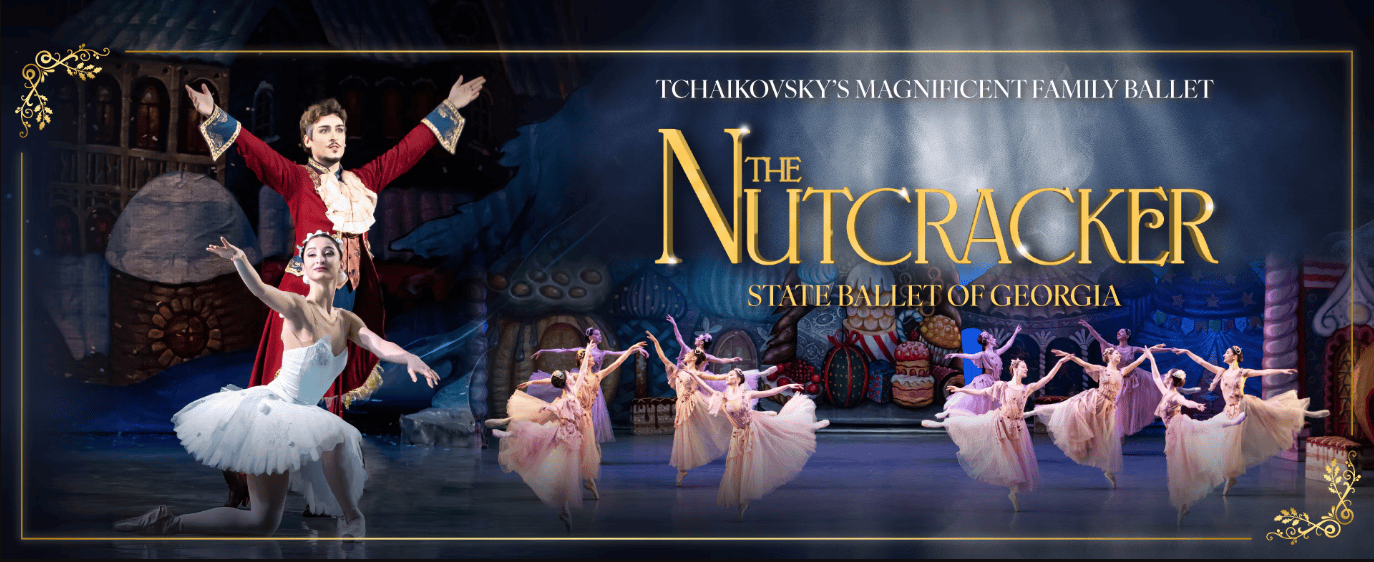
Few ballets capture the wonder of the festive season quite like The Nutcracker. With Tchaikovsky’s cherished score, enchanting winter landscapes and a magical journey from Christmas Eve to the Kingdom of Sweets, the timeless classic continues to captivate audiences across generations. Following its sold-out 2025 Singapore season of Swan Lake, the world-renowned State Ballet of Georgia returns to Sands Theatre, Marina Bay Sands, from 26 to 29 November 2026, bringing with it another beloved masterpiece of classical ballet to usher in the festive season.
Featuring a touring company of 60, the State Ballet of Georgia is celebrated for its refined classical technique, traditional staging and visually enchanting productions. Under the artistic direction of former Bolshoi Ballet and American Ballet Theatre prima ballerina Nina Ananiashvili, the company has built an international reputation for its commitment to classical ballet while embracing contemporary and neoclassical works.
Taking on two of the production’s most iconic roles are Leading Soloists Daler Zaparov as the Nutcracker Prince and Nino Samadashvili as the Sugar Plum Fairy. Both accomplished dancers with extensive international experience and an impressive repertoire spanning classical and contemporary works, they bring their own artistic interpretations to these beloved characters. In this exclusive conversation with Bakchormeeboy, Daler and Nino share what these roles mean to them, the experiences that have shaped their careers, the discipline behind their craft, and why The Nutcracker continues to hold such a special place in the hearts of audiences around the world.
Daler Zaparov

Bakchormeeboy: The Nutcracker is one of the most beloved ballets in the classical repertoire, performed and revisited by generations of audiences. What does this particular production mean to you, and what do you enjoy most about being part of it?
Daler: For me, The Nutcracker is a very special production, and I have been fortunate enough to perform in several different versions of it. Each one is unique in its own way, but they all share one important quality: the ballet brings joy and creates an atmosphere of magic. Our production has its own distinctive style, and I always enjoy being part of it.
Bakchormeeboy: How do you approach portraying the Prince, and what do you hope audiences feel through your performance?
Daler: The Prince is probably one of the most iconic and recognisable characters in ballet, which makes portraying him particularly challenging. It is important to create an interpretation that feels unique and different from the princes in other ballets. I hope to convey all the beauty, nobility and grace that are inherent in this character.

Bakchormeeboy: Having performed with several prestigious companies across Russia, South Korea and Kazakhstan before joining the Tbilisi Opera and Ballet State Theatre, how have these different experiences shaped you as a dancer?
Daler: I believe that growth and continuous progress are essential for every artist. I have been fortunate to gain valuable experience working with different companies and in different countries. Wherever I have been, I have always tried to learn something new.
I have had the privilege of working with many legendary choreographers, teachers and dancers, and all these experiences have shaped me as an artist. I believe I am still growing and constantly discovering new things. Even now, I have the opportunity to work alongside living legends. I can honestly say that I am a very fortunate artist, and I thank God for all the opportunities I have been given.

Bakchormeeboy: Your repertoire spans classical masterpieces as well as contemporary and neoclassical works. What do you find most rewarding about moving between these different styles, and does one challenge you in a particularly different way?
Daler: As I mentioned earlier, I have been fortunate enough to perform some real gems of both the classical and contemporary repertoire. I believe this can only benefit an artist. Finding yourself in contemporary choreography can help you explore and express your potential much more fully in classical ballet. The same works in the opposite direction: classical ballet can also bring a deeper understanding to contemporary movement.
Bakchormeeboy: Ballet demands an extraordinary combination of athleticism, precision and artistic expression. What does your preparation look like in the lead-up to a production like The Nutcracker, and how do you maintain the physical and mental stamina required for a touring schedule?
Daler: I believe that having a consistent daily routine is very important for a professional dancer. As for me, my routine is quite simple and perhaps a little boring. What matters most is having a good classical ballet class and spending time rehearsing in the studio. I also try to go to the gym to maintain my overall physical condition. Nowadays, there are so many different ways to develop as an artist, but ultimately, the most important work still happens in the rehearsal studio.
Bakchormeeboy: The Nutcracker is often associated with childhood memories, Christmas traditions and a sense of wonder. Do you have any personal memories or traditions connected to the ballet, and what would you hope first-time audiences take away from watching it?
Daler: The Nutcracker was the first ballet in which I performed a leading role, which makes this production especially meaningful to me. For those who will be experiencing the ballet for the first time, I would love them to immerse themselves in a world of wonder and magic alongside us, and to leave the theatre feeling wonderful, filled with that special sense of anticipation and excitement that comes with the Christmas season.
Nino Samadashvili

Bakchormeeboy: The Sugar Plum Fairy is arguably one of the most iconic roles in classical ballet, known for her grace, technical precision and ethereal quality. What does it mean to you to perform this role, and how do you make it your own?
Nino: For me, the Sugar Plum Fairy represents elegance, serenity and a certain kind of magic that cannot be expressed through technique alone. She is almost like a dream – graceful, delicate and powerful at the same time. I don’t see her simply as a beautiful fairy; I see her as the heart of the magical kingdom, a character who brings a sense of harmony and wonder to the entire story. When performing this role, I try to find a balance between her regal presence and her delicate, almost ethereal nature.
Musicality is especially important to me. I believe every movement should feel connected to the music, as though the character is not simply dancing to it but becoming part of it. My intention is to create an atmosphere in which the audience can experience her magic rather than simply observe her technique.
Bakchormeeboy: You have danced many of ballet’s most celebrated female roles, from Odette-Odile in Swan Lake to Giselle and Juliet. How does the Sugar Plum Fairy differ from these characters, both technically and emotionally?
Nino: Each of these characters has a completely different personality and requires a different approach, both technically and emotionally. Swan Lake is, in many ways, the ballet of ballets. What makes Odette and Odile particularly challenging is that you have to portray two almost opposite characters within the same performance. Odette, the White Swan, is gentle, fragile and vulnerable, while Odile, the Black Swan, is confident, powerful and seductive. Finding the distinction between these two personalities is one of the greatest challenges of the role.
Giselle and Juliet demand a different kind of artistic expression. They require enormous emotional depth, passion and acting ability. You have to become an actress as much as a dancer, because their stories are so deeply connected to human emotions. The Sugar Plum Fairy, on the other hand, belongs to a world of fantasy and innocence. She represents something sweet, magical and almost dreamlike. Although the role is technically very demanding, its emotional character is quite different from the dramatic intensity of Giselle or Juliet.
Of all these characters, Giselle is probably the one I feel most personally connected to. She has a very special place in my heart.

Bakchormeeboy: Having been with the Tbilisi Opera and Ballet State Theatre since 2011, you’ve grown from a Ballet Artist to a Leading Soloist. Looking back on this journey, what have been some of the most defining moments in your career, and how has your artistry evolved?
Nino: Joining the Tbilisi Opera and Ballet State Theatre in 2011 was one of the most important steps in my life. Looking back, I realise that every stage of my career has contributed to the artist I am today. Each role, each performance and every experience on stage has taught me something valuable, not only about ballet but also about myself.
One of the most meaningful aspects of my journey has been the opportunity to work with our Prima Ballerina and Artistic Director, Nina Ananiashvili, from childhood. I am truly grateful for everything I have learned from her throughout these years. I have also had the privilege of working with inspiring choreographers, ballet masters and extraordinary dancers such as Julio Bocca, Giuseppe Picone and Oliver Matz, among others.
Moving from Ballet Artist to Soloist and then Leading Soloist was not simply a professional progression; it was a journey of artistic growth, responsibility and self-discovery. I believe a dancer never stops learning. With every new role, I discover different emotions, challenges and possibilities. Today, I value not only technical achievement but also artistic maturity, individuality and the ability to communicate something meaningful to the audience.
Bakchormeeboy: Your repertoire includes works by renowned choreographers such as George Balanchine, Jiří Kylián and Alexei Ratmansky, alongside traditional classical ballets. How have these different choreographic approaches influenced the way you move, interpret music and express yourself on stage?
Nino: Working with choreographers such as George Balanchine, Jiří Kylián and Alexei Ratmansky has been an incredibly valuable part of my artistic development. Each of them has a very distinctive choreographic language, musical approach and movement vocabulary. Working with their styles has taught me to be more versatile, to explore different physical possibilities and to approach movement from different perspectives.
Balanchine’s choreography, for example, requires extraordinary musicality, speed and precision. Kylián introduces a very different physical language, with a strong emphasis on fluidity, dynamics and the relationship between movement and music. Ratmansky has a wonderful ability to combine classical ballet traditions with his own distinctive artistic vision.
For me, neoclassical ballet is particularly challenging because it requires a different kind of freedom, physical awareness and musical understanding. It pushes me beyond the familiar classical technique and constantly challenges me as an artist. I think experiencing these different choreographic worlds has made me a more versatile dancer and has helped me approach every new role with greater curiosity and openness.

Bakchormeeboy: You’ve performed extensively around the world, from Europe and Asia to the Middle East and the Americas. How does performing for different international audiences influence your experience on stage, and what has touring taught you about connecting with audiences through dance?
Nino: Performing internationally is always a special experience because ballet creates a universal language that goes beyond words and cultural differences. What I find most beautiful is that, although audiences may come from completely different backgrounds, the emotions we share through dance are often the same. Music, movement and genuine emotion can create a connection that needs no translation.
Representing the State Ballet of Georgia on international stages is also a great honour and responsibility. It gives us the opportunity to share our artistic traditions, our school and our dedication to classical ballet with audiences around the world. Every audience has its own energy, and I find it very rewarding to feel that connection from the stage. Touring has taught me that, regardless of where we perform, the most important thing is to be sincere in what we do. For me, that exchange between the performer and the audience is one of the most beautiful aspects of being a dancer.
Bakchormeeboy: The Nutcracker has a special place in the hearts of audiences, particularly during the festive season. What do you think gives this ballet its enduring magic, and what do you hope audiences in Singapore will remember most about this production?
Nino: I think the beauty of The Nutcracker lies in its ability to speak to everyone, regardless of age, culture or background. It is a story about imagination, childhood dreams, love and the magic of believing in something beautiful. Tchaikovsky’s music is extraordinary. It creates such a vivid world that even before the curtain opens, you can feel the atmosphere of the story. Combined with the choreography and the visual beauty of the production, it becomes an experience that touches people on many different levels.
Perhaps what makes this ballet timeless is that it allows adults to rediscover a little of their childhood while introducing younger generations to the beauty of classical ballet. Every year, audiences return to it, yet it never loses its magic. I hope the Singapore audience will leave the theatre with beautiful emotions, a sense of wonder and perhaps a little of that childhood magic that The Nutcracker brings to all of us. It would be a great pleasure and honour to share this special production with the Singapore audience.
Photos courtesy of State Ballet of Georgia
The Nutcracker by State Ballet of Georgia runs from 26th to 29th November 2026 at Sands Theatre, Marina Bay Sands, Singapore. Tickets available here

