
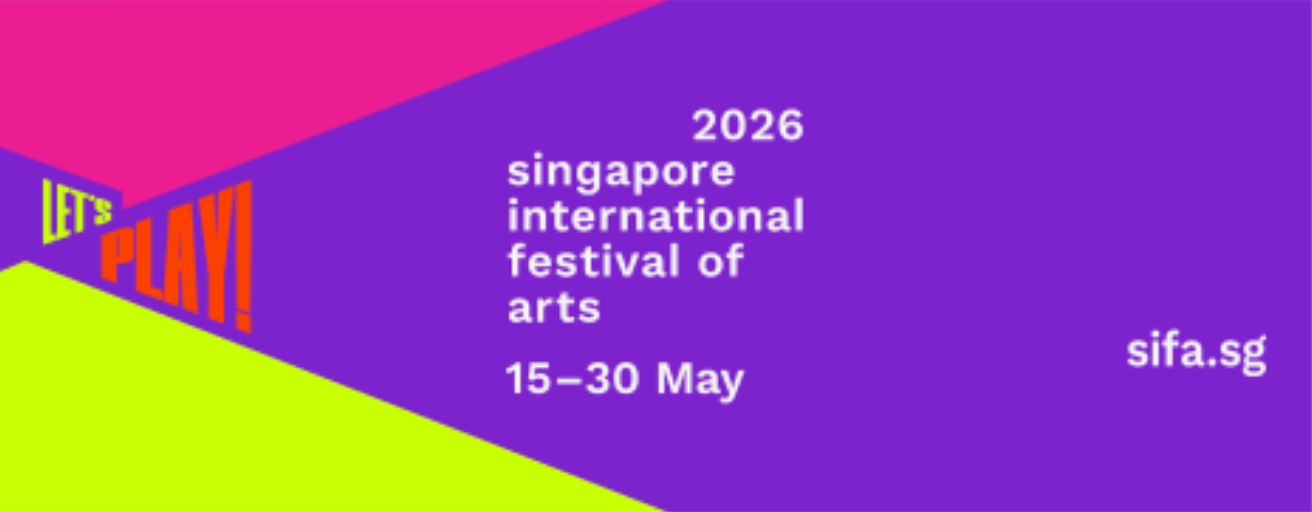
For two weeks in May, Singapore becomes a stage. Across theatres, parks and historic civic spaces, the Singapore International Festival of Arts (SIFA) returns from 15 to 30 May with performances that stretch from aerial dance spectacles and immersive theatre to experimental late-night encounters. This year’s edition carries an unusually simple invitation: “Let’s Play.”
The phrase captures the spirit of a festival that wants audiences to explore the arts with curiosity rather than obligation. Instead of treating performances as isolated events, SIFA 2026 encourages visitors to spend an evening moving between multiple experiences, arriving early for an outdoor performance, catching a major stage production, and lingering afterwards for conversations and late-night works.
Behind this approach is Festival Director Chong Tze Chien, who sees this first edition under his directorship as the beginning of a longer story for the festival. As SIFA approaches its 50th anniversary next year, the next three editions will unfold as a curatorial arc: Legacy (2026), Roots (2027) and Renaissance (2028).

The first chapter asks artists to reflect on inheritance, both artistic and cultural. “Legacy asks what we inherit and what we choose to carry forward,” Chong said during the programme briefing. “It’s about looking at the foundations that shape contemporary practice.” At the same time, the festival’s public-facing tagline deliberately shifts away from abstraction. “Let’s Play,” Chong explains, is a call to action—an invitation to experience art through discovery and participation.
To realise that idea, the festival unfolds through five programme strands: Festival Village, Festival Stage, Festival Play!Ground, Festival House, and Festival Late Nites. Together they transform the city into a constellation of artistic encounters, allowing audiences to experience several works in a single evening.

A key highlight of the festival sees the return of Festival Village, a lively outdoor hub set against the historic civic district at Empress Lawn, extending toward Anderson Bridge. Running nightly, the Village functions as a social gathering space where audiences can drift between performances, installations and food stalls. Most of the programmes here are free, lowering the barrier for newcomers while recreating the communal atmosphere that once defined earlier editions of the festival.
Chong describes the Village as “a festival within a festival”, where audiences might arrive without a fixed itinerary and discover performances by chance. The programme includes works that encourage active participation. Makan Culture, for instance, combines theatre and dining in a playful exploration of Singapore’s culinary heritage. Participants receive a meal and follow the performance through wireless headsets, turning the shared act of eating into a form of storytelling.

Elsewhere in the Village, the interactive performance We Live Here invites audiences to rediscover the choreography hidden within everyday movements. Created by theatre practitioners drawing on Biomechanics and Laban Movement Analysis, the work explores how ordinary gestures—walking, turning, exchanging glances—can evolve into expressive sequences shared between strangers. Designed for the open festival setting, the piece encourages visitors to step into the performance space and experiment with movement, transforming casual encounters into moments of collective expression.
Other Village presentations include Just Keep Swimming 《记忆游泳池》 by The Theatre Practice, a work that blends live conversation, music and movement to reflect on artistic mentorship and creative lineage. The installation YOU ARE (NOT) WHAT YOU EAT! by Yang Derong examines Singapore’s relationship with food culture and consumption, while the dawn sound installation RUPTURE by The Observatory Singapore band transforms seismic recordings and field sounds into an evolving morning soundscape. The Village will also host Next Gen, a showcase featuring emerging artists from the University of the Arts Singapore, as well as participatory installations and performances that unfold across the festival grounds. Together, these works frame the Village as a place where audiences can encounter art casually, sometimes intentionally, sometimes by accident.

Some works move beyond a fixed stage entirely. Conceived as a speculative theatrical procession, A Light Between Rains unfolds across the city as a moving celebration of creativity and community. Set during the inter-monsoon season—when winds shift and the atmosphere feels charged with anticipation—the performance invites audiences to join a collective journey through sound, colour and movement. Blending walking theatre, performance installations and community workshops, the piece becomes a shared act of world-building. Performers and participants move together through the city, embodying the elements that shape life while celebrating artistic traditions and the connections that bind communities together. The work culminates in a large-scale finale at the festival grounds, where participants and audiences gather in a moment of collective celebration.

While outdoor programmes invite exploration, the Festival Stage anchors the festival with its major theatrical productions. One of the most visually striking works is Tempo, a collaboration between Swedish and Brazilian artists directed by visual artist and magician Kalle Nio. Blending stage illusions, choreography by Fernando Melo, and music by Samuli Kosminen, the production transforms an ordinary moment into a dreamlike meditation on time.
Through sequences of falling, stumbling and near-accidents, Tempo explores how time can accelerate, stretch or appear to stand still. Dreamlike scenes unfold alongside rhythmic compositions for prepared metronomes and text by writer Harry Salmenniemi, creating a theatrical environment where gravity seems to vanish and the laws of nature dissolve. The result is a mesmerising reflection on the fragility of everyday life and the strange elasticity of time.

One of the most ambitious productions is LACRIMA, a large-scale theatrical work by French director Caroline Guiela Nguyen. The piece follows the global network of artisans secretly commissioned to produce a royal wedding dress, revealing the hidden labour behind luxury fashion.

From South Korea comes a new staging of Hedda Gabler, presented by the National Theater Company of Korea and starring veteran actress Lee Hye-young. The production revisits a play that has historical significance for the company, reflecting the festival’s broader interest in artistic legacy.

Other international highlights include Hamlet, a reinterpretation from Peru that brings together actors with Down syndrome to reimagine William Shakespeare’s classic tragedy, and Planet [wanderer], a visually striking collaboration between choreographer Damien Jalet and Japanese sculptor Kohei Nawa that explores humanity’s fragile relationship with nature. Together, these works place Singapore audiences in dialogue with global artistic practices while reflecting the festival’s central theme of inheritance and reinvention.

Few works speak more directly to the festival’s theme than Last Rites, a new cross-disciplinary production presented by Emergency Stairs and directed by Liu Xiaoyi. The piece brings together five renowned performance artists from across Asia—whose average age is 74—to reflect on a provocative question: if you could imagine your final performance, what would it look like? Rather than portraying death directly, Last Rites traces the artists’ journeys back to their earliest creative impulses and the struggles that shaped their careers. Their stories form a powerful tapestry of artistic conviction, from the late Singapore theatre pioneer Kuo Pao Kun’s influence on actor Yang Shi Bin, to Korean veteran Jung Dong-hwan’s commitment to performing every show as if it were his last. Other contributors include Japanese Noh performer Kanji Shimizu, Indonesian dance icon Didik Nini Thowok, and Chinese performance artist Nam Geung-ho. Through interviews, projections and staged encounters between the virtual and the physical, the work transforms the stage into a liminal space where memory, imagination and the living body converge.

Beyond the theatre, the Festival Play!Ground programme brings large-scale performances into public spaces across the island. A centrepiece of this strand is Noli Timere, an aerial performance created by choreographer Rebecca Lazier in collaboration with visual artist Janet Echelman. Performers move within a monumental net sculpture suspended high above the ground, their movements rippling across the structure as they navigate its shifting tensions.

The work will appear first near Empress Lawn before travelling to Punggol Digital District, where audiences can also participate in Discover the Nets with Noli Timere, an interactive experience that invites visitors to explore the massive sculptural structure up close, and continuing the festival’s effort to bring large-scale arts experiences beyond the city centre. From a distance, the sculpture itself already commands attention, drawing passers-by toward the performance space before revealing the choreography unfolding within it.

While Play!Ground emphasises scale and spectacle, Festival House at The Arts House Singapore offers a quieter counterpoint. This programme strand focuses on immersive performances, workshops and conversations that invite audiences to engage more directly with the creative process. Here, the boundaries between performer and spectator often blur, creating encounters that feel more conversational than conventional theatre.
Among its highlights is The Lighthouse, an immersive promenade performance designed for young audiences and families. Blending installation, science experiment and theatrical adventure, the work invites visitors to wander through interconnected rooms exploring the properties of light. Each space reveals a different phenomenon through interactive installations and sensory experiences, transforming the venue into a house of marvels filled with reflection, perspective and luminous illusions. By combining art and science, The Lighthouse encourages participants to experiment and discover—turning curiosity itself into the central performance.
The programme also includes a series of talks and film screenings reflecting on the evolution of Singapore’s performing arts scene, offering audiences a chance to revisit the festival’s history while looking ahead to its future. Festival House also hosts discussions and gatherings for artists and audiences, including initiatives that explore new forms of collaboration across Asia and conversations around disability arts in the region.

Local artists remain central to the festival’s programme, many of them reflecting on their own creative histories. One highlight is Lush Life, directed by theatre-maker Ong Keng Sen. The production brings together jazz vocalist Jacintha Abisheganaden and composer-performer Dick Lee, tracing their artistic journeys through personal stories and live music.
Another major Singapore production is Salesman之死, directed by Danny Yeo and written by Jeremy Tiang. The play revisits the historic moment when playwright Arthur Miller travelled to Beijing in 1983 to direct a Mandarin-language production of Death of a Salesman. By examining the translators and collaborators who made the production possible, the work highlights the often-invisible labour behind cross-cultural theatre.

Dance also features prominently in the Singapore lineup with Strangely Familiar《熟悉的陌生》, a new work by T.H.E Dance Company Singapore that explores the relationship between the physical body and digital identity. Together, these works reflect on Singapore’s own artistic inheritance, bringing past collaborations, creative relationships and personal histories into dialogue with the present.

As night deepens, the festival shifts into a different rhythm through Festival Late Nites. Curated by the collective Hothouse, the series AUTOMATA brings together filmmakers, musicians and performance artists exploring themes of ritual, repetition and the systems that shape modern life.

The programme includes multidisciplinary performances, conversations and experimental music events that unfold late into the evening, culminating in the closing celebration Excess Without Return. For Chong, Late Nites revives an important dimension of festival culture: the informal conversations that happen after the curtain falls. “Festivals used to have a social life beyond the theatre,” he said. “Late Nites is about creating space for those encounters again.”
Beyond performances, SIFA 2026 also introduces Diversity Futures, a transnational creative think tank connecting emerging artists from Singapore with peers in Korea and Hong Kong. The initiative aims to foster new collaborations and expand regional networks, allowing younger artists to exchange ideas and develop projects that reflect the evolving cultural landscape of Asia.

Taken together, the programmes of SIFA 2026 reveal a festival that is both reflective and forward-looking. The Legacy theme asks artists to examine the histories that shape their work, whether through artistic mentorship, cultural memory or collaborations that cross borders and generations. At the same time, the festival’s structure encourages audiences to experience art in a more fluid way: wandering from lawn to theatre, from conversation to performance, discovering unexpected connections along the way.
It is an approach that feels particularly fitting as the festival approaches its milestone anniversary next year. If Legacy begins by asking what the arts community has inherited, the next question, one that will unfold over the coming years, is what comes next.
For now, SIFA 2026 begins with a simple invitation: Let’s play.
Photos Courtesy of The Arts House Group
SIFA 2026 runs from 15th to 30th May 2026. More information and tickets to be released here
 Bakchormeeboy