
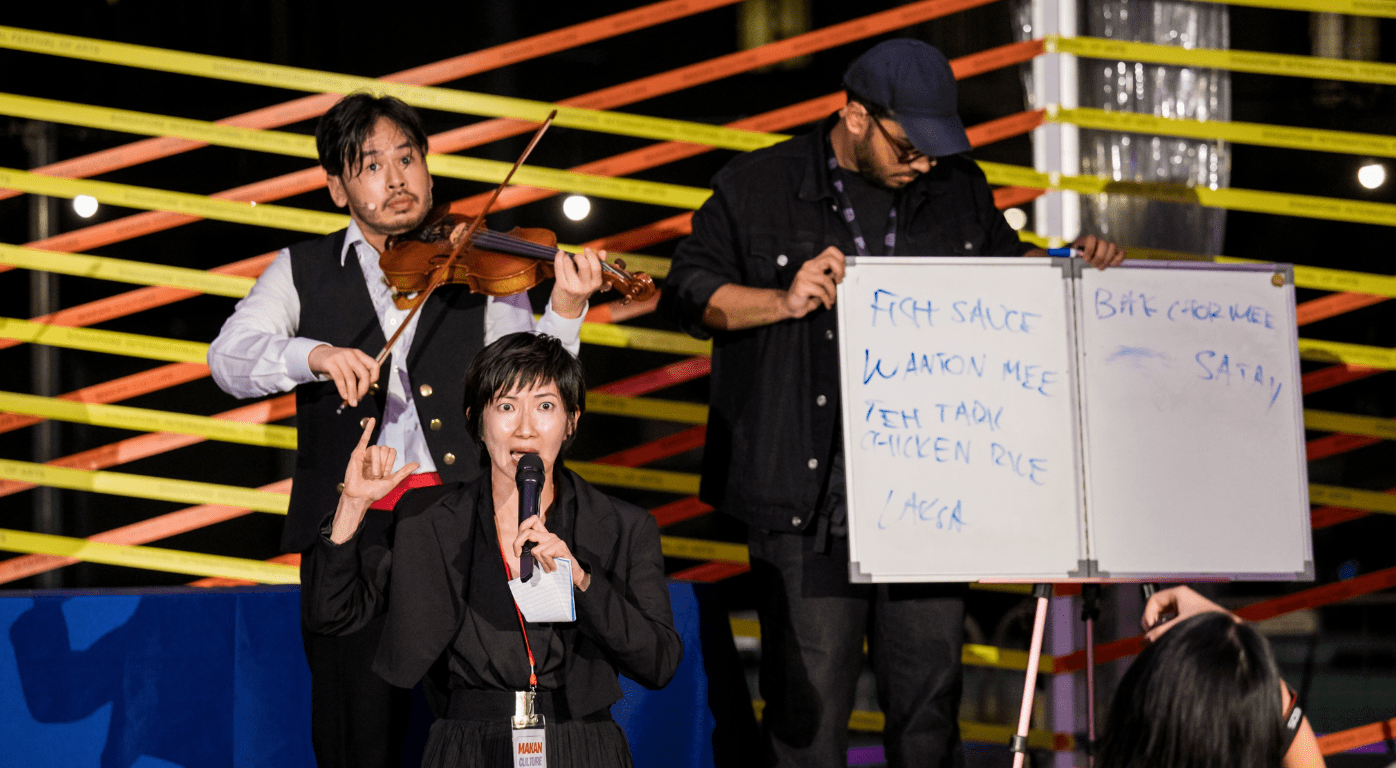

Earnest, wry and smile-inducing commentary on pride, joy, and criticism in the local arts and culture scene.
Singapore has long measured success in terms of efficiency, practicality and polish, so it’s perhaps unsurprising that the local arts scene often finds itself trapped in an exhausting cycle of comparison. Why watch a homegrown production when there’s Broadway and West End to assure us of ‘quality’? Why champion something proudly Singaporean when international work is assumed to be “better”? But with Makan Culture, playwright Jo Tan and director Krish Natarajan deliver an enormously entertaining, emotionally sincere and sharply intelligent response to exactly that mindset.
Commissioned as part of the 2026 Singapore International Festival of Arts (SIFA), Makan Culture transforms a custom-built pavilion on Empress Lawn into something between a hawker centre, a community gathering and a theatrical battleground. It is thematic without being pretentious, interactive without becoming awkward, and constantly alive with the messy, funny contradictions of Singaporean identity and our views towards the arts. The way people interrupt each other, hedge opinions, code-switch between sincerity and sarcasm, complain because they care, and it all feels instantly recognisable.

Before the show even properly begins, audiences are seated communally at round tables reminiscent of hawker centres, encouraged to mingle with strangers and cast members alike. It’s casual and slightly chaotic, with headphones provided to cut through the surrounding Festival Village noise, creating the strange sensation of intimacy amidst public bustle. That communal atmosphere becomes central to the entire production: Makan Culture isn’t interested in passive spectatorship, instead inviting participation, conversation, and even a little friction.
And then the controlled chaos begins. Jo Tan opens as a nervously formal representative of authority, setting up the evening with an air of uncertainty that already hints at the instability to come. Dennis Sofian follows with a delightfully unpolished blend of performance art and physical comedy, committing so fully to intentional awkwardness that it becomes its own kind of precision, turning cringe into something unexpectedly joyful through sheer confidence and comic timing.

A disruptive critical voice in the form of Ellison Tan soon enters the frame, reframing the evening and challenging the production’s legitimacy, tone, and value. Rather than resolving this tension neatly, the work allows it to escalate into increasingly absurd attempts to “improve” or “elevate” what is being presented: musical detours, audience-driven improvisation, and spontaneous acts of cultural remixing that constantly blur the line between satire and celebration. The humour lands because it understands something deeply Singaporean: how easily pride and embarrassment coexist in the same breath.
Yet beneath the farce lies a genuinely thoughtful exploration of cultural insecurity, legitimacy and ownership. What counts as “good” Singaporean art? Who gets to decide? Why is external validation so often the default benchmark? These questions emerge organically through the ensemble, particularly in moments led by Masturah Oli and Fahim Murshed, whose performances anchor the production’s emotional and comedic rhythms with warmth and clarity. Masturah’s effortless storytelling brings heritage and identity into focus through food as metaphor, while Fahim’s energetic explanations of local culinary histories are delivered with a mix of sincerity and playful invention, often involving audience participation that turns the pavilion into something closer to a living kitchen than a stage. Both performers excel at keeping the work grounded even as it constantly threatens to spiral into delightful excess.

The production’s emotional centre arrives in a quieter, more reflective register, as the earlier tensions between art, critique and identity deepen into something more personal. Arriving with a tender theatrical sequence that blends humour, improvisation and puppetry, it is a key scene that reveals how deeply intertwined artistic disagreement and emotional history can be. Even at its most playful, the work never loses sight of the vulnerability underneath its comedy. Performances across the ensemble remain consistently strong here, with Ellison Tan’s critic figure holding the space with a sharpness that gradually reveals nuance, while Fahim Murshed provides an emotional counterweight that grounds the exchange in genuine feeling rather than polemic.
What’s particularly impressive is how naturally audience interaction is woven into everything. Singaporean audiences are notoriously reserved, yet Makan Culture somehow draws participation with ease through trust. Audience members become narrators, helpers, and collaborators, drawn into the rhythm of the performance without ever feeling coerced. It never feels forced because the cast are so skilled at facilitation, gently guiding engagement while remaining open to unpredictability. It is this balancing act between structure and spontaneity, satire and sincerity, chaos and control that the production excels at.

The included bento meal also cleverly reinforces the show’s themes. Featuring laksa mee tai mak, rainbow kaya sandwiches and fruity rojak, the food becomes an extension of the storytelling rather than a gimmick. Originally conceived as a communal sharing experience before logistical realities intervened, the final version still works beautifully, grounding the experience in the sensory intimacy that food uniquely creates in Singaporean life.
Admittedly, the production occasionally tries to juggle too many ideas at once. Some metaphors land more cleanly than others, and the final stretch can feel dense with competing perspectives. But even its messiness feels appropriate for a work about Singaporean identity itself: contradictory, overloaded, still forming. There is no neat resolution, only a recognition that these tensions are ongoing, and perhaps must be lived with rather than solved.

Makan Culture knows there are no easy solutions. One performance will not suddenly transform national attitudes toward the arts, nor does the show pretend that simply “supporting local” magically resolves the tensions surrounding Singaporean culture. Instead, it brilliantly dissects those anxieties about taste, legitimacy, class, identity and what counts as “good” art, with both sincerity and sharp humour. The production recognises that Singaporeans are often caught between pride and insecurity, wanting something unmistakably our own while still measuring ourselves against international standards. Yet rather than condemning that contradiction, the show embraces it, presenting local culture not as a finished product to be judged, but as an evolving, messy process still finding its voice.
That is what makes Makan Culture so unexpectedly moving. Beneath the absurd comedy, audience participation and food metaphors lies something deeply hopeful: the belief that perhaps the only way forward is to keep showing up, keep experimenting, keep laughing and keep making art anyway. Warm, weird, self-aware and enormously generous toward its audience, the production captures the peculiar emotional texture of Singaporean life with startling precision, balancing farcical humour with genuine intelligence and emotional honesty. For all its commentary about “premium” art and cultural inferiority, Makan Culture itself ultimately proves that Singaporean theatre does not need to imitate Broadway or the West End to matter. It only needs the courage to sound like itself, at times awkward and contradictory, but always sincere, and to accept that culture-making is a journey, not a destination.
Photos Courtesy of The Arts House Group
Makan Culture plays from 15th to 30th May 2026 at Festival Market @ Empress Lawn. Tickets and more information available here
SIFA 2026 runs from 15th to 30th May 2026. More information and tickets available here
Production Credits
| Playwright and actor Jo Tan Director Krish Natarajan Cast Fahim Murshed, Ellison Tan, Dennis Sofian, Masturah Oli |


One thought on “★★★★☆ Theatre Review: Makan Culture by Jo Tan and Krish Natarajan (SIFA 2026)”