
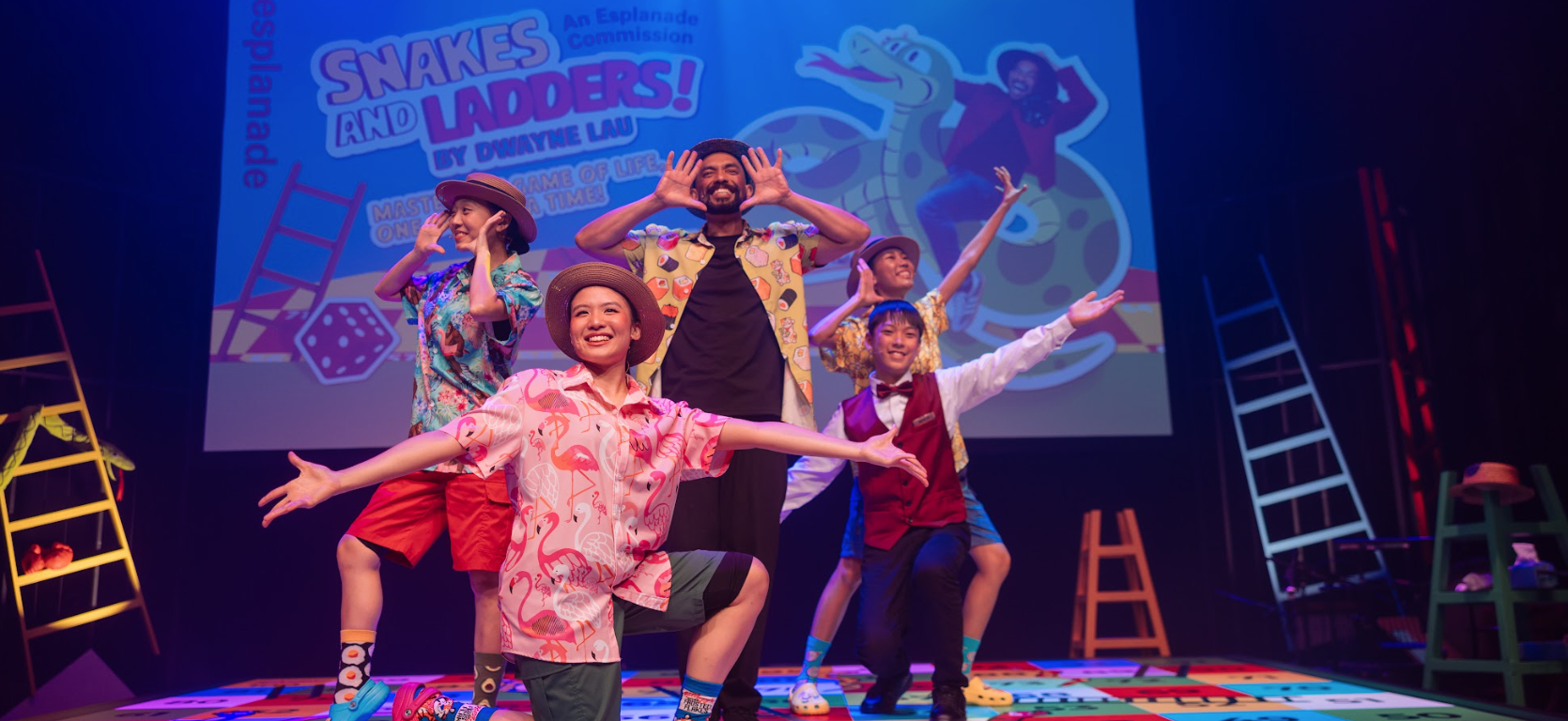

Theatrical metaphor for how life never progresses in a straight line, but we keep rolling the dice and continue moving forward amidst the ups and downs.
Back in June when Snakes & Ladders premiered as a 40-minute work-in-progress at the Esplanade Concourse, it felt like a charming autobiographical cabaret searching for a stronger narrative spine. Now expanded into a full-length production for the Esplanade’s Flipside 2026 main programme, writer-director Dwayne Lau’s deeply personal theatrical game has undoubtedly grown in scale, confidence and emotional depth. Yet what remains most striking is that it has not attempted to solve its central dramaturgical challenge of finding a fixed structure. Instead, it has embraced it.
The premise remains deceptively simple. Inspired by the first board game his mother taught him to play, Dwayne invites the audience to guide him across a giant Snakes and Ladders board through the roll of two oversized dice. Each square unlocks a story, song, memory or theatrical vignette from his life. The audience controls the journey, while Dwayne simply rolls with whatever fate delivers.

The show opens exactly as one might expect from a performer as exuberant as Dwayne. Entering to J.Lo’s “Let’s Get Loud”, he immediately establishes the afternoon’s atmosphere with infectious energy and self-aware humour. He openly admits to having a loud voice, loud personality and loud fashion sense, before quickly revealing the vulnerability that lies beneath. As he observes, the funniest people are often the saddest. That balance between humour and heartbreak has always been one of Dwayne’s strengths as a storyteller, and Snakes & Ladders continues to mine it effectively.
As the game progresses, audiences encounter a collage of memories. There are stories of discovering musical theatre through The Wizard of Oz and later Wicked. There are recollections of his fourteen unsuccessful auditions before landing a first professional role with TheatreWorks (now T:>Works). There are anecdotes about competing in Singapore Idol, navigating Mandarin theatre despite limited Chinese proficiency, surviving the uncertainty of the COVID-19 pandemic, and finding unexpected purpose through children’s programming and digital storytelling.

What emerges is not so much a chronological biography than a scrapbook of experiences. Last year’s work-in-progress occasionally felt like a collection of stories waiting for a clearer structure. In this expanded version, however, the fragmentation appears entirely deliberate. Rather than focusing on a straightforward, linear narrative, Dwayne instead designs the show such that it recreates the unpredictable way memory itself operates. Joy sits beside disappointment, triumph gives way to grief, and well, ladders are followed by snakes. Whether audiences find this liberating or frustrating will likely determine their overall response to the piece.
There is also, crucially, an implicit reframing of that central metaphor: the “snakes” are not necessarily venomous, but read instead as detours that only appear negative in hindsight, part of a broader argument that meaning is often constructed after the fact rather than within the moment itself.

The randomness of the game’s structure remains both its most distinctive feature and its greatest limitation. While the dice mechanic creates genuine spontaneity and ensures no two performances will be identical, it also prevents the evening from developing sustained dramatic momentum. Some stories resonate deeply while others feel more anecdotal, and the production occasionally struggles to build towards a cumulative emotional payoff. Yet this lack of conventional structure increasingly feels inseparable from the show’s thematic ambitions. Life, after all, rarely unfolds in neat dramatic acts. In that sense, the audience is not just observing Dwayne’s story, but actively co-authoring its shape in real time and turning biography into something closer to lived contingency than fixed narrative.
What has evolved most significantly from the earlier version is the emotional weight carried by the material. While the original work-in-progress focused heavily on perseverance and finding silver linings, the full-length production feels far more invested in themes of grief, legacy and acceptance. The emotional centre of the evening arrives whenever Dwayne speaks about his late father. These moments are delivered with genuine vulnerability; his rendition of “Because He Lives” becomes both tribute and remembrance, while repeated references to the advice his father gave him reveal how deeply those words continue to shape his life and career. The production’s reflections on loss feel richer now, perhaps because time has allowed them to evolve from immediate pain into contemplation.

Dwayne is also supported by a strong creative team that helps further elevate the material. The life-sized game board designed by Wong Chee Wai provides a striking visual anchor for the evening. Alvin Chai’s lighting adds texture and atmosphere to what could otherwise become a static storytelling exercise. Music Director August Lum, joined by Jamie Lee on live instruments, ensures the transitions between songs and stories feel fluid, while Charmaine Ho’s choreography injects energy into the larger musical sequences.
The supporting cast of Beatrice Jaymes Pung, Eugenia Lee, Victoria Lam and Gratus Aw prove equally valuable. The three female performers in particular bring vocal power, humour and theatrical flair throughout the evening, while Aw’s appearance as the game’s “Game Master” carries an added layer of significance given his real-life relationship as Dwayne’s godson. Together, they prevent the production from becoming overly introspective, continually reminding audiences that theatre remains a collaborative art form.

Still, the production never escapes the fact that it is fundamentally about Dwayne himself. This is both its greatest strength and its greatest risk, as the audience is invited to witness his successes, disappointments, insecurities, ambitions and moments of self-doubt. Some will find this openness deeply moving. Others may occasionally wish for more critical distance or broader thematic exploration beyond the autobiographical framework. The show’s willingness to wear its heart on its sleeve is admirable, but sincerity alone cannot always sustain dramatic tension across ninety minutes.
And yet, by the end, it is difficult not to be won over by the generosity of spirit underpinning the entire endeavour. On this particular afternoon, the audience only manages to guide Dwayne to square 70. The game ends before reaching 100. In most circumstances, that would feel like failure. Here, it feels oddly appropriate. One year on, this production has expanded into a fully realised theatrical experience without abandoning the uncertainty that inspired it in the first place. Dwayne has not solved the puzzle of life’s unpredictability but instead has simply learned to embrace it.

As he closes the show with a tender rendition of “Somewhere Over the Rainbow”, the lesson becomes clear. Success is not reaching square 100. It is continuing to roll the dice, accepting the snakes alongside the ladders, and finding meaning in the journey regardless of where it ends. For a show about navigating life’s twists and turns, there could hardly be a more fitting conclusion.
Photos by Crispian Chan, courtesy of Esplanade – Theatres on the Bay
Snakes and Ladders! played from 29th to 31st May 2026 at the Esplanade Recital Studio. More information available here
Flipside 2026 runs from 29th May to 7th June 2026 at the Esplanade. Tickets and full programme available here
Production Credits
| Writer and Director Dwayne Lau Dramaturg Julian Wong Music Director August Lum Choreographer Charmaine Ho Lighting Designer Alvin Chai Set and Props Designer Wong Chee Wai Costume Designer The Costume Pte Ltd Cast Dwayne Lau, Beatrice Jaymes Pung, Eugenia Lee, Victoria Lam, Gratus Aw Live Musicians August Lum, Jamie Lee Production Manager Irabu Jeannette and Xu Xin’en Stage Manager Goh Xin Yi Assistant Stage Manager Shermin Chia Producer Tan Rui Shan |

