
Ingeniously simple concept that reminds us of the joy of circus, stripping is back to its essentials and delivering on a rollicking good time.
When most people think of circus, they imagine massive spectacle: towering big tops, elaborate costumes, dazzling lighting rigs, and performers transformed into larger-than-life characters. Contemporary circus after all, often leans towards ever-greater scale, bigger stunts, more ambitious concepts, and increasingly elaborate theatrical frameworks. Bucking that trend, Gravity & Other Myths’ A Simple Space takes that expectation, cheerfully tosses it aside, and somehow emerges as one of the most exhilarating circus experiences you could hope to witness.
Presented as part of Esplanade’s Flipside 2026 programme, A Simple Space feels almost outrageous on paper. A contemporary circus work staged in the intimate confines of the Theatre Studio, a venue more commonly associated with dramatic works than gravity-defying acrobatics? Surely something has to give. How do you fit the scale, the danger and the excitement of circus into a room where the audience sits just metres away? Gravity & Other Myths’ answer is deceptively straightforward: strip everything away until all that remains are the performers, their bodies, and their trust in one another.
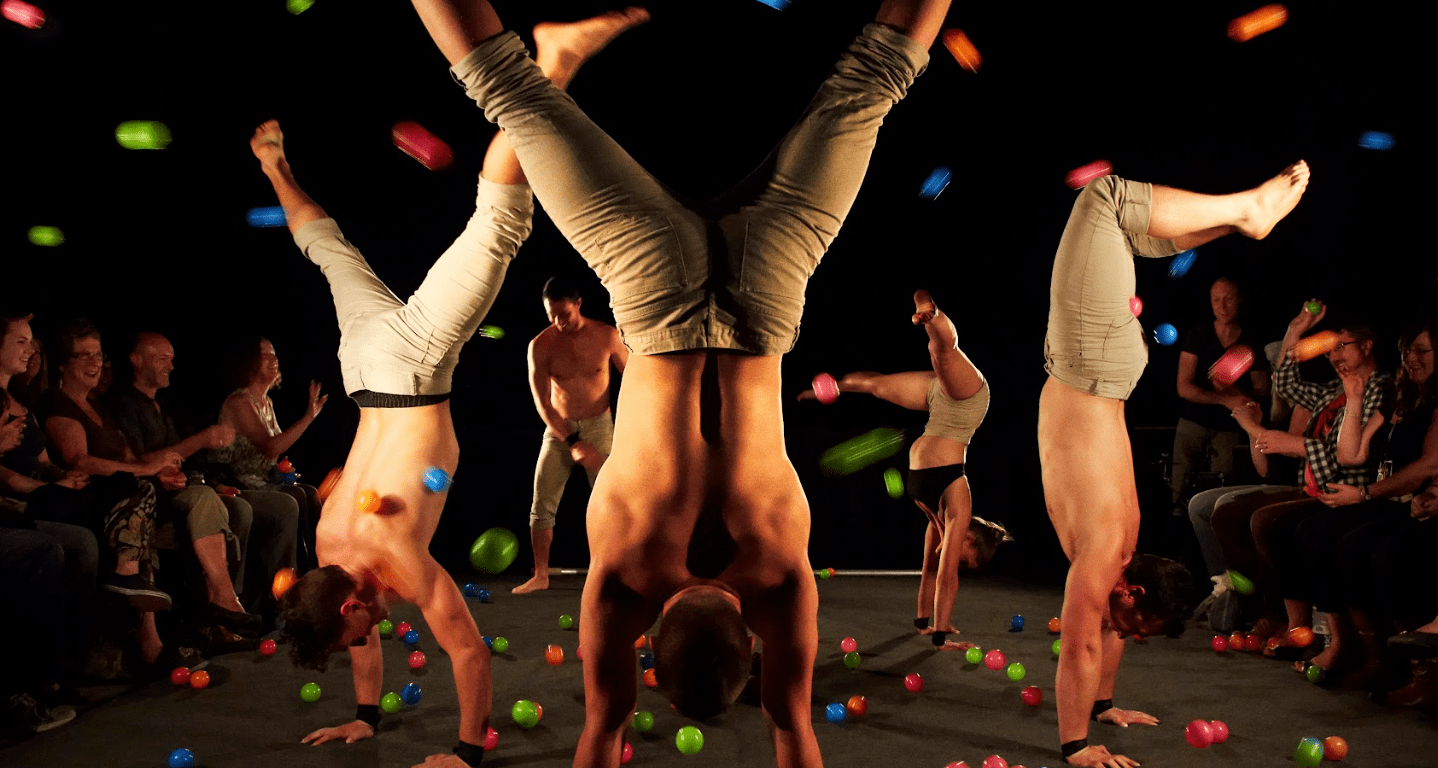
The audience is seated on three sides of a thrust-stage configuration. The set consists of little more than a black floor and four lighting towers positioned at the corners. There are no glittering costumes or theatrical disguises. Performers Emily Gare, Ashley Youren, Hamis McCourty, Georgia Webb, Léann Gingrass, Skip Walker-Milne and David Trappes emerge barefoot, dressed in shorts and T-shirts as casually as if they had wandered in from a morning coffee run, while musician Yuk Afella takes his place behind.
Then someone suddenly yells, “Falling!”, as they run into the space, and launches themselves backwards. At the very last moment, another rushes in to catch them. Then another person falls. Then another. And another.
What begins as a familiar trust exercise rapidly escalates into a wonderfully chaotic blur of bodies hurtling across the stage. Performers sprint from one side of the room to the other to make impossible catches and near-impossible saves. The pace quickens. The margins shrink. The near misses become increasingly nerve-racking. At one point, a performer is deliberately left to hit the ground, staring up in mock betrayal as the audience erupts in laughter.

It is a brilliant opening because it establishes the central truth that underpins everything that follows. Every astonishing feat in A Simple Space is built on absolute trust, the kind that allows someone to throw themselves headfirst into danger because they know somebody else will be there to catch them.
Yet for all the remarkable athleticism on display, trust is only half the story. The other ingredient is play. What makes A Simple Space so infectious is that every act feels simultaneously like a polished circus routine and a game that has spiralled delightfully out of control. The performers are unquestionably elite athletes capable of feats that seem to challenge both gravity and common sense, but they never present themselves as untouchable virtuosos. Instead, they approach each sequence with the energy of friends constantly daring one another to go further.
One of the evening’s funniest sequences begins with something as mundane as skipping. Three performers are handed luminous green skipping ropes and begin jumping. The pace gradually increases. One misses a step and removes his shirt. The competition continues. Another mistake, another article of clothing disappears. Before long, what began as a simple test of endurance has evolved into a gloriously ridiculous strip-skipping contest, with increasingly panicked laughter from audience members and more than a few startled expressions from parents who had perhaps not anticipated quite this level of audience participation.
That spirit of friendly one-upmanship runs throughout the entire production. In one act, a performer repeatedly launches himself across two other performers’ bodies, each leap slightly longer and seemingly more reckless than the last. Every successful landing is met with a collective gasp followed by relieved applause, all the way until the final, seemingly impossible jump, where we are left surprised by the end result. Elsewhere, the cast challenge one another, seeing if one of them can hold a handstand longer than the rest can hold their breath. These sequences are absurd, playful and often laugh-out-loud funny, but they are also remarkably effective at showcasing the performers’ skill. Beneath the humour lies astonishing strength, balance, stamina and control.
The sheer physical dexterity on display is extraordinary. Bodies become ladders, platforms, counterweights and launchpads. Human towers rise improbably high within the Theatre Studio’s modest dimensions. Performers climb onto shoulders, shoulders onto shoulders, until formations stretch towards the ceiling. There are moments when three people balance atop one another, and you watch with bated breath as they show just the hint of a struggle before success, and we are left floored by their capability.
Without costumes, characters or theatrical framing to create distance, the performers remain recognisably human throughout. You can hear their breathing. You can see sweat drip from their faces. You notice every tiny adjustment required to maintain balance and every burst of exertion needed to complete a lift. Rather than diminishing the spectacle, this intimacy magnifies it. Watching a fantastical circus character perform a trick is impressive. Watching an ordinary-looking person standing a few feet away accomplish the same feat somehow feels even more extraordinary.

That humanity extends beyond the acrobatics themselves. Some of the evening’s biggest laughs come from moments that have little to do with circus at all. A communal towel becomes the centrepiece of a hilariously disgusting challenge as performers take turns wiping increasingly questionable body parts before daring the next person to use it. There is endless teasing, mock rivalry and affectionate sabotage. Throughout it all, there is a palpable sense that these are people who genuinely enjoy performing together, proving that their chemistry proves just as important as the acrobatics.
Gravity & Other Myths has often spoken about friendship and play as foundational elements of its work, and nowhere is that more apparent than here. The performers do not simply execute tricks but also celebrate one another’s successes, laugh at one another’s mistakes and continually push one another towards greater heights. The result is a show that feels like a welcome invitation to share in a collective act of joy.
The audience, naturally, gets swept up in it. At one point, colourful balls are distributed and spectators are encouraged to throw them at performers balancing in handstands. It is a simple idea, almost childishly simple, but the effect is magical. Suddenly the room transforms into a playground. Adults who moments earlier were quietly observing world-class acrobatics now gleefully hurl projectiles at the cast, while the performers grin through the challenge and attempt to maintain their balance. Elsewhere, volunteers are invited onstage to become part of a hypnotic sequence involving carefully distributed weight and trust. Balloon animals are sculpted and gifted. It’s not long before the entire room becomes united by the same spirit of mischief.
Even Yuk Afella gets his moment to shine. More than simply providing accompaniment, his driving percussion helps accompany Elliot Zoerner’s soundtrack and becomes the pulse of the performance, propelling acts forward with infectious energy. At one memorable point, he even takes to the stage himself and turns his own body into a musical instrument, demonstrating a virtuosity that matches the acrobats sharing the stage with him.
The final stretch of the show somehow finds another gear. By now the performers have already demonstrated astonishing strength, precision and fearlessness, yet they continue escalating. Bodies become skipping ropes. Human beings are swung through the air like pendulums. Performers launch, catch and redirect one another with such speed and confidence that the audience scarcely knows where to look. It is thrilling, ridiculous and utterly euphoric, allowing it to end on such a powerful landing.
Contemporary circus increasingly chases scale, whether through technology, spectacle or narrative ambition. Gravity & Other Myths radically serves up the opposite. There is no grand mythology here, no elaborate story and no attempt to disguise effort behind theatrical illusion. Instead, the company places extraordinary faith in something much simpler: the inherent fascination of watching human beings do extraordinary things together. There is risk, certainly, but the show never fetishises danger. Instead, it celebrates courage, trust and most importantly, joy.
There are those who may dismiss A Simple Space as mere entertainment without much depth. But sitting in a packed, intimate Theatre Studio, surrounded by a full house of people laughing, gasping, cheering and applauding together, it becomes clear that joy is not a lesser emotion. There is something deeply moving about witnessing a room full of strangers united by delight. For fifty-five minutes, the outside world falls away, replaced by a shared sense of wonder that feels increasingly rare. By the time the joyous finale arrives and the audience rises to its feet, it is impossible not to find yourself smiling.
Thirteen years after its premiere, A Simple Space remains a powerful reminder that circus does not need spectacle to be spectacular. Utterly mesmerising, relentlessly entertaining and with a willingness to stretch human physicality to its limits, A Simple Space is contemporary circus at its most joyful.
Featured Photo Credit:Andy Phillipson
A Simple Space played from 29th to 31st May 2026 at the Esplanade Theatre Studio. More information available here
Flipside 2026 runs from 29th May to 7th June 2026 at the Esplanade. Tickets and full programme available here
Production Credits
| Created by Martin Schreiber, Lachlan Binns, Jascha Boyce, Jacob Randell, Triton Tunis-Mitchell Composer Elliot Zoerner Musician Yuk Afella Performers Emily Gare, Ashley Youren, Hamis McCourty, Georgia Webb, Léann Gingrass, Skip Walker-Milne, David Trappes |

