
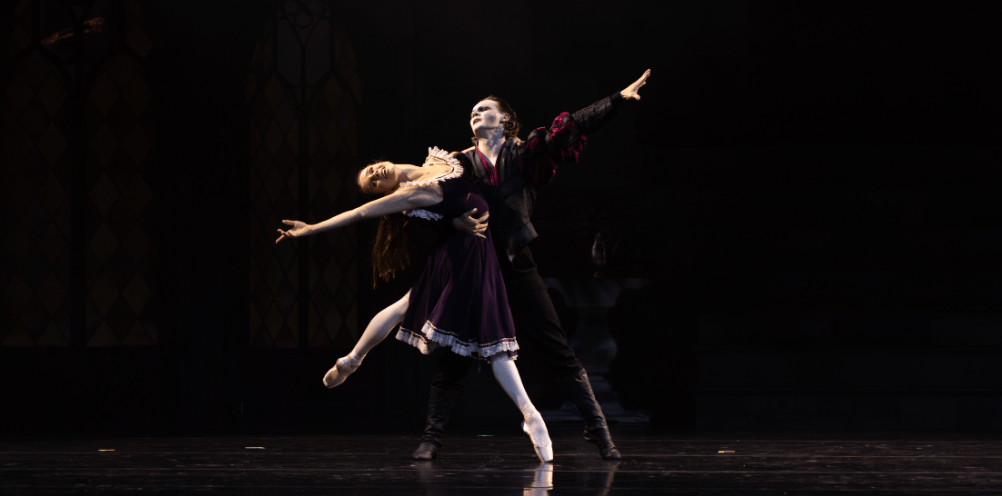

Following its sold-out West End run, Dracula: Ballet at its Darkest arrived in Singapore with a bold reimagining of Bram Stoker’s gothic classic. Under the artistic direction and choreography of Joel Burke, the production traded traditional ballet conventions for cinematic storytelling, psychological tension and an evocative score featuring works by Bach, Mozart, Rachmaninov, Liszt and Debussy, inviting audiences into a haunting world where love, grief and immortality collide.
Beyond the production itself, Burke shares his thoughts on the resurgence of narrative-driven ballet, the creative challenge of translating gothic horror into movement, and why contemporary dance is finding new audiences around the world. He also reflects on what international audiences have taught the company, why Singapore was a natural stop on its global tour, and his vision for redefining what ballet can be for the 21st century.

Bakchormeeboy: Dracula is one of literature’s most enduring and frequently adapted stories. What drew you
to reinterpret this classic as a ballet, and what new emotional or psychological dimensions
does movement allow you to explore that words or film cannot?
Joel Burke: Dracula endures because it’s fundamentally about appetite — for blood, yes, but also for love, power, and escape from mortality. Those are things the body understands before the mind does. Ballet strips away exposition and lets us sit inside a feeling: the tremor before a bite, the paralysis of desire, the long slow unravelling of a man losing his humanity. Words can describe fear; movement can make an audience feel their own pulse change.

Bakchormeeboy: Narrative ballets appear to be enjoying a resurgence with audiences around the world. Why do you think story-driven productions are resonating so strongly today, and how do you see contemporary ballet evolving to attract people who may never have considered attending a ballet before?
Joel Burke: Audiences are craving stories again — not spectacle for its own sake, but narrative they can follow without a program note. Story-driven ballet gives newcomers a way in: you don’t need to know ballet vocabulary to understand grief, obsession or betrayal. We’re seeing contemporary ballet evolve toward cinematic staging, tighter running times, and scores people already recognise — all of which lower the barrier for someone who’s never set foot in a theatre for dance before.

Bakchormeeboy: Your version of Dracula leans heavily into gothic horror, psychological tension and supernatural themes. What were the biggest creative challenges in translating fear, obsession and immortality into choreography, and how did you ensure these emotions remained authentic rather than theatrical spectacle?
Joel Burke: The challenge wasn’t choreographing fear — it was choreographing restraint. Horror in dance tips into camp very quickly if you chase the scare rather than the psychology underneath it. We spent most of rehearsal on stillness: what a body does in the seconds before violence, not the violence itself. Every gothic flourish — the capes, the shadows, the partnering that verges on menace — had to be earned by an emotional truth first, or it was cut.

Bakchormeeboy: The production is set to a score featuring composers including Bach, Mozart, Rachmaninov, Liszt and Debussy, rather than a newly commissioned soundtrack. How did you curate this musical journey, and how does the music shape the emotional arc of the story and your choreography?
Joel Burke: We built the score as an emotional arc rather than a chronological playlist — Bach and Debussy for the interior, private moments; Liszt and Rachmaninov for obsession and excess; Mozart where we needed to remind the audience of the humanity Dracula has lost. Using existing repertoire rather than a commission meant we could choreograph to music with its own century of emotional weight already built in, and let the choreography argue with it rather than simply illustrate it.

Bakchormeeboy: The ballet presents Dracula beyond just a monster, but as a tragic figure driven by grief, love and loss. How important was it for you to humanise such an iconic villain, and what do you hope audiences take away from that interpretation?
Joel Burke: Enormously important. A monster with no interior life gives dancers nothing to play and audiences nothing to feel beyond fright. We wanted Dracula’s cruelty to be legible as grief that curdled — a man who lost everything and chose immortality over letting go. We hope audiences leave less certain about where villainy ends and heartbreak begins.

Bakchormeeboy: Following a sold-out West End season, you’ve now brought Dracula: Ballet at its Darkest to Singapore. What have you learned from audiences in different parts of the world, and why did Singapore feel like the right next destination for this production?
Joel Burke: London taught us that this story travels on emotion, not on shared cultural reference points to the original novel. Audiences who’d never read Stoker still followed the arc because it’s built on love and loss, which are universal. Singapore felt right because it’s a city with a genuinely sophisticated, curious arts audience and a growing appetite for bold international theatre — exactly the audience this production rewards.

Bakchormeeboy: Across Asia, there’s growing interest in contemporary performing arts experiences. How do you see audiences in this region responding to bold reinterpretations of classical ballet, and what opportunities do you see for contemporary dance to grow here?
Joel Burke: We’ve found Asian audiences arrive with fewer preconceptions about what ballet “should” look like, which makes them wonderfully open to reinterpretation. There’s real opportunity here for touring contemporary dance that doesn’t dilute itself to feel safe — audiences in this region are responding to ambition and craft, not familiarity.

Bakchormeeboy: Beyond Dracula, your company has built a reputation for reimagining familiar stories in unexpected ways. What is your broader artistic vision for creating an internationally touring ballet company, and how do you hope it will reshape perceptions of what classical dance can be in the 21st century?
Joel Burke: Our broader ambition is to prove that classical dance can carry genre — horror, romance, tragedy — without losing its technical rigour. We want to build a company known for taking stories audiences think they already know and finding the version they didn’t expect, touring work that changes what people picture when they hear the word “ballet.”
Photography by Braeden O’Connor & En Pointe Productions
Dracula: Ballet at its Darkest played from 15th to 19th July 2026 at the Esplanade Theatre.

