
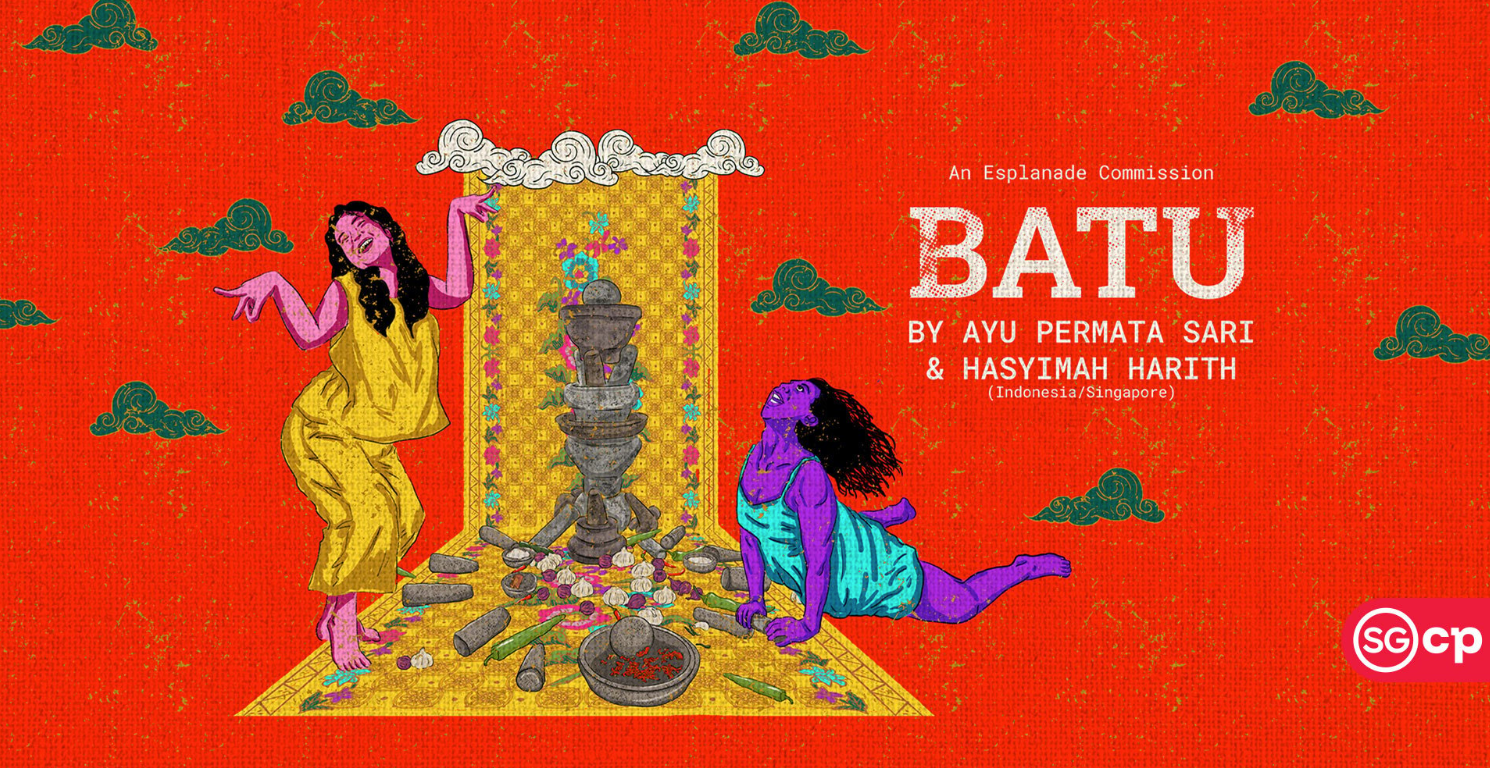
A kitchen can be many things. It is a place where food is prepared and domestic work is done, but it can also be where women gather, where stories are exchanged, where knowledge is passed between generations, and where rituals are repeated almost without thought. For Indonesian choreographer Ayu Permata Sari and Singaporean artist Hasyimah Harith, it is also a space through which questions of womanhood, heritage, intimacy and power can be brought into the body.
Their new work, BATU, takes its name from the traditional grinding stone found in Malay households. Developed with the support of Esplanade – Theatres on the Bay’s Contemporary Performing Arts Research Residency, supported by the National Arts Council, Singapore, the work is the first commissioned work to emerge from the programme, which supports female choreographers from Southeast Asia. Presented as part of this year’s edition of da focus – Connect Asia Now (CAN) in October, BATU brings together Ayu and Hasyimah in a performance that moves between domestic and ritual spaces, and between sensuality and spirituality.
BATU of course, centres on the batu, or mortar and pestle. More than a kitchen tool, it becomes a witness, a sacred sign and a keeper of ancestral knowledge. Held close to the body, it carries memories across generations, revealing the habits and histories embedded within matrilineal lineage. For Ayu, the object also carries memories of her upbringing in Lampung and of the cultural knowledge surrounding food. One of the most vivid examples is sambal, where the preparation of food can carry expectations about womanhood and marriage. “People claim that you can tell if someone is ready to be married from the quality of their sambal,” she says, recalling the idea that a woman’s readiness could be judged by how well she makes it.
It was through conversations like these that BATU began to take shape. Ayu and Hasyimah had actually known each other for years before they began making the work. They first met in Singapore in 2016 through an Esplanade programme, where Hasyimah helped Ayu with a script. They became friends and continued working together across different programmes and residencies in Taiwan, Malaysia and elsewhere, even as their individual artistic practices developed in different directions.
Then, in 2024, Esplanade put out an open call for the Contemporary Performing Arts Research Residency, and the two decided to apply together. Hasyimah had already been thinking about the mortar and pestle through her own artistic practice, particularly after making Daging (2021). Her interest in the object came partly from her experience of pregnancy and becoming a mother. “I was obsessed with pounding meat,” she says, connecting the physical action to the Malay saying darah daging (flesh and blood, referring to one’s child) and to the anxieties surrounding pregnancy and birth. “The pounding was a cathartic and source of relief for the anxiety of pregnancy and the birth of a mother,” she says. “So the batu lesung became a curiosity point for me and a point of connection.”
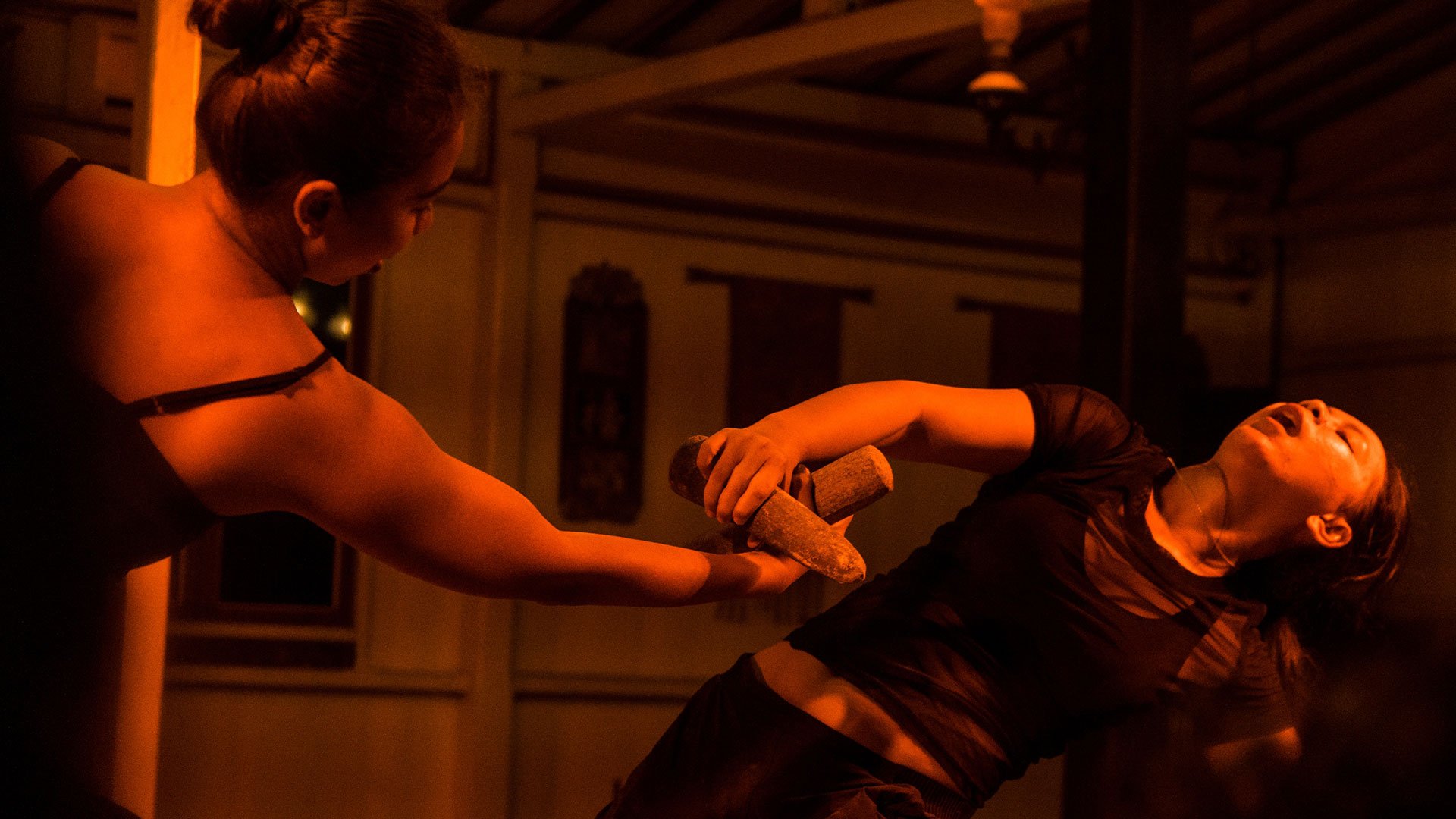
The two artists found that their existing practices could meet through the body. Both work across movement, although they approach it from different perspectives. For Ayu, dance offered a way of exploring knowledge that has traditionally been passed between women without necessarily being articulated. “We decided dance as the medium to tell our stories and education and stories of women handed down,” she says. “The body cannot lie. Sometimes the body is more honest than what we dare to say.”
Hasyimah approaches this less as a question of being a dancer and more as one of developing a movement language. That language, she says, is inevitably connected to roots and culture. As they developed BATU, the artists began to also think about the environment surrounding the body: the kitchen, its smells and sounds, the conversations that happen there, and the knowledge carried through different lineages. “The smallest of gestures can be subtle, but also very loaded,” Hasyimah says.
That attention to such gestures sits alongside a deliberately expansive sensory approach. BATU incorporates movement and voice, but also sound, smell and taste. Audiences encounter sambal and food as part of the experience, while dialogue and sound create another way of entering the work. “We chose a few strategies for this work to be a multisensory performance,” Hasyimah explains. “We do have dialogue, we use voice and sound and also taste and smell. So it’s a sort of allowing people to associate their memories with the senses in the space.”
For Ayu, those different sensory entry points are important because there is no single way for an audience to encounter the work.“We hope the audience can get into the work because we try to smell and feel and deal with the sound,” she says. “We want to offer them different access points in taste, sound and image and all these sensory responses.”
The emphasis on the senses also reflects the artists’ interest in the kitchen as something beyond a place for preparing food. During a residency in Bali, Ayu encountered a different understanding of the kitchen as a holy space, which prompted her to reconsider what the domestic sphere could represent. “For us, the kitchen is not just a space for cooking,” she says. “What we want to talk about is really to read the kitchen not just as a space for cooking, to cook our perspectives and ideas and cultures and memories and history and heritage, and connecting from woman to woman.”
She recalls how, during gatherings in Bali, women might naturally congregate in the kitchen, preparing food while talking and gossiping. Rather than viewing this as incidental, BATU considers the kitchen as a space where relationships and knowledge are actively produced. “In Bali some people say the kitchen is like a space for women,” Ayu says. “There is a party in one house and all the women will be in the kitchen and will be using it as a space to gossip.”
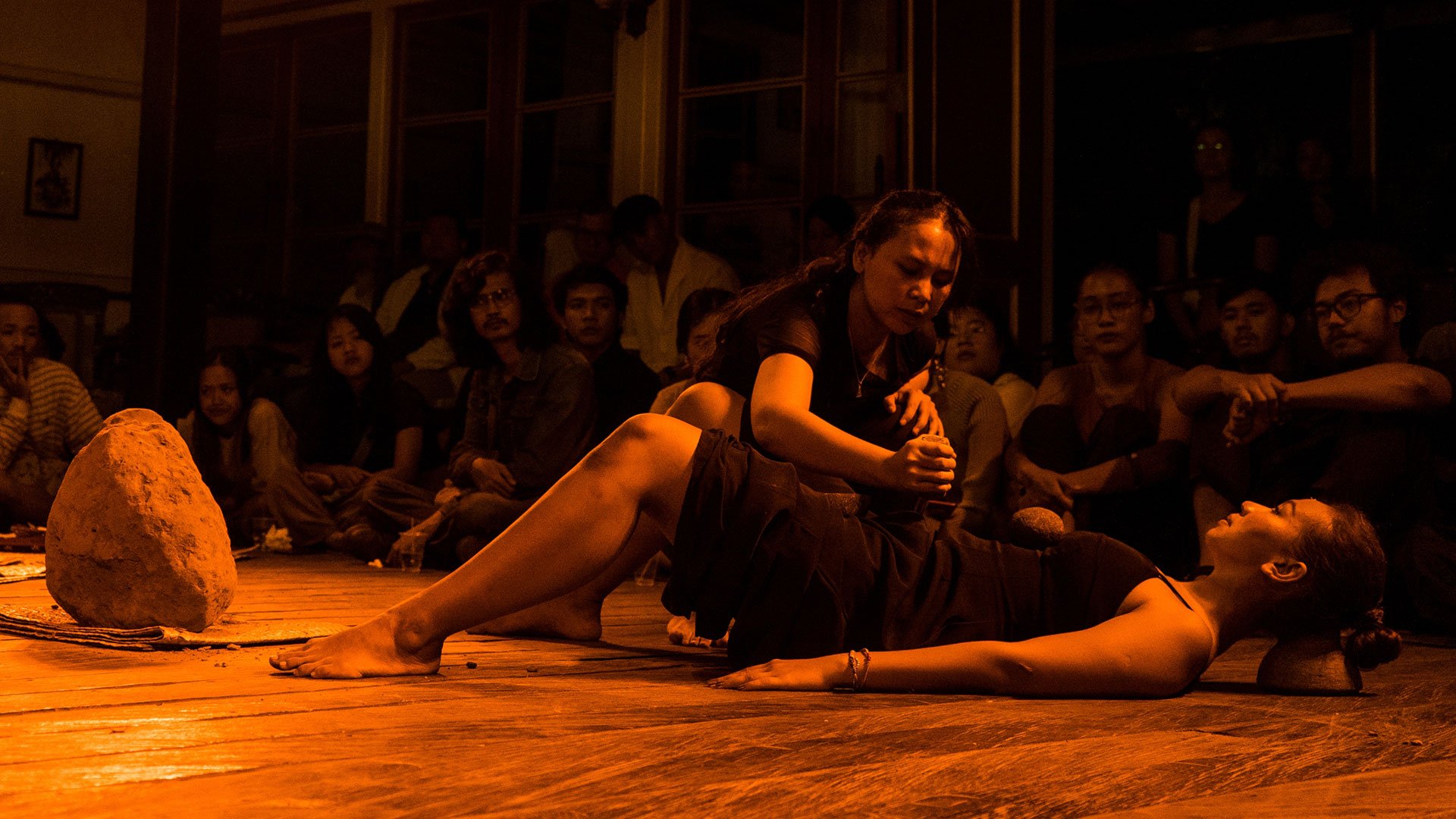
The artists are interested in what happens when this familiar domestic space is understood differently, expanding it and understanding it as a place where women can hold knowledge, exercise agency and negotiate sensuality and spirituality. “We don’t like to choose or do spiritual or sensuality things,” Ayu says. “We like to be in between and feel the tensions of both.”
Hasyimah sees another possibility in this idea of the kitchen: gathering. She points to the way people might sit around a game, play mahjong and allow conversations to unfold around the activity. For her, this offers a useful way of thinking about what the performance itself could become. “We’re trying to find a way for the kitchen to be a place of gathering and contemplation and care,” she says. “We can dare to think a performance can be a space of gathering.”
That desire for gathering extends into the artists’ relationship with the audience. Hasyimah says she does not want the work to function as something that is simply presented to spectators before they leave. “I personally like to meet my audience halfway instead of just being static and the audience watching me and leaving,” she says. “For them to have a stake and the memories and presence in the work to contribute to the entire experience.”
The artists also see vulnerability as part of that exchange. By opening up the work to different sensory and emotional responses, they give audiences space to bring their own histories into it rather than prescribing what they should feel. “The batu is a shared artefact,” Hasyimah says. “It doesn’t just belong to me and Ayu.”
That sense of shared ownership is important to the work’s larger ideas about solidarity. The batu may begin as a specific object connected to particular cultural traditions, but its meaning expands through the people who have used it, the memories attached to it and the stories it can evoke in different communities.
The artists’ collaborative process has similarly depended on making room for different perspectives. Their creative team includes dramaturg aRco Renz and sound artist Rosemainy Buang, among others, and the team became an important first audience for the work. “We are so lucky for the team who’s able to give us feedback and develop the work alongsie us,” Ayu says.
Those responses could reveal interpretations the artists had not anticipated. Because different people carry different cultural memories of the batu, an image or sound might touch someone in a way that differs from the artists’ original intention. “It’s hard to always receive a response like that,” Ayu says, “and different ways from us, like our intentions, and touched on different perspectives because different cultures and memories about batu.”
Rather than trying to eliminate those differences, the artists use them as part of the creative process. Hasyimah describes this as a process of testing, trial and error, designing different sections of the work with different aims and considering how stereotypes might be challenged or reproduced. “When we are the artists themselves and the artists moving our bodies, sometimes we need a third person to read our bodies,” she says. “We work very closely. Maybe also our first audiences and first point of negotiation, and that has always been the methodology for the work.”
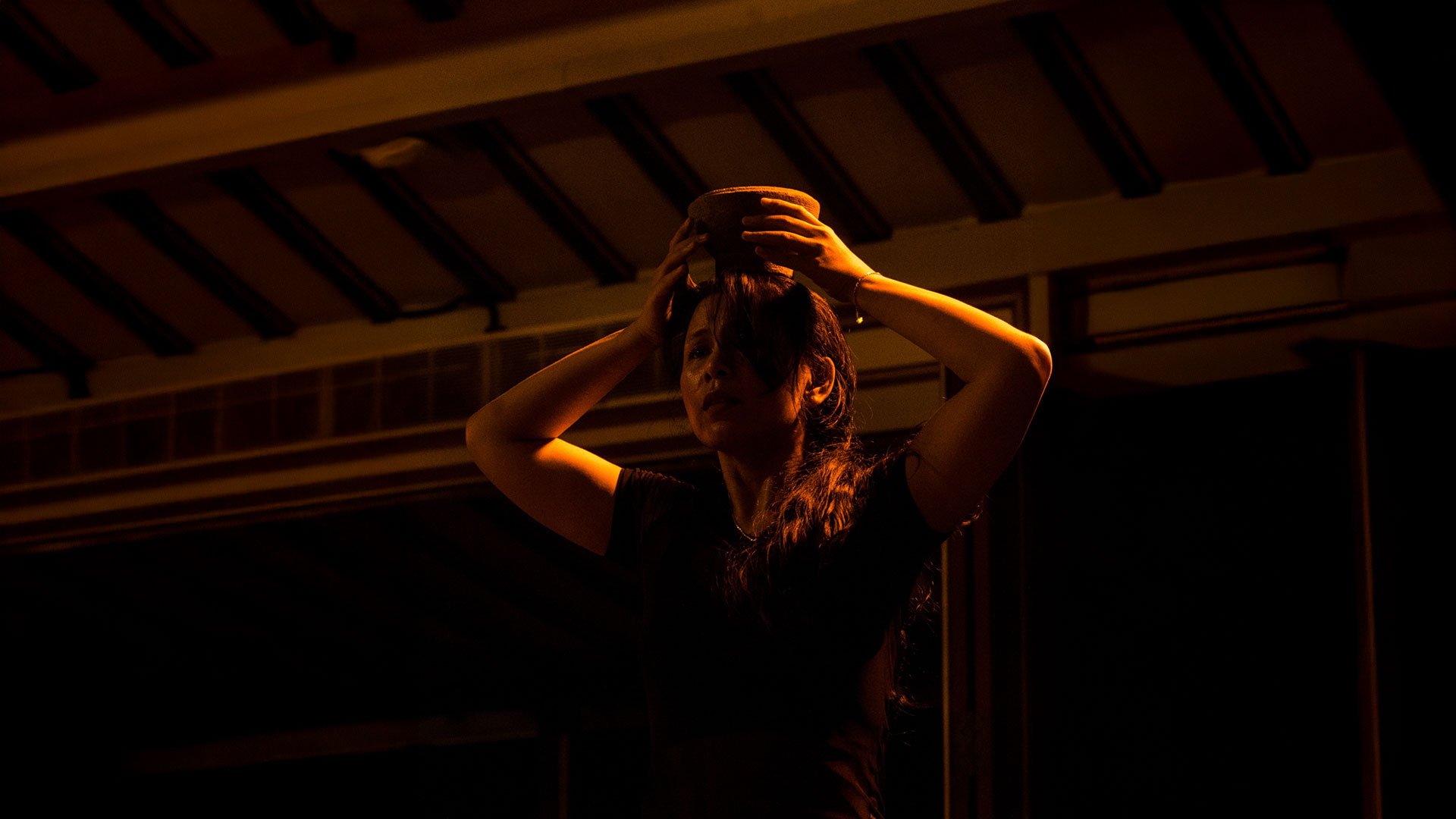
Ayu describes their approach as a strategy of play. They change the rules, test different sequences and ask how the work might be understood from another perspective. The performance itself has shifted through different presentations, including changes between Singapore and Bali. “The first time [we had the] presentation in Singapore, we have stories with audience and shared with audience in the beginning, but in Bali we changed it in another part and changed it in another part again,” she says.
Those changes became a way of asking how audiences who might have some distance from the batu could find their way into the work, constantly revising and reimagining it to its current form. That constant revision has also allowed the work to resist becoming too easily explained. For Hasyimah, one of the pleasures of the performance lies in the possibility that audiences may initially think they understand what they are seeing, only to discover that it keeps shifting. “I would rather it be unimaginable,” she says.
For her, the work is built around “a slow revelation”. It can begin with something familiar and gradually transform into something harder to define, intimate and personable on one hand, but psychologically intense and unpredictable on the other. “You think you know us but you have no clue,” Hasyimah says. “It’s peeling back the layers, where we would like to start with the familiar and involve a transformation where we may not be very understandable.”
For her, that multiplicity reflects the reality of being a woman, where different roles and sides of the self can coexist, and tells us that she an Ayu will be taking on multiple personalities and roles throughout the performance. Both artists are also equally conscious that BATU should not dictate a particular lesson to its audience. Ayu says she does not want to insist on a specific takeaway. “I don’t like to educate the audience,” she says. “I just want them to takeaway what they want and bring what they want.”
That might mean engaging with the cultural histories in the work, responding to a particular movement or sound, or simply enjoying the experience. “In this era everyone has different backgrounds,” Ayu says. “And their backgrounds, even if not artists, they can bring something. So I hope my audience can just enjoy the process and enjoy the sambal.”
Behind that openness, however, is a recognition of the more difficult questions the work is asking. Both artists come from conservative societies and communities in Indonesia and Singapore, and Hasyimah is careful not to position BATU as a work that will single-handedly transform those environments. “We don’t have much expectation of how it would have an effect,” she says. “Maybe not a big change, but at leas to create ripples and provoke thought.”
Those ripples might begin with something as simple as creating a gathering where women feel valued, seen or less alone. The work also makes room for the less comfortable aspects of inherited history. “It’s not just the glorious memories or histories,” Hasyimah says. “Even the bad habits and wounds that keep repeating themselves.”
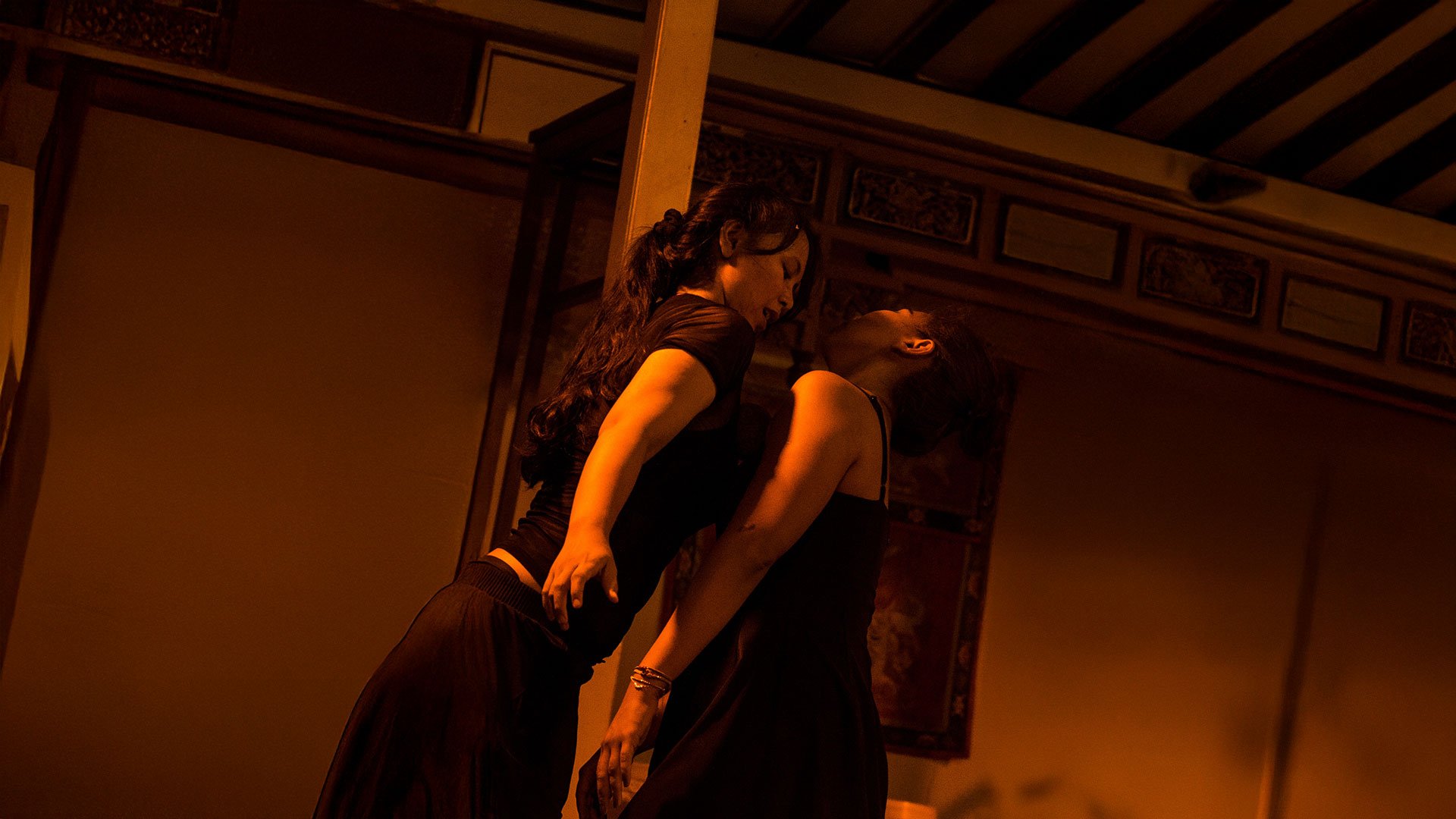
For her, the opportunity to make the work together is itself meaningful: a chance to witness one another, to create a space around these questions and to consider how knowledge might continue moving between communities. The artists hope to eventually share BATU in other spaces, where they can continue tracing the knowledge held in cooking and in the mortar and pestle, and encounter different communities of women with their own relationships to domestic objects, food and tradition. “The mortar and pestle holds a lot of cultural memory even in the kitchen,” Hasyimah says. “And different communities of women, and we want to carry them forward in diverse spaces.” For Ayu, that process begins with continuing the conversation. “We need to dialogue more,” she says. “I hope we can have all these conversations and more to better understand all these perspectives and histories available.”
BATU does not offer a single answer to what the kitchen, the female body or the batu should mean. Instead, it opens these spaces up, to memory and contradiction, to pleasure and restraint, to spirituality and sensuality, to inherited knowledge and the possibility of change. And perhaps that is why an ordinary grinding stone can carry so much weight. It is not only an object from the past. It is something that has been held, used and passed on, carrying with it the traces of the people who came before. In BATU, Ayu and Hasyimah bring those traces into the body, inviting audiences to encounter them through movement, sound, taste, smell and their own memories.
Photo Credit:Amrita Wayan
BATU plays from 16th to 18th October 2026 at the Esplanade Theatre Studio. Tickets available here
da:ns focus – Connect Asia Now runs from 15th to 18th October 2026 at the Esplanade. More information and tickets available here

