
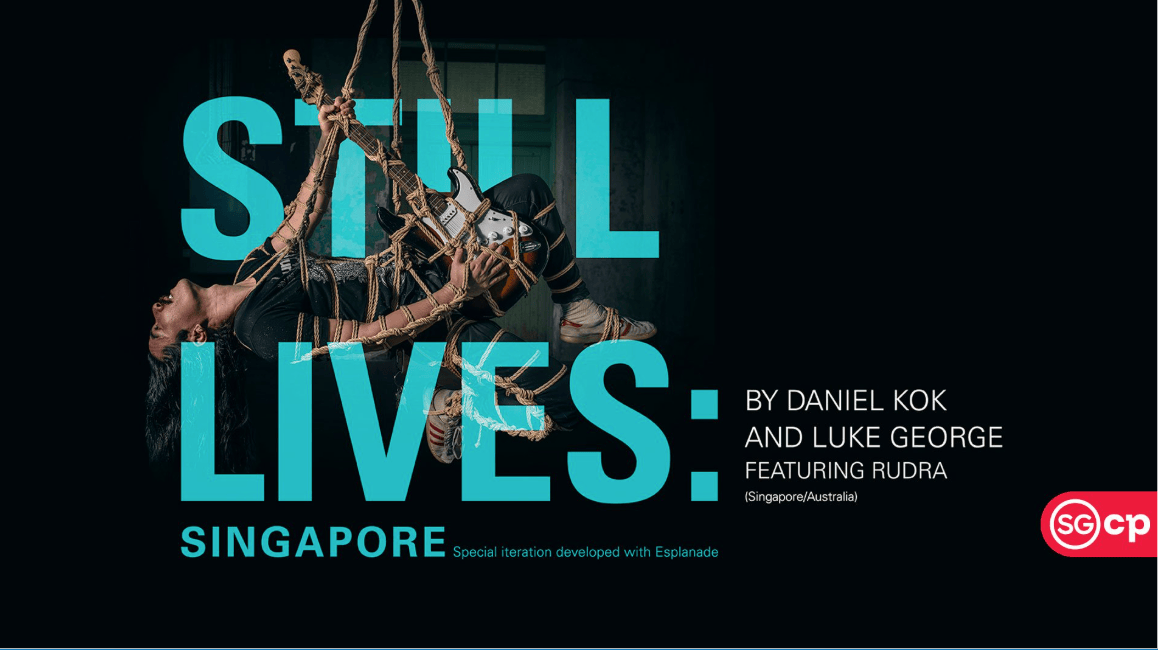

Bodies, instruments and histories held in stasis, Still Lives: Singapore turns the act of tying into a meditation on care, memory and the communities that gather around them.
Duration: ~105 minutes
What does it mean to watch a metal band that cannot play its instruments, in a theatre where nobody is quite required to sit still? In Still Lives: Singapore, four members of pioneering Vedic metal band RUDRA are gradually bound and lifted towards their suspended instruments, transforming into a living sculpture. But the spectacle is only part of the story. Around them, an eclectic audience gathers, ranging from fans, artists, members of the queer community, kink practitioners and the curious, sharing a space where a practice becomes a performance which slowly becomes an event, and watching becomes a way of being together.
Created by lead artists and performers Daniel Kok and Luke George, Still Lives is an ongoing artistic inquiry into how bodies, objects and cultural histories might be literally tied together through shibari, the Japanese art of rope bondage. Each iteration responds to the place in which it is presented. For Singapore, Kok and George turn to RUDRA, whose members have spent more than three decades developing a sound that brings together extreme metal and Vedic philosophy, alongside Indian classical modalities. Rather than simply presenting the band and its music, the work asks what happens when a particular subculture and the people who sustain it are held in place, allowing their histories to be encountered from a different perspective.

The stage is already a curious sight upon entering the Singtel Waterfront Theatre. With the usual rows of ground-floor seats removed, audiences are free to settle onto cushions near the performance, take a chair further back, or watch from the upper level. Instruments and sound equipment hang suspended overhead, creating the impression of an installation waiting to be activated. Four video screens show footage of RUDRA’s members discussing their histories, musical inspirations and preparations for the work, with the documentary offering glimpses of the people and their lives behind the music.
Kok and George introduce themselves, establishing rules, safety boundaries and offer up an invitation to the audience to move around, take photographs and find their own way of watching. The arrangement feels unusually open. Rather than asking spectators to sit in the dark and receive a finished work, Still Lives gives them a degree of agency over how they encounter and experience it.
Yet most people remain where they are. Perhaps they are conscious of blocking someone else’s view; perhaps the familiar etiquette of theatre-going encourages everyone to find a place and stay put. Whatever the reason, the small contradiction is revealing. The audience is given permission to move, but its members continue to negotiate their behaviour collectively, reading the room and one another, ourselves already suspended in stasis. The social life of the performance begins before the tying itself has properly started.

When RUDRA are introduced, the room responds with a cheer. Kok, George and sound designer and performer Marco Cher-Gibard wear the band’s shirts, a small but affectionate acknowledgement that this is a collaboration rather than an appropriation of the musicians’ image. The tying begins, and the performance settles into a rhythm of pulling, looping, checking, adjusting and tightening. Through microphones, the friction of rope against rope becomes audible, alongside the movement of rigging and the soft sounds of the equipment. Cher-Gibard’s ambient metal soundscape creates a subtle pulse beneath the action, lending the space something of the atmosphere of a concert without quite becoming one.
What might sound like an unpromising proposition, watching a process unfold over an extended period, becomes surprisingly engrossing. There is something compelling about seeing the work take shape incrementally, without the usual theatrical sleight of hand that conceals the labour behind a finished image. Kok and George work with the confidence of practitioners deeply familiar with shibari, making visible its technical precision and its possibilities as a sculptural art. They speak to the musicians as they work, checking in, adjusting their positions and attending to their comfort. The rope is not merely a means of restraining the body. It becomes a way of negotiating proximity, trust and care.

There is room for play, too. One musician lies on the floor with his eyes covered by rope; another is positioned on all fours, a guitar resting on his back as it is gently strummed. At another point, the band’s frontman is lifted slightly off the ground and allowed to rotate. These moments feel like experiments unfolding within the performance, testing what the body and its relationship to an object might allow. They are intimate without necessarily being sexual, drawing attention instead to the trust that develops over time and the process, between the people tying and those being tied. Before the bodies can become sculpture, they must first be bodies that can communicate, respond and be cared for.
As the work progresses, the winches and pulleys become increasingly conspicuous. The audience becomes acutely aware of the weight being carried: the musicians, their instruments and the equipment suspended overhead, and the precision required to keep everything in place. When the ropes tighten and the bodies begin to rise, the atmosphere takes on a genuine tension. The moment feels precarious, even as the rigging and the artists’ expertise make it possible.

Then the audience is invited to move closer. A small rush of people fills the newly available space, cushions and all. For a moment, the social choreography becomes unmistakable. The possibility of seeing something extraordinary at close range draws the crowd together, and the audience’s movement becomes part of the event itself.
The final image is striking. All four members of RUDRA hang suspended in the air, their bodies bound and their instruments held aloft, some holding them, some beside them. Lighting designer Katie Sfetkidis shifts the atmosphere towards red; fog fills the space; lights sweep across the suspended figures as a RUDRA track enters the soundscape. It is a strange reversal of the conventional metal concert. The musicians are present, their music surrounds the room, and yet they cannot simply take up their instruments and play. Their bodies and sonic identities have been arrested in a carefully composed image, held between movement and stillness.

For a band whose music depends on force, precision and physical energy, this suspension is particularly evocative. The instruments become part of the sculpture rather than tools of performance; the musicians, usually animated by music, are held in place. The result does not diminish their presence. Instead, it draws attention to their weight, their vulnerability and the decades of shared history they bring into the room. The accompanying video portraits deepen this impression, reminding the audience that these are not abstract bodies or convenient symbols of a subculture. They are men with lives beyond the stage, whose stories have unfolded alongside Singapore’s own transformations.
This is where Still Lives: Singapore becomes more than an exercise in creating a striking image. Its process is inseparable from its performance. The tying, checking, waiting and gradual lifting are not merely preliminaries to the final tableau; they are what give the tableau its meaning. The finished image carries the memory of everything that has gone into it: the labour, technical precision, conversations and trust required to arrive there. Stillness is not the absence of movement but its accumulation, the point at which countless small actions become visible as a single composition.

The work also makes the theatre itself newly perceptible. A ticketed performance space temporarily takes on the character of a public gathering place, where people can circulate, watch, photograph and share space without necessarily looking at the same thing in the same way. There is a particularly interesting tension between the artists’ invitation to move freely and the audience’s apparent reluctance to do so. Attention remains a choice, but it is a choice made in the presence of others. While the musicians are being bound together, the audience finds itself bound, more loosely, by the shared experience of witnessing them.
Perhaps this is where the work’s relationship to Singapore resides most compellingly. Not in a claim that RUDRA can stand for the entire nation, nor in an attempt to explain Vedic metal to an unfamiliar audience, but in the act of bringing a particular local history into a space where it can be encountered afresh. The band has existed for decades, carrying its own musical, philosophical and cultural commitments through a city that is constantly remaking itself. For one evening, that history is held aloft, literally and figuratively, so that it can be given time and attention.

As part of da focus – Connect Asia Now, Still Lives: Singapore exemplifies the possibilities of bringing different artistic practices and communities into conversation. Shibari, metal music, choreography, video and installation are not simply placed alongside one another; they become interdependent parts of an experience that changes how each is perceived. The result is less a conventional dance performance than a temporary world assembled around the act of gathering.
By its end, Still Lives: Singapore offers no definitive picture of Singapore, nor does it need to. Its significance lies in the encounter itself: in the histories brought into the room, the care made visible through the process, and the collective attention that gathers around a group of suspended bodies. For a fleeting moment, a theatre becomes something between a gallery, a concert venue and a public square, and a place where people who might not otherwise meet find themselves looking, listening and sharing the same space, and in such a moment, we find ourselves part of a newly forged piece of shared history and experience.

Still Lives: Singapore took place on 17th October 2026 at the Singtel Waterfront Theatre at Esplanade. More information available here
da:ns focus – Connect Asia Now ran from 15th to 18th October 2026 at the Esplanade. More information available here
Production Credits
| Lead Artists and Performers Daniel Kok and Luke George Collaborators and Performers RUDRA Sound Designer and Performer Marco Cher-Gibard Lighting Designer Katie Sfetkidis Videographer Angelo Rodriguez Production Manager Kae Yuan Technical Manager Romi Ahmad Stage Manager Stanley Ng Rigging, SB Rope Access Specialist, Rehearsal Models Anaesthesia, Bibi, _cloud, Kiv Distribution Something Great With rehearsal venue & administrative support from Dance Nucleus |

