
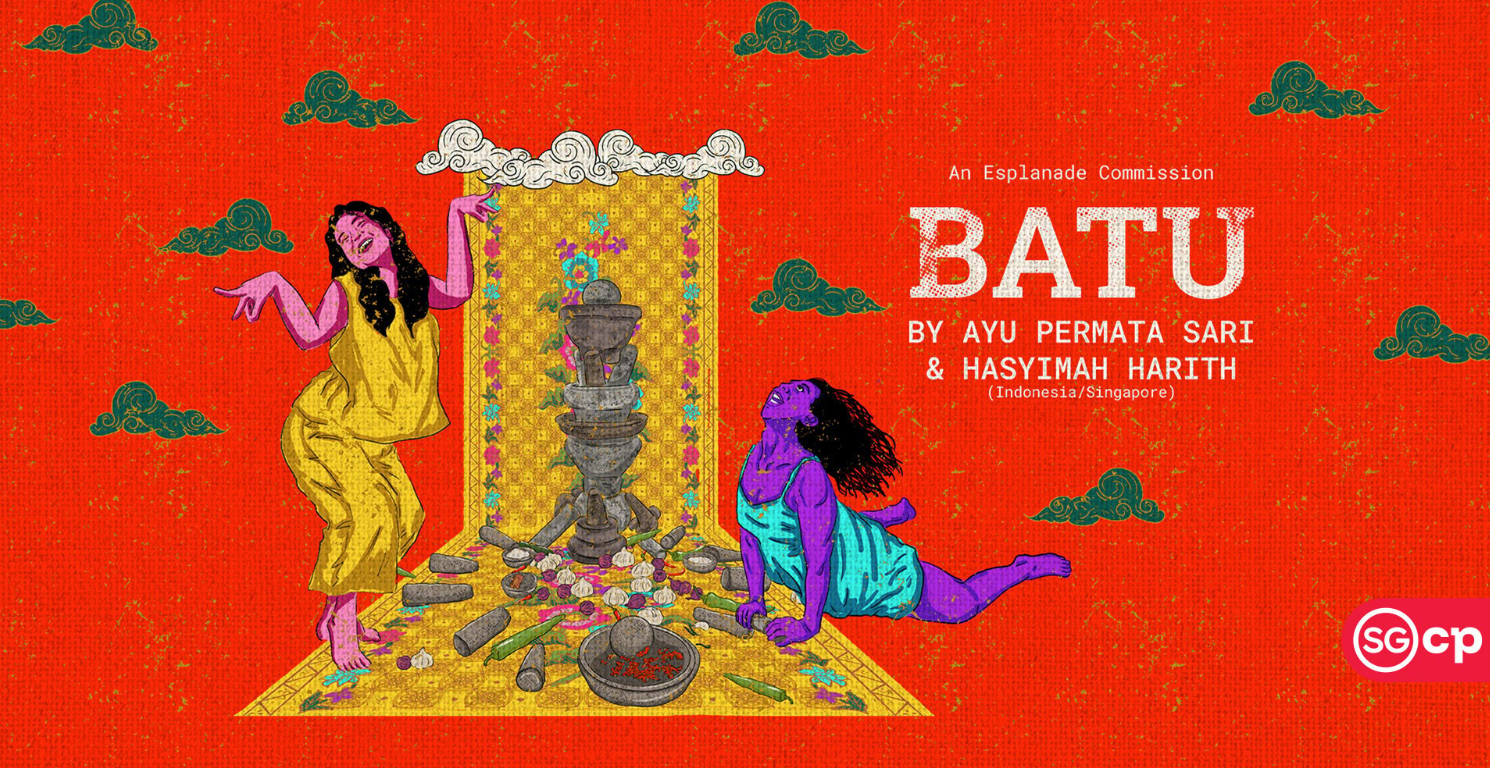
A multisensory fever dream that examines femininity in all its sorcery, esoterica, and erotica through the lens of the humble mortar and pestle, and the stories passed down from woman to woman in the kitchen.
Duration: 75 minutes
You can watch a dance, or you can feel it take hold of your body. BATU does both, pulling you into its strange, increasingly feverish world through the smell of sambal, the sound of stone pounding against stone, and two performers whose bodies seem capable of transforming into almost anything.
Co-created and performed by Indonesian choreographer Ayu Permata Sari and Singaporean artist Hasyimah Harith, BATU takes its name from the traditional mortar and pestle, an object deeply embedded in Malay domestic life. The work explores the memories, expectations and inherited knowledge carried by women through food, ritual and the body. But rather than present these ideas through straightforward storytelling, it allows them to emerge through movement, sound, smell, taste and a series of increasingly unpredictable physical encounters.
Playing as part of the Esplanade’s 2026 edition of da:ns focus: Connect Asia Now, before BATU has even properly begun, you are already participating in its world, offered a lemper ayam and accompanying sambal bawang to eat before or during the performance, a show of hospitality and a gustatory point of entry. It is an appropriately unusual introduction to an unhinged work that takes the familiar and domestic and gradually transforms it into something sensual, ritualistic, grotesque and, at times, gloriously absurd.
Created by Indonesian choreographer Ayu Permata Sari and Singaporean artist Hasyimah Harith, BATU takes its name from the traditional mortar and pestle, an object deeply embedded in Malay domestic life. The work explores the memories, expectations and inherited knowledge carried by women through food, ritual and the body. But rather than present these ideas through straightforward storytelling, it allows them to emerge through movement, sound, smell, taste and a series of increasingly unpredictable physical encounters.
The opening resembles a club, with mortars and pestles arranged across a platform space like the instruments of some strange ceremony, including a central totem. Ayu and Hasyimah flirt, groove and twerk with an infectious playfulness before sitting across from each other, flipping their outfit to produce a quick-change into an apron, before demonstrating the preparation of sambal belacan. They seemingly leave the wild life behind, and have traded it for a milder more domestic one.
The pounding begins, and they smile. and laugh. But what initially seems like an everyday domestic gesture gradually acquires the force of a ritual. The atmosphere shifts; their bodies contort and convulse beneath increasingly eccentric lighting, and as it flashes, like strobe lights in a club, giant chillis become monstrous appendages, they grunt and groan as they physically transform, convulse and writhe. Suddenly, these two women seem possessed by something beyond themselves.
And then, just as the work threatens to settle into one interpretation, it pulls the rug out from under itself. Literally. The performers return to the batu, but their relationship with it changes yet again. They cradle it, coo at it, massage each other with it and roll it along each other’s bodies without using their hands. Play becomes intimacy; intimacy becomes wrestling, spanking and something unmistakably erotic. In one particularly striking moment, Ayu sustains a long guttural note while Hasyimah balances a batu on her chest before letting it fall, the pestle rolling past her thighs, in a gesture that evokes the strange physicality of childbirth.
Elsewhere, wilder still, Hasyimah begins to eat raw chilli, to gasps from the audiences. Ayu eggs her on, while a chant builds around her, turning an ordinary ingredient into something almost sacrificial, a competition, a means of proving herself, even as tears well up in her eyes. They kick the batu around, like a soccer ball, letting out burps and allowing their bodies to produce its natural orchestra. It is a show that is essentially batshit crazy, but not without purpose.
What makes BATU so compelling is the way Ayu and Hasyimah transform before us. Their bodies move between roles and states of being, from playful to monstrous, nurturing to confrontational, tender to unabashedly lustful. The batu is alternately a tool, a burden, a partner, a child, a witness and something closer to a sacred object. These meanings are never pinned down, and the performance is all the better for it.
It is liberating to watch these women allow their bodies to be noisy, excessive, grotesque and entirely ungraceful, without immediately apologising for it or trying to make themselves beautiful again. Burping is an involuntary, thoroughly ordinary bodily function, yet it can feel almost transgressive when brought into the theatrical space, where bodies are usually expected to be controlled, composed and aesthetically pleasing. Here, the grotesque becomes a kind of freedom. Within the strange, almost ritualistic world of BATU, the performers seem to inhabit a space in which they can be primal, bodily and unapologetically human, without having to sanitise themselves for our consumption.
For a work concerned with the expectations inherited by women, this feels particularly potent: these are bodies that can nurture and give birth, but also burp, lust, contort, dominate and repel. They need not be graceful or desirable at every moment. They are allowed to simply be. As such, it would be too easy to read the work as a meditation on motherhood, womanhood and the domestic obligations inherited across generations. Those themes are certainly present: the kitchen becomes a space where women pass down knowledge, but also where expectations about femininity are reproduced. Yet BATU is far more interested in what happens when women take possession of these inherited symbols and play with them, distort them and make them their own. The body becomes a site not only of memory and obligation, but of desire, pleasure and resistance.
This is where the work’s refusal of literal storytelling proves particularly effective. Rather than instructing us on what to think, it lets images, gestures and sensory associations accumulate. The result is occasionally bewildering, but rarely dull, and always fun. The audience is drawn into a process of interpretation, left to negotiate the shifting meanings of an object that seems to become something different every time it is touched.
The multisensory elements help make that experience feel immediate rather than purely intellectual. The smell of sambal, the sound of pounding, the taste of chilli and the performers’ direct engagement with the audience all reinforce the sense that cultural memory is something experienced through the body, not merely inherited as an abstract idea. We are not simply watching the batu acquire meaning; we are being invited to encounter it through our own senses and associations.
Most of all, there is something liberating about watching Ayu and Hasyimah surrender to the full range of what their bodies can express. They are not confined to being mothers, dutiful women, bearers of tradition or symbols of cultural identity. They can be ridiculous, frightening, affectionate, aggressive, sensual, grotesque and strange. Their physicality gives these contradictions room to coexist, without demanding that they be resolved into a neat narrative.
BATU may occasionally leave you wondering exactly what you have just witnessed, but that uncertainty feels integral to its appeal. This is a work that trusts movement and metaphor to do what words cannot, allowing the familiar to become uncanny and the domestic to become something wild. By the end, the humble mortar and pestle has become almost unrecognisable, and so too, delightfully, have the women wielding it.
BATU played from 16th to 18th October 2026 at the Esplanade Theatre Studio. More information available here
da:ns focus – Connect Asia Now ran from 15th to 18th October 2026 at the Esplanade. More information available here

