

Moments stretch, reverse and repeat through magic, circus and dance in this frustratingly slow meditation on time.
Time is supposed to be objective, but more often than not, it is deeply relative; stretching, compressing and slowing according to emotion, attention and memory. Presented as part of the 2026 Singapore International Festival of Arts, Tempo takes that idea and turns it into a performance experiment, where moments linger unnaturally long, bodies appear suspended between movement and stillness, and time itself seems to lose its usual rhythm. In many ways, this is exactly the sort of boundary-pushing work suited for an arts festival, stretching not only time itself, but also conventional definitions of performance and theatre.
Conceived by director Kalle Nio and choreographer Fernando Melo, the production blends dance, illusion, physical theatre and spoken text into a meditation on temporality that is at once visually mesmerising and frustratingly inert. And while Tempo involves choreography, it exists somewhere beyond dance alone, incorporating Nio’s background in magic and illusion alongside text by writer Harry Salmenniemi.

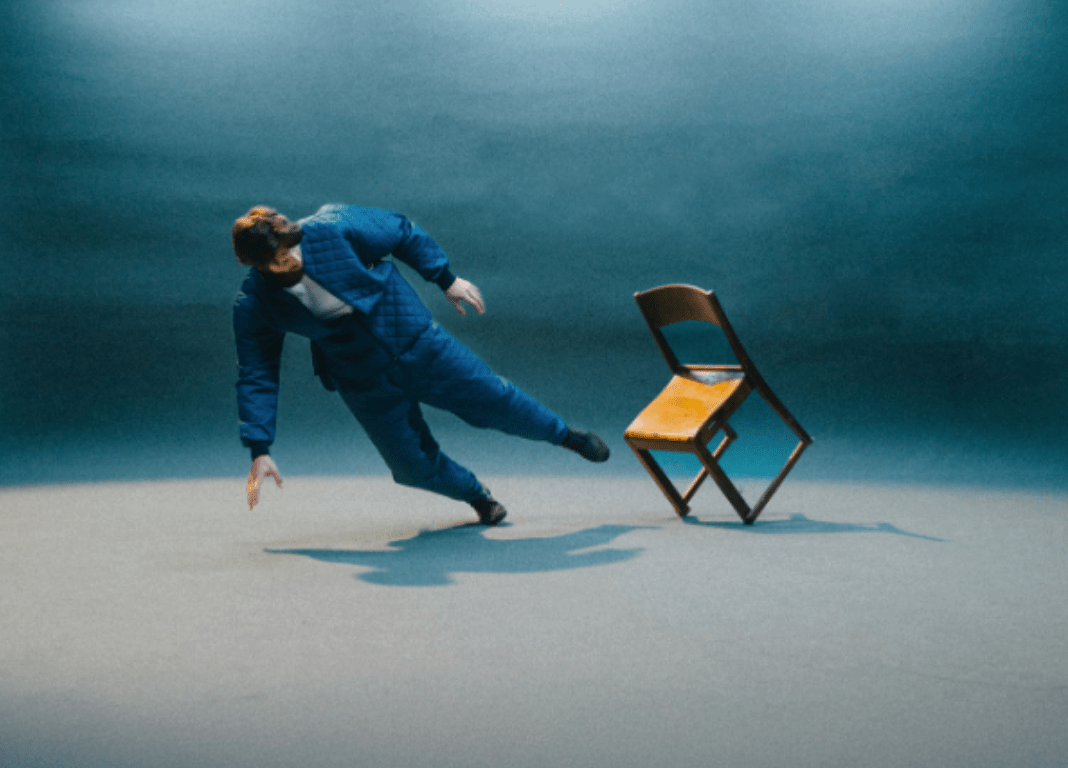
What keeps Tempo compelling, even at its most frustrating, is the astonishing precision of its performers. Against the droning compositions of composer and sound designer Samuli Kosminen, performers Barbara Kanc, Luigi Sardone and Winston Reynolds execute physically demanding sequences with near-impossible control. The production alternates between Salmenniemi’s omniscient voiceover and wordless scenes where time appears suspended: dancers move in extreme slow motion, hold impossible balances mid-fall, or seemingly teleport across the stage through split-second blackout transitions. Elsewhere, objects hover in mid-air, suspended by nearly invisible threads that create the uncanny impression that gravity itself has loosened its grip.

Visually, the production is often breathtaking. Nearly every frame of Tempo feels like a still photograph worthy of a gallery wall: chairs stacked into surreal formations that leave the semblance of afterimages, bodies frozen at impossible angles, figures suspended between collapse and stillness. Melo’s choreography and Nio’s illusion work merge seamlessly into images that feel dreamlike, absurd and strangely sculptural. The production’s strongest moments emerge not through narrative, but through these carefully composed ruptures in perception, where ordinary gestures and near-accidents are stretched into something uncanny and monumental.

Yet for all its conceptual sophistication and technical accomplishment, Tempo is also exhausting. At just under an hour, the production somehow feels far longer, not simply because it successfully manipulates the audience’s perception of duration, but because it often mistakes slowness for profundity. What begins as hypnotic gradually becomes laborious, asking audiences to admire precision without offering enough emotional or intellectual momentum to sustain it.

Part of the problem lies in the production’s reliance on abstraction over emotional connection. Though Tempo gestures toward vague existential reflection and the fragility of life, there is little dramatic or emotional anchor beneath its imagery. Salmenniemi’s text ultimately proves the production’s weakest element. Its philosophical musings on endings and temporality feel less revelatory than insistently abstract, repeatedly interrupting the visual momentum rather than deepening it. Long stretches of narration drain tension from the performance instead of enriching its atmosphere, particularly early on, where the work feels as though it is buying time rather than exploring it.

Ironically, the closer Tempo moves toward stillness, the more fragile its illusion becomes. Small imperfections, such as a barely visible string, a performer shifting just a little too slow out of position, a slowed movement momentarily losing consistency, puncture the carefully sustained spell. In a more intimate black box venue, these details might have disappeared into proximity and atmosphere. But atop the large Drama Centre Theatre stage, the surrounding emptiness occasionally swallows the production whole, making the stage feel less transcendent than hollow.

Still, there is something undeniably admirable about Tempo’s ambition. The sheer discipline involved in maintaining its intricate illusions and hyper-controlled movement is remarkable, and there are moments where the production genuinely succeeds in destabilising the audience’s sense of time and physical reality. But the work also raises an unavoidable question: can technical precision alone sustain emotional resonance? Tempo is easier to admire than to surrender to: a striking gallery of moving images that never fully discovers why they need to become theatre.

Yet perhaps that too speaks to the relativity at the heart of the production itself. Just as time stretches or contracts depending on who experiences it, so too does art. For some, Tempo’s suspended moments may feel profound and transcendent; for others, they may feel interminable, emotionally distant, or self-consciously abstract. The production succeeds most not as a definitive statement on time, but as an experiment in perception, revealing how differently audiences measure meaning, feeling and duration for themselves. In that sense, perhaps Tempo ultimately proves its own thesis: that neither time nor art is ever truly objective, only experienced.
Photos Courtesy of Kalle Nio
Tempo played from 15th to 17th May 2026 at the Drama Centre Theatre. More information available here
SIFA 2026 runs from 15th to 30th May 2026. More information and tickets available here
Production Credits
| Director Kalle Nio Choreographer Fernando Melo Writer Harry Salmenniemi Composer and Sound Designer Samuli Kosminen Performers Barbara Kanc, Winston Reynolds, Luigi Sardone |

