

Surreal, interactive series of experiential light installations that turn physics into magic, ideal for younger audiences.
For those who have never quite learnt about reflection and refraction in science class, interactions with light can feel like pure magic. That sense of innocent mystery is exactly what Patch Theatre harnesses in The Lighthouse, an experiential promenade work that guides audiences through a series of interconnected rooms and installations, each inviting them to play, experiment, and explore.

Installed across The Arts House for the Singapore International Festival of Arts 2026, audiences begin by ascending a staircase towards a faint purplish glow. At the top sits a decorative cluster of illuminated baubles, each adorned with tiny human figurines perched atop them as though standing on miniature planets. It is a quietly whimsical opening image, one that immediately frames the evening less as a conventional story and more as an invitation into a child’s imagination, a suggestion that each individual occupies their own tiny world, waiting to be explored.

The Lighthouse is less interested in narrative than sensation and exploration. Instead, the production loosely evokes the feeling of a cosmic expedition: audiences wander through unfamiliar spaces guided only by curiosity, much like astronauts or travellers charting strange new terrain. The recurring imagery of stars, planets, darkness, and drifting light gives the experience an almost interstellar quality, as though the audience is collectively journeying through a miniature universe built out of reflection and shadow.

Entering Gallery II, each audience member is handed a small torch that shifts intermittently between ordinary and UV light. Inside the darkened room, children excitedly sweep their beams across the floor, revealing hidden glow-in-the-dark markings etched into the carpet, discovering constellations, galactic symbols, and mysterious traces otherwise invisible to the naked eye. Elsewhere, textured reflective plates are perched, for a yet to be revealed significance.

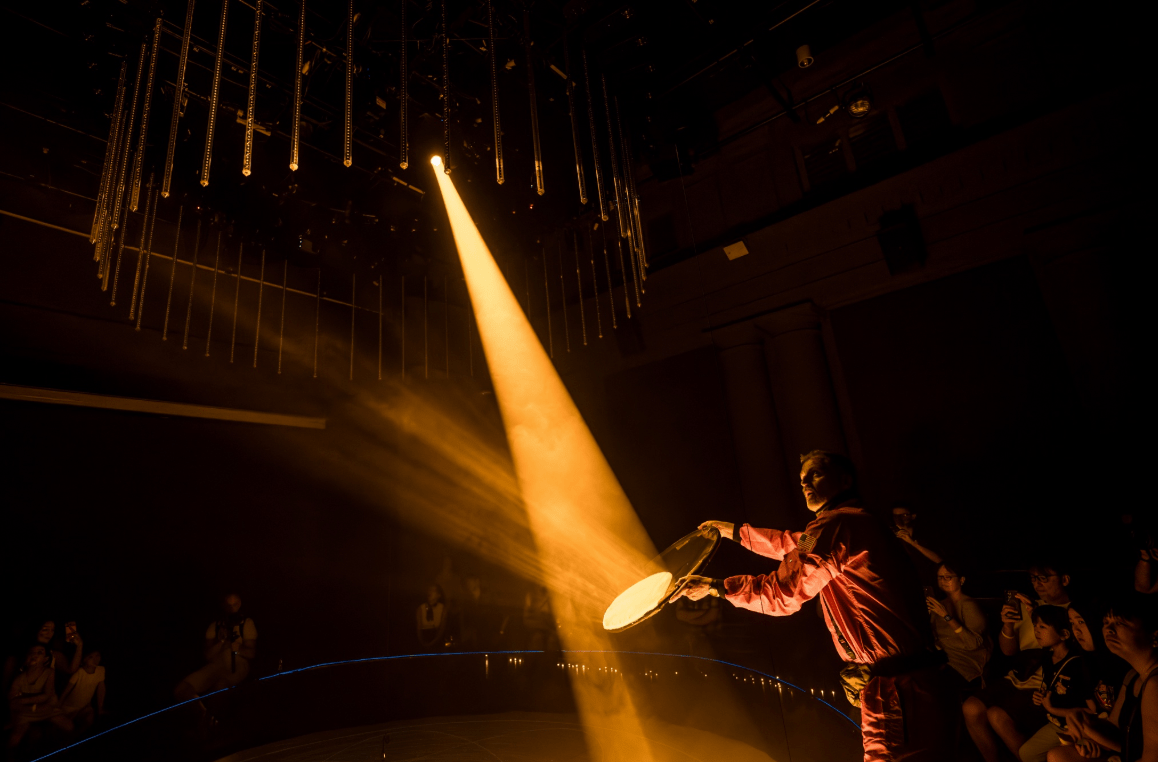
The room gradually comes alive with performers. An astronaut (Vincent Crowley), initially almost hidden within the darkness, suddenly rises and gestures silently for the audience to follow. Without dialogue, he becomes less a character than a fellow explorer, discovering the environment alongside the audience rather than leading from ahead of them. As he experiments with the reflective plates to bend and split beams of light, the production gently reframes scientific principles as acts of play and discovery.

Traversing the building, we arrive at the Play Den, reconfigured into a circular arena. Here, the astronaut encounters another figure seemingly from another world (Zoë Barry). The pair remain entirely non-verbal, communicating instead through movement and light. Swinging a torch like a pendulum, they create fleeting drawings and messages etched across the floor from simple greetings to illustrations, before allowing the swinging light to blossom into larger abstract patterns resembling miniature supernovas. There is something evocative here about connection across distance: strangers who cannot speak communicating through gesture, rhythm, and shared wonder and humanity.

The journey continues into the Living Room, split into two contrasting segments. In the first, towering above even the adults, Cheryl Charli appears with striking red hair and an elaborate tube-like costume through which glowing balls roll and tumble. Children immediately rush to collect them, turning the interaction into an instinctive game of participation and discovery. Carrying these illuminated spheres into the next chamber, a cavernous black tent, audiences listen to a childlike voiceover musing curiously about light and the universe. Suddenly, darkness descends completely, and tiny “fireflies” dart rapidly overhead, producing one of the production’s more enchanting moments. The sequence captures the feeling of encountering something vast and unknowable through the eyes of a child: intimidating for only a second before wonder takes over.

From there, audiences enter the Chamber, where a winged figure greets them gently before exchanging their glowing balls for handheld mirrors. These mirrors become the centrepiece of the Blue Room next, where children are encouraged to experiment with reflections much as the astronaut had earlier. Light beams fracture and multiply across the walls before transforming into circles projected onto the floor, prompting audiences to follow them, cross paths with one another, and interact spontaneously. Eventually, the mirrors are assembled onto a small branching structure that forms a glittering reflective orb, while audience members are handed looping light devices that create spinning circles of light when swung through the air.

The experience concludes back in the Play Den with a gentle finale. A cellist (Barry) performs live while machinery in the centre slowly generates giant soap bubbles that drift across the space. Around them, children continue spinning their lights in widening circles, almost as though participating in a shared visual language with the performers and musicians. Overhead, poles of light have been programmed to form multiple patterns, a computerised, seemingly alive set of light movements that blur the line between the artificial and natural, at times appearing like a deluge of rain. As smaller bubbles suddenly fill the room, the atmosphere becomes unexpectedly calming, less a theatrical climax than a communal moment of quiet awe. Upon exiting, audiences return the looping lights and receive a small finger light bearing the Patch Theatre logo as a souvenir, a simple but thoughtful keepsake that extends the experience beyond the performance itself.

As an adult viewer, The Lighthouse feels very specifically calibrated towards children and families rather than broad all-ages appeal, but that focus is also precisely where its strengths lie. The absence of a conventional storyline may leave some adults searching for firmer narrative cohesion, yet the production seems intentionally designed around guided free play rather than linear storytelling. In many ways, the joy comes less from following a plot than from observing children navigate the installations with genuine curiosity and delight.

Patch Theatre’s commitment to creating an environment of tactile wonder remains evident throughout. The Lighthouse ultimately succeeds not through conventional explanation, but by restoring some of the mystery of light, framing exploration itself as the experience’s true destination. Through planets, darkness, reflections, and wandering pathways, the work gently reminds audiences that discovery often begins simply with stepping into the unknown and allowing curiosity to guide the way.
Photos Courtesy of The Arts House Group
The Lighthouse plays from 15th to 24th May 2026 at The Arts House. Tickets available here
SIFA 2026 runs from 15th to 30th May 2026. More information and tickets available here
Production Credits
| Creators Geoff Cobham, Michelle ‘Maddog’ Delaney, Chris Petridis, Meg Wilson, Zoë Barry, Daisy Brown, Jason Sweeney, Wendy Todd, Clara Grant Costume Design Renata Henschke Costume Construction Seana O’Brien Set Construction James Dodd 2026 Singapore cast Zoë Barry, Vincent Crowley, Cheryl Charli, Vanessa Toh |


One thought on “Theatre Review: The Lighthouse by Patch Theatre (SIFA 2026)”