
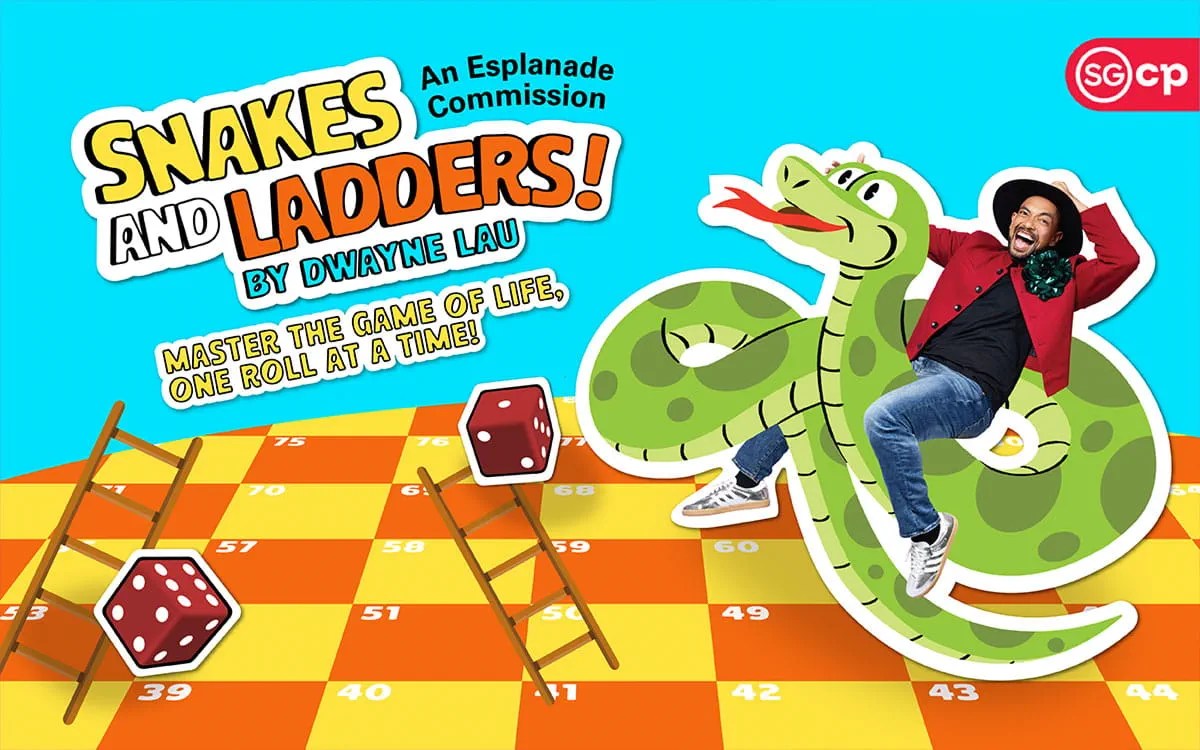
For actor and musical theatre performer Dwayne Lau, his original work Snakes & Ladders! is a way of re-living, re-framing, and re-negotiating the unpredictable shape of a life that has unfolded very much like the board game at its centre. What began as a 40-minute showcase at the Esplanade Concourse has now grown into a full 90-minute theatrical experience a year later. But for Dwayne, the most significant change is not scale, but depth.
“It’s definitely longer now. It’s a full 90-minute show and I have incorporated new stories. I have deepened some of the existing stories that were there,” he explains. Yet even as the material expands, the core idea remains unchanged: life is not linear, and theatre, like life, should reflect that fragmentation rather than smooth it over.
That philosophy is also what shaped the show’s unusual structure. Audiences roll giant dice to determine Dwayne’s movement across a life-sized Snakes and Ladders board, triggering songs, stories, sketches, and moments from his personal and professional past. But what looks like randomness is, in his words, carefully designed.
“It feels random, but it actually is carefully placed. There’s a certain narrative structure that I know is there.” This tension between control and chaos sits at the heart of the work. Dwayne originally conceived the piece through the lens of “games we play”, before landing on Snakes and Ladders as a childhood memory shared with his mother. “It came from an element of fun first,” he recalls, “but then as I was sharing my stories, I thought that life is really not all about fun.”
That evolution led him toward a clearer thematic spine built around resilience, what he calls “rolling with the punches”, but he resists turning the show into a straightforward narrative arc. Instead, he keeps it structured as a montage, deliberately echoing how memory itself works.
“We don’t experience life in a linear fashion. Sometimes it’s joy, sometimes it’s fear, sometimes it’s grief, sometimes it’s disappointment, sometimes it’s an achievement,” he says. “I like the idea of just going in and out of different experiences.” Even in the expanded version, he is careful to preserve that sense of fragmentation, because for him it feels closer to emotional truth than any neatly structured storyline ever could.
Much of that emotional truth is rooted in deeply personal material, particularly the loss of his father, which remains central to the work. In rehearsal, revisiting those moments continues to affect him in ways he does not attempt to control. “Most definitely it makes me feel emotional,” he says simply. “During one of the rehearsals when I was delivering the lines, I got emotional. I allow that emotion to show. I may tear. I don’t know what happens, because the emotions are like waves, they just hit you randomly.”
What emerges is performance that doesn’t distance him, but keeps the memory close, keeps it alive rather than merely containing it. “I want to honour my dad’s memory. I want to honour his legacy. He supported me in my journey as an actor. He always showed up at all my shows.”
That openness extends into a broader philosophy of vulnerability that underpins the entire production. Dwayne speaks candidly about grief not as a singular event, but as something that must be lived with and processed over time. “As Asians, sometimes we don’t really talk about grief, we don’t really sit in our feelings,” he reflects. “We think that we should move on faster. But I constantly want to champion that it’s fine to sit in your grief. It’s fine to go through something.”
For him, the audience’s response to these moments has been unexpectedly affirming. “I realised that people are invested in these emotions. They are willing to listen to your story.” In that sense, the show becomes less about revelation and more about recognition, a shared space where private experiences become collectively understood.
The unpredictability of the format reinforces this idea of shared experience. Because audiences physically control the dice rolls, every performance unfolds differently, sometimes in ways even Dwayne cannot anticipate. He recalls one rehearsal where the structure collapsed entirely because the players reached square 100 far too quickly. “It was only half an hour into the show and I was like, ‘Oh my gosh, what do I do now?’” he laughs. “Do we restart the game?” That uncertainty is not a flaw in the system, but its defining feature. “We really cannot control it. We just have to figure it out when we are there. And I guess that’s the fun and excitement of it.”
That sense of improvisational resilience mirrors Dwayne’s broader outlook on life, particularly in moments of real-world crisis. He recalls, for instance, preparing for rehearsals of Charlotte’s Web while his sister underwent surgery for stage one colon cancer, a moment that coincided painfully with memories of his father’s passing two years earlier. “I was literally going into a theatre while she was going into the operating theatre at the same time,” he says. “We embraced the fear, the frustrations, the anger. But after that, you’ve just got to find ways to work around it.”
The experience, which ultimately ended in his sister’s recovery, became another unplanned “snake” that forced him to reapply the same philosophy the show explores: there is no avoiding uncertainty, only learning how to move through it.
That belief also extends into how he understands success itself. After nearly two decades in the industry, Dwayne has begun to interrogate the idea more deeply through the process of revisiting his own life on stage. “What does success really mean? What do we leave behind? Was it worth it?” he asks. “There were some choices that could have been made better, but as time has gone by, I realised it’s important to prioritise what really matters as you grow older.” In this sense, Snakes & Ladders becomes a form of ongoing self-interrogation, resisting easy closure rather than seeking it.
Despite its emotional weight, the production is equally defined by its playfulness. Influences like the late Jonathan Lim and sketch-based works such as Chestnuts inform its tone, blending parody, musical theatre, improvisation, and audience interaction into a deliberately unstable theatrical language. “Life is never linear,” he says. “One day you’re up, the next day you can be at rock bottom.”
Yet even at its most chaotic, the show is designed to remain accessible and inviting, never tipping into despair. “I didn’t want audiences to leave thinking ‘poor thing’,” he says. “I want them to think, ‘wow, you managed to get out of it, maybe I can do it as well.’”
Ultimately, what Dwayne is building is not a conventional narrative arc, but a lived experience shared between performer and audience, shaped by chance, memory, and emotional honesty. He hopes audiences leave not with answers, but with perspective, a sense that their own lives, with all their unpredictability, are not failures of structure but expressions of it.
“I hope everybody will be able to embrace each season of their lives,” he says. “Be it climbing up the ladder or sliding down the snake.” And perhaps most tellingly, he adds: “There’s no point sitting in where you are because then you’ll never be able to play the game to get up to 100.”
Snakes and Ladders! plays from 29th to 31st May 2026 at the Esplanade Recital Studio. Tickets available here
Flipside 2026 runs from 29th May to 7th June 2026 at the Esplanade. Tickets and full programme available here

