
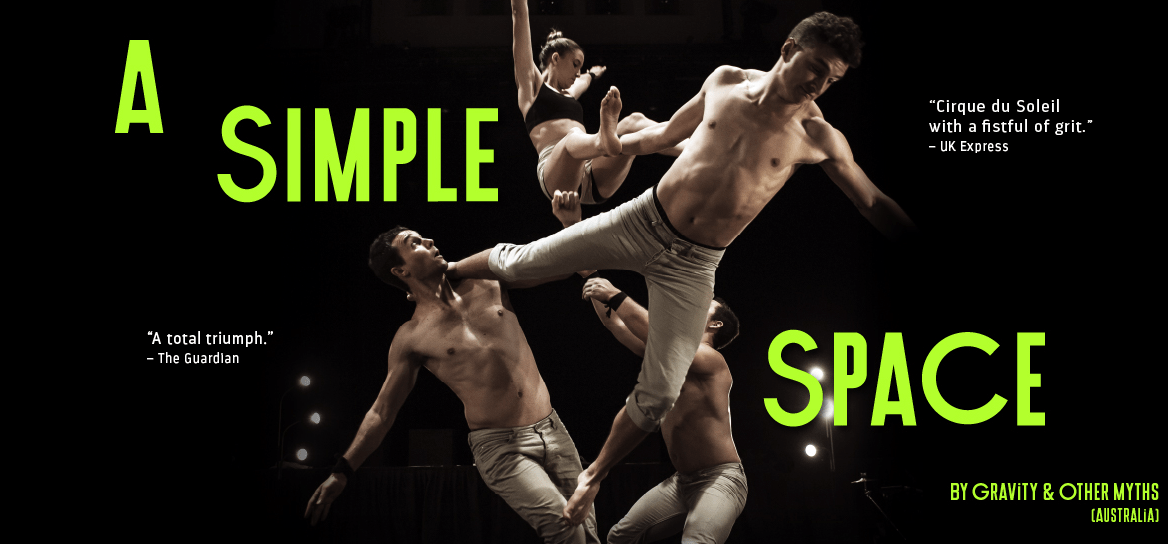
When A Simple Space first premiered in 2013, contemporary circus was undergoing a global shift. Traditional big-top spectacles and variety-style performances were still dominant, shaped in part by the influence of companies like Cirque du Soleil, with their elaborate staging, narrative framing, and theatrical spectacle.
But for co-creator and performer Lachlan Binns, the goal was to go in the opposite direction. “We made the show in 2013, about 13 years ago now,” he explains. “Contemporary circus was on the rise around the world, and there was this idea of circus as a variety show; big tents, lots of different acts, unicycles, trapeze, traditional circus skills. We love that. As performers ourselves, we’re excited by acrobatics, climbing on each other, and the huge amount of variety within that one small part of circus.”
Rather than expand outward into spectacle, the creative team narrowed their focus. They deliberately removed narrative, characters, and excess production elements, choosing instead to centre the raw physicality of the performers. “We got tunnel vision,” he says. “We decided deliberately not to tell a story, not to have characters, and not to have too many production values. It became all about the acrobatics.”

Behind that decision is a simple but powerful idea: the fascination of watching real people do extraordinary things. “There’s something about stumbling across someone doing something in the street,” he says. “It can be almost more impressive to see a normal person doing something incredible than a fantasy creature. We wanted to focus on the human part of it on stage, and that’s how A Simple Space became what it is.”
That focus on humanity has helped the show transcend language and cultural barriers over its extensive international touring life. “You don’t have to be part of Western culture to engage with the work,” Binns notes. “We’ve had such different responses depending on where we are. In Europe, where audiences see a lot of contemporary art, people are very appreciative and very visceral in their responses: the cheering, the gasping. All over the world, people are impressed by the acrobatics.”
A defining feature of the production is its intimacy. With the audience seated close enough to hear breath, see sweat, and witness every wobble and strain, the performance becomes less about polished perfection and more about shared human effort. “You can hear someone breathe and see the sweat dripping down their face,” he says. “Everyone’s tried to lift a heavy box into a car or do a workout before, so you recognise that effort. These are real people just like you.”

That closeness is no accident. The staging deliberately surrounds the performance space on three sides, allowing audiences not only to watch the performers but to see each other reacting as well. “People are smiling, clapping, laughing,” he says. “It becomes a celebration of what’s happening in the middle.”
The origins of that energy go back long before the show itself. The original seven members of Gravity & Other Myths trained and studied together for years, building both their skills and their relationships long before A Simple Space was created. “We were friends for almost 10 years before we made the show,” Binns says. “We always had competitive games and training together. Like they say, when you play together, you stay together. When you have fun, you don’t want to stop. So we started making shows that reflected that, and put the fun, the joy, and the games into the work.”
That philosophy extends into the structure of the performance itself. With minimal set design and no elaborate technical systems to rely on, the show depends entirely on the performers’ physical abilities and trust in one another. “We can’t compromise on overhead height,” he explains. “We rely on the content and choreography to carry the show. There aren’t scenic elements to create atmosphere or narrative. Everything comes from physical preparation.”
That stripped-back approach also introduces risk and spontaneity. With bodies constantly in motion, swinging, climbing, balancing, mistakes can happen, and the performers must be ready to respond instantly. “Sometimes things go wrong,” he admits. “And because the space is small, the team has to be very quick to catch you when you fall. There’s a huge level of trust involved, and someone is always there to save you.”

That trust is not accidental, but built through years of shared practice. “There’s a pretty universal language of trust when you train in acrobatics,” Binns says. “And whether it’s someone we know we bring in, or someone completely new comes in, we build that trust slowly. We don’t give them everything at once, it’s step by step process, with communication and preparation. If you get the casting right, it works. It’s a non-negotiable.”
While the core ensemble has remained largely consistent, occasional new members bring fresh energy and perspective. “Sometimes when you’ve worked together a long time, you can get complacent,” he says. “A new person can be a good reminder to rebuild that trust and stay attentive.”
Over time, the show has also evolved physically. While its core structure remains the same, individual acts have shifted depending on the performers’ skills and bodies. “The journey is still the same,” he explains. “But the acts can change to suit the people in the show. New performers often come in at a higher skill level now, so over ten years the acrobatics have become even more impressive.”
As an artist-led company, Gravity & Other Myths places strong emphasis on creative agency and collaboration. Performers are not only interpreters but active contributors to the work. “We’re an artist-led company,” Binns says. “We give people agency and creative control. When we make new shows, artists have a lot of say. We prioritise their comfort, their ideas, and their creative voice.”
At its core, though, A Simple Space remains rooted in something simple: connection. “It’s about a group of people doing something they love together,” he reflects. “It’s about care, trust, and coming together to do something amazing with your friends and community. And also having a good time and not taking it too seriously.”
In an age of increasingly elaborate spectacle, A Simple Space continues to find power in restraint: in sweat, breath, balance, and the shared joy of watching humans push each other, literally and figuratively, to extraordinary limits.
A Simple Space plays from 29th to 31st May 2026 at the Esplanade Theatre Studio. Tickets available here
Flipside 2026 runs from 29th May to 7th June 2026 at the Esplanade. Tickets and full programme available here

