
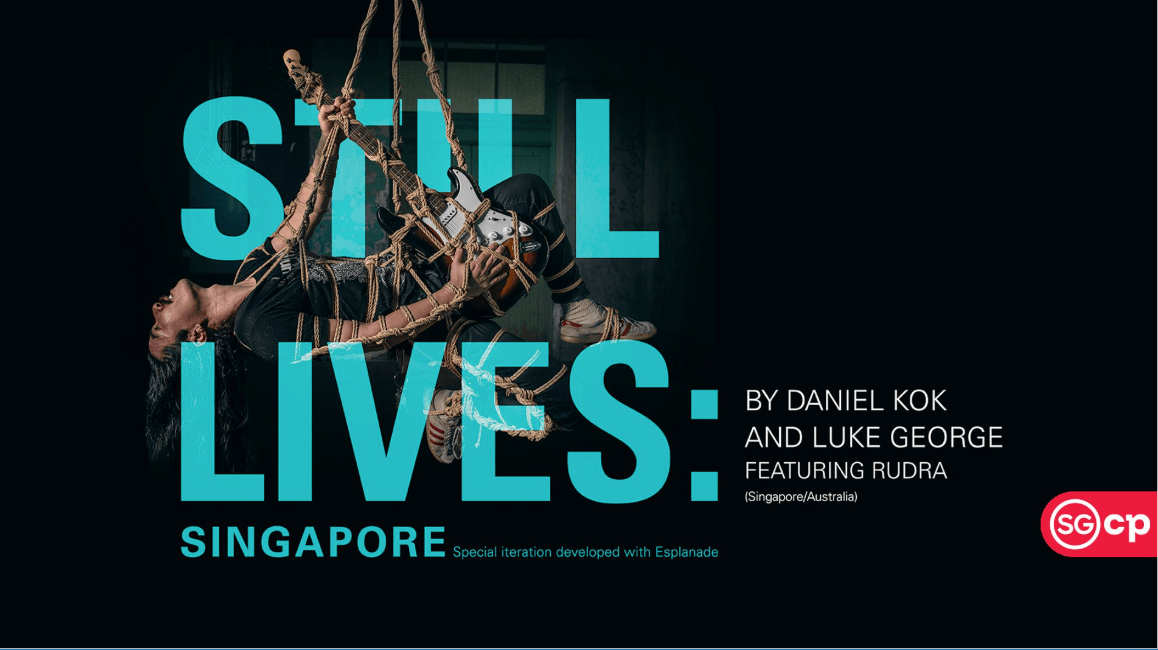
A performance called Still Lives might sound, at first, like an exercise in holding still. But for artists Daniel Kok and Luke George, stillness is only the beginning.
Built around rope, bodies, objects and the act of carefully binding people into sculptural compositions, Still Lives is less a fixed work than an evolving encounter with each place it enters. Since its beginnings during the pandemic, Kok and George have repeatedly adapted the project to the people, histories and cultural questions of the cities where it is presented. In Melbourne, they worked with Australian Rules football players. In Florence, they collaborated with people to recreate a Baroque sculpture. In Brisbane, they worked with punk bands.
For its Singapore iteration at Esplanade, the artists turned to RUDRA, the pioneering Singaporean Vedic metal band whose history stretches back to the 1990s. “This is the way the work is supposed to be,” Kok says, referring to the larger-scale Still Lives: Singapore that audiences will encounter at the Singtel Waterfront Theatre. An earlier version, Still Lives Marina Bay, was created specifically for a Singapore International Festival of Arts (SIFA) presentation in a more limited bar setting. “That was a much smaller version,” he explains. “We didn’t know if there was interest, and adapted the work to test it out for SIFA after we got the invitation.”
Now, he says, the artists are glad to be able to realise the work “in the way it’s meant” to be experienced, hence the more all-encompassing name of Still Lives: Singapore. “There are many reasons and lots of backstory to the series,” Kok says. “The work was intended to be different every time we make it.”
More specifically, the project emerged from an interest during Covid, in what it might mean to create performance that could respond deeply to its surroundings, rather than making a finished work and simply taking it from one city to another. “As artists we were interested in what performing speaks to a place in particular,” he says. “Not a question of making a finished work, touring it, that changes. Can we work more slowly and in conversation and deeper engagement with the way that the work comes into contact with a place?”
Each iteration begins with a question: what person, object, movement or cultural icon might say something about the place they are entering? In Singapore, the first thought was sport, an area they were already familiar with in previous iterations. Kok explains that sports figures seemed an obvious way of thinking about Singaporean identity and aspiration, particularly in a small country where only a handful of athletes have become nationally celebrated. “It’s more a part of how we think about ourselves and the aspirations in Singapore as a small place, where we don’t have so many sports personalities, and the few we do have, we might even question what counts as a truly ‘Singaporean’ athlete.”
But as he and George talked, they began looking for something less expected. Then they found RUDRA. The band’s history offered a more unique way into exploring Singapore. way into those questions. Kok was particularly interested in their experience of growing up in Marsiling, and in the kind of Singapore that shaped them through the 1990s and 2000s. “They’ve been around a long time,” he says. “As a group of Singaporeans and musicians, they have grown up together, and the Singapore they grew up in, and it’s a Singapore I understand very well.”
He describes a period when Singapore was repeatedly defining itself as a developed country, gaining confidence in the idea that it had “arrived”. But RUDRA’s individual stories also run alongside that larger national narrative. “I was interested in picking up more on what this journey has been like for them, and their individual experiences running in parallel to the national identity,” he says.
For George, the encounter with RUDRA has been especially revealing because he entered it without Kok’s existing familiarity with the band or Singapore. :This is very fresh and new to me,” he says. “Coming into the conversation with RUDRA totally green, and that’s an interesting point of view.”
The difference in their perspectives has become part of the collaboration. When George worked on the Melbourne iteration, Kok entered as the outsider, bringing a broader perspective. Now, in Singapore, that relationship is reversed. George was immediately drawn to what he calls the “incredible meeting point” between RUDRA’s combination of Sanskrit philosophy and death metal, and the artists’ own medium of rope. “It’s an unlikely fusion,” he says. “And what we’re doing with rope and bondage and suspension, and a metal band, is very unlikely too.”

He is curious not only about RUDRA as musicians, but about “who they are culturally and what they carry philosophically and spiritually”, and how those things intersect with death metal as both musical practice and subculture, and even the physical connection. “Metal music requires such precision and body and breath control and focus,” George says. “And that is a beautiful marriage of rope as well, which shares a similar focus on precision and breath and stillness.”
That idea of stillness is embedded in the title itself. Still Lives is a term that borrows from visual art and paintings, but Kok was attracted to the contradiction contained in the phrase. “It’s an oxymoron,” he says. “The contradiction is interesting to us in the practice of shibari specifically, and thinking about movement in relation to shibari.”
When a body is bound, it may appear to be held completely still. But the process of getting there is anything but static. “If you took two hours to tie a group of people up just to recreate a moment or still image, there’s still a lot of movement involved,” Kok says. “That title came to us quickly, and it coheres quite well as to how we think about shibari as a practice and performance strategy.”
George pushes the idea further. The rope is not merely a technical device or visual signature. “We could do this without the rope,” he says. “We could do it in a more choreographic way and performance way, to bind the body and cultural objects.”
For him, binding itself becomes a sculptural practice: “It’s a practice of sculpting and arresting movement and arresting time and bringing these bodies and objects and visual and physical relation and to appreciate what it means and as artefacts and this place in particular,” he adds. “The rope is also creating tensions and vectors and connections to everyone in the room, and all of it comes back to this idea of “How do we tie a place?”
That question is central to the Singapore iteration. The work will involve four RUDRA members, with both Kok and George also participating onstage. The objects and equipment are part of the larger installation, and the performance unfolds as a process of bodies being carefully and deliberately brought into relation.
For Kok, what audiences may see is not simply an image of four men suspended in rope, but a negotiation of trust. “In this case, four Singaporean uncles (and me being the fifth one) onstage,” he says. “These are the guys on the street, the heads of their households for many of them, yet they are in the public eye showing vulnerability and trusting themselves and their bodies to help them realise this image cooperatively.”
That vulnerability is inseparable from the care required to create it. “It’s about how we relate to each other and take care of one another,” George says. “The whole practice of care [is] how we approach the band members and how we speak to them and how they come into the space.”
The process involves constantly checking in: how they touch someone, how they check how it feels, how they adjust things, how to sustain and support the bodies. Even though the final suspended image may only last a short time, getting there takes much longer. “We do take two hours to do this,” George says. “And the time they are suspended in the air, it’s a short moment in the two hours.”
That duration is key to the work, allowing sufficient time for the artists and participants to consider what is happening rather than rushing towards an image. “It takes time to consider the care and respect,” he says, describing what the artists have learnt over the years of working with rope. “Actually, to see here as we tie the people we’re working with.”
For the Singapore performance, that care begins long before an audience arrives. There are technical discussions with Esplanade, the design and rigging teams, and RUDRA, followed by test ties and rehearsals. “We want it to be fresh and real,” George says, “and also for people to feel our participants to feel safe and supported and confident about what they’re doing as they step in. We don’t want to just throw someone into the deep end where they feel anxious and not sure how to communicate with that.”
Consent and communication are not additional considerations imposed on the work. They are part of the artistic methodology itself. “What we learnt from working with rope and bondage is that we are informed by very strong pillars of consent and communication and care that form the basis of collaboration,” George says.
And that care is something they want audiences to be able to witness. “How our participants come out feeling great about what they’ve done and audiences should be able to witness that as well,” he says.
This is particularly important because Still Lives asks audiences to reconsider what they think they are looking at. George does not see the performance as traditional theatre or dance, nor quite as performance art in a white-box gallery. “We’re looking for something else,” he says. “How people gather in the institutional space and how people are working together.”
The audience, therefore, is not simply there to watch a spectacle. “Tying specific people and objects in a moment that speaks to the place and allowing time for the audience to notice things and angles and other people in the space as well,” George says.
He is interested in the audience as a collective body, too, and wonders how, in the Singtel Waterfront Theatre, this group of three, four hundred people will engage in the performance together? Kok remembers how strongly the physical surroundings shaped Still Lives: Marina Bay. “Marina Bay Sands is a place that everyone outside of Singapore knows it as well,” he says. The location itself framed the work, and now at the Esplanade, oddly, people still end up seeing Marina Bay again outside of the theatre, the same city skyline.
“As people arrive before the show begins, what they’re looking at before the show begins,” he says, becomes part of the experience. A large part of the show then is also about getting audiences to think about the theatre itself “as a function and space of gathering”, a place where people sit together in darkness to watch something, but also a place where people come together to think about what they experience in a city.
The result, he says, is a confluence of different forms of gathering: “for shibari, for a metal concert and an art show at the Esplanade and an overlap with each other.” That overlap also means audiences may arrive carrying their own assumptions about RUDRA, metal music or shibari. The artists are interested in what happens when those expectations meet something they cannot quite predict. “People have to get over their initial expectations, whether they’re versed in shibari or not,” George says. “This is not a kink session. Rope and shibari is just our medium.”
Kok acknowledges that the work has had to negotiate questions around how shibari is understood, particularly in Singapore. “To some degree, we are often unfair to ourselves and refer to ourselves as conservative,” he says. “But frankly, everywhere we go there are also some questions about why is this art, why is this ticketed and allowed to be seen.”
The earlier Marina Bay presentation became important precisely because audiences could encounter the practice for themselves. “There was some initial discomfort about shibari at SIFA,” Kok says. “And people could actually see the practice and how it comes from an alternative erotic space but [we’re] not working with it like that. After people witnessed it for what it was, they became more understanding, and even conversations with the National Arts Council became easier because they saw what we’re trying to do,” he says. “There was a lot more buy-in and people become more relaxed about it.”
There is still, he adds, “more work to do”. For Kok and George, however, the artistic challenge is not simply about explaining shibari to an audience. Each new iteration of Still Lives changes what the artists themselves have to figure out. “The biggest thing that continues to be artistically challenging for us in Still Lives is shifting away from what was more obviously movement oriented to something more abstract,” Kok says.
Earlier versions focused more clearly on sport. The work they did was akin to using high-speed cameras to capture an action in mid-motion, but now taking up to two hours to recreate in rope and bondage. But working with punk or death metal presents a different problem. “How is this still about movement, especially something about sound and music?” he asks. “How do we negotiate with something immaterial? It brings a new dimension to the work that makes it interesting artistically.”
George sees the same process on a larger scale. “Every city brings its own cultural nervous system into the room,” he says. “To me it raises an even bigger question of how an artist moves through the world right now and why do this,” George says. “Not for the sake of touring a show, but making a project that wants to keep looking and opening and finding and learning more.”
As a movement-based artist, he is increasingly interested in what happens beyond movement itself: “the social interaction and participating at a very local level with participants and audience and sense and feel what is going on in the room.” “The rope isn’t just about the body,” he says. “But holding a specific social tension. I come back to this idea of how the work changes the space to becoming somewhere between a theatre and gallery and somewhere else,” George says. “A concert venue? A town square? Church? A sports field or stadium? It could be any one of these, and it’s so fascinating to see how people gather and circulate, and watch what draws them to things and just examine the subtle choreographies of that place.”
Kok describes the audience’s role through two words: “tension and attention”. “With agency, we want to let people decide,” he says. “They are an active element in the conception of the performance.”
That agency can be as simple as choosing whether to stand or sit, or deciding how long to watch. “For us it is really about shaping and deciding for themselves the kind of tension they want to invest into what they’re experiencing,” Kok says.
In a conventional theatre, he observes, audiences are generally seated and expected to watch from beginning to end. Their attention is rarely made visible. But here, it becomes part of the performance. “When everyone is sat down in a conventional theatre setting, when you watch something from beginning to end, your attention is not necessarily put into question,” he says.
But Still Lives asks audiences to recognise that they, too, are part of the room. “This is about you as well,” Kok says. “Not just you, but you all of us. We are all different and can see each other.”
As the performance continues, differences in attention and engagement become visible. Some people may understand what is happening immediately; others may not. Some may stay for the entire process, while others may move around or shift their focus. “It becomes visible over duration of the performance,” Kok says.
Ultimately, he wants people to decide for themselves “where they want to arrive individually and collectively at the end of the performance.” Even the behaviour of the audience is approached with a certain openness. There is no elaborate list of rules. “We didn’t need any ground rules,” Kok says. “How we conduct ourselves is very clear.”
Audiences are encouraged to take photographs, move around and speak a little, just not so loudly that they overwhelm the room. If someone were to interfere with the ropes, the artists would simply stop them, supported by an unspoken code of ethics built on mutual respect and trust-building. “What I noticed is that protocol bleeds out into the larger collective,” George says, “and informs the room on how we can handle ourselves in this situation, and also the watchers.”
That may be one of the most interesting tensions in Still Lives: a work concerned with holding bodies still is, in practice, deeply concerned with movement, how people move towards one another, how trust moves through a room, how attention moves between bodies and objects, and how a city’s cultural history moves into the present.
For Singapore, that history enters through RUDRA: four musicians who have spent decades living through the country they are now being asked to represent, not as symbols of a single national identity but as individuals whose lives have unfolded alongside it.
The rope holds their bodies in place, but the performance keeps asking what cannot be held still: memory, music, identity, attention, vulnerability and the constantly shifting relationship between people and the places they inhabit.
And so Still Lives: Singapore arrives not as a finished picture of Singapore, but as another attempt to ask what becomes visible when a group of people are given time to gather, look, listen and pay attention to one another.
Still Lives: Singapore takes place on 17th October 2026 at the Singtel Waterfront Theatre at Esplanade. Tickets and more information available here
da:ns focus – Connect Asia Now runs from 15th to 18th October 2026 at the Esplanade. More information and tickets available here

