
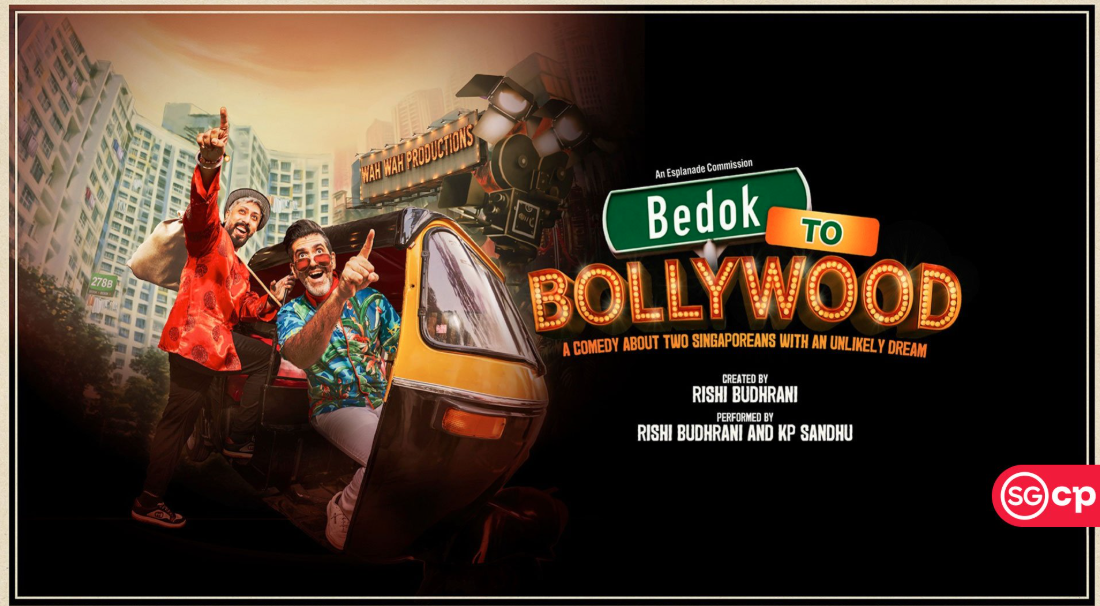
For Rishi Budhrani and K.P. Sandhu, the journey from Singapore to Bollywood has never been a straight line. Now, in a new theatrical collaboration built on decades of friendship, professional gambles and hard-won lessons, the two performers are telling a story about ambition, belonging and the courage to keep dreaming — even when the odds seem absurd.
What does it mean to dream of becoming a Bollywood star when you are sitting in an HDB flat in Bedok, thousands of kilometres away from the industry you hope to conquer? How do you begin to imagine a future in a world of more than a billion people when you come from a country of fewer than seven million? And at what point do you stop asking whether the dream was ever realistic, and start wondering whether the pursuit of it has changed you into someone you could never otherwise have become?
These are some of the questions at the centreof Bedok to Bollywood, a new theatrical collaboration between Singaporean performers Rishi Budhrani and K.P. Sandhu. Inspired by their real experiences, the production follows two Singaporeans chasing a Bollywood dream across three decades, bringing together comedy, music, romance, heartbreak and audience interaction in a story that is as much about the journey as it is about the destination. There are jokes about the absence of a ten-year television series, the lack of industry godfathers and the SkillsFuture credits that might have come in handy. But beneath the humour lies something more vulnerable: the uncertainty of trying to build a life around a dream that other people might struggle to understand, and the question of what happens when the dream itself begins to change.
The idea began with Rishi, who had originally imagined Bedok to Bollywood as a solo show. Years earlier, he had pitched another production, Can I Make You a Suit, Mate?, to an Esplanade contact, and in 2022, during Kalaa Utsavam, a casual conversation led to an invitation to consider another project. At the time, he had little more than a title and a synopsis: a story about people in Singapore living in HDB flats while hoping one day to make it big in Bollywood. He initially imagined drawing on his own experiences, combining autobiographical material with jokes and stories. But as he began developing the idea, he realised that telling it alone would leave out someone whose presence had fundamentally shaped his journey.
“I got to a point where I felt I couldn’t move forward with this story with full integrity and authenticity without having my friend KP in it, not just mentioned fleetingly, but very much a part of it,” Rishi says. “So I picked up the phone and called him. I told him the concept, what I was thinking of doing, and asked whether he wanted to do it together. That’s how it started. We’ve always wanted to do something cool together, and we hadn’t done something like this in a while. It felt like we needed a new creative experiment, a chance to take a risk on ourselves. And here we are.”
For K.P., the invitation was a long time coming. The pair have known each other for years, having come up through Singapore’s entertainment scene together, including their time in what they describe as Singapore’s first professional Bollywood dance group. They shared that early chapter with fellow performer Sharul Channa, and while their careers have since taken different directions, all three have remained in the entertainment industry. Rishi went on to build a career spanning stand-up comedy, acting, writing and hosting, while K.P. became a familiar face on the hosting circuit, known for his ability to connect with audiences at weddings, corporate events and major productions. They have watched one another perform, cheered each other on and accumulated experiences that could not have been imagined when they first started out.
“About time he called me!” K.P. says, laughing. “We call each other a lot, but it was about time we had this collaboration. We’ve always liked watching each other perform, even though we’ve gone down different paths. It’s nice to come back and perform together again, especially now that life has given us so much more experience. We’ve both had the opportunity to work overseas, in television and in different areas of entertainment. Whatever expertise we’ve picked up along the way, this feels like the right time to bring it all together.”
There is something moving about that timing. Bedok to Bollywood is not the story of two young men just beginning to dream. It is the story of two performers who have spent years working, learning, making mistakes and finding their own ways to survive in an unpredictable industry. They know more now about what the dream demands, what it can cost, and how little can be guaranteed by talent alone. They also know one another far better than they did at the beginning. The show gives them an opportunity to bring those accumulated years onto the stage, not as a neat retrospective of two successful careers, but as an honest account of what it takes to keep going.

Neither performer is particularly interested in putting the production into a tidy category. Rishi. whose work has moved between stand-up, theatre, television and film, says that even his own team has struggled to decide what to call it. Is it theatre? A comedy? A two-hander? A musical? A one-man show that somehow became something else? For him, the uncertainty is part of the appeal.
“I love creative experiments, and I hate boxing work into a genre,” he says. “My own team will ask me, ‘Is it theatre? Is it comedy? Is it a one-man show?’ But even during our rehearsal, I realised that we don’t need to define it. Someone buys a ticket, comes in, and should leave having had an entertaining and reflective experience. They should have had a good time, had some laughs, and perhaps walked away feeling inspired to follow their own dreams. That’s what matters to me.”
He recalls a similar reaction to Can I Make You a Suit, Mate?, when someone told him it was the best stand-up comedy they had ever seen. Budhrani had no desire to correct the person by explaining that the work was theatre rather than stand-up. “I wasn’t going to tell him, ‘Actually, it’s theatre!’ Forget it. If you’ve had a good experience, that’s what matters. We want to give the audience something that surprises them, something they might not have expected from us, and something that lets us play with different forms.”
K.P. sees the production through a similarly expansive lens, comparing it to a Bollywood film unfolding onstage. “Bollywood is its own genre, and within it you have so many different things, such as musicals, romance, action, comedy, heartbreak. You expect a kaleidoscope of emotions to hit you by the end of a film. I hope our piece can encapsulate that too. It shouldn’t be something you can easily box up. There should be a bit of everything.”
That mixture is particularly suited to the material. The dream of Bollywood can be ridiculous and exhilarating at the same time. It can invite grand fantasies of fame, romance and reinvention, while confronting those who pursue it with the realities of money, access, competition and rejection. The production’s comedy makes space for the absurdity of chasing such an outsized ambition from a small island, but its emotional weight comes from understanding why someone would chase it anyway.
Both men already spend much of their working lives in front of audiences. K.P. can be found hosting weddings, dinners and corporate events; Rishi performs stand-up, appears in screen projects and works across different creative forms. Their collaboration offers something audiences cannot necessarily see in those familiar settings: the personal histories behind the public personas.
“We both do live shows so often that it’s our bread and butter,” Rishi says. “You might catch KP at a wedding or a D&D, or see me at a comedy club down the street, doing a documentary or something else. But when we come together, we want people to experience something they can’t get from those other spaces. We want them to be surprised by the content, to think, ‘I didn’t know this about Rishi and KP. I had no idea this was part of their journeys, or that they would do something like this.’”
The invitation is therefore not simply to watch two entertainers do what they already do well. It is to see what happens when they step outside their familiar roles and allow an audience into the stories that have shaped them.
For all its humour, Bedok to Bollywood takes its central question seriously. What exactly are the two men chasing? Is Bollywood a physical destination, an industry to break into, or a symbol of the recognition and possibility they have been working towards? And if you do make it there, will you find what you imagined?
Rishi s acutely aware of the scale of the ambition. “When you dream of becoming a superstar in a nation of a billion people, while you’re sitting in your HDB flat in a country of fewer than seven million, sometimes your brain can’t fully comprehend the mountain you’re trying to climb,” he says. “Both of us have made trips to India to understand what kind of beast this really is. We’ve had rude shocks, some positive and some not so positive. There have been wins, small wins, many losses, and a lot of learning. And through all of that, you start asking yourself: was Bollywood really the dream, or was it a way of learning how to dream in the first place?”
K.P. offers a question of his own: “Is Bollywood a location, or is it an emotion?”
It is a deceptively simple distinction. The dream might begin with a place: Mumbai, film sets, red carpets, the prospect of working alongside the stars whose films have shaped your imagination. But over time, it can come to represent something larger: the possibility of being recognised for your work, of proving that where you come from does not have to determine how far you can go, and of discovering what you are capable of when you refuse to rule yourself out before you begin.
For Singaporean performers, particularly those from minority backgrounds, the journey also raises questions about belonging. What opportunities are available at home? What happens when you move into a larger industry, and is a bigger market necessarily a more welcoming one? Budhrani frames the dilemma in terms of identity and geography: “As minority performers in Singapore, you ask yourself whether going into that bigger sea is really better. Is it better to be a brown person in a brown place?”
K.P. has experienced both the opportunities and the complications of taking his work beyond Singapore. Over the course of his career, he has become a prominent host in the local Indian community and has had opportunities that once might have seemed unimaginable. For four consecutive years, he was invited to host the Indian equivalent of the Oscars, becoming, as he describes it, the first Singaporean and first Southeast Asian to do so. This year, however, a major scheduling mix-up meant that he was unable to make the trip. He was disappointed, but the experience prompted him to think differently about what might come next.
Then came another moment of professional serendipity. Rishi had the opportunity to interview Bollywood superstar Aamir Khan at the Singapore International Film Festival, an opportunity K.P. had himself experienced seven years earlier. The coincidence could easily have become a source of comparison. Instead, it brought their shared history into sharper focus.
Rishi jokes that Khan has been particularly fortunate to have been interviewed by both of them. “No other Bollywood superstar has had that privilege!” he says, before adding that kismet, or destiny, can be a powerful thing.
K.P. remembers how the news landed with him. People asked why, as “the Bollywood guy”, he had not been the one to interview Khan this time. The questions came from people who did not necessarily understand that he had already had that experience years earlier, or that his friend’s opportunity did not diminish his own. He was proud of Rishi, and could recognise his success as something to celebrate rather than compete against. But the moment also made him consider whether he was ready for a new role in his own story.
“When that happened, his successes felt like mine, and his failures would feel like mine too,” K.P. says. “Some people were asking, ‘You’re the Bollywood guy, so why didn’t you get the interview?’ But the truth is that I’d already had that opportunity. I didn’t have any further questions to ask. And maybe it hit me that it was time to stop being the interviewer and become the star. It was time to make that final transition. I’m really happy about that, because it means levelling up. It’s time for me to be on the other side of the red carpet.”
It is a significant realisation, made more poignant by the fact that it arrives not through a carefully planned career strategy but through the experience of watching a friend move forward. Rather than interpreting Rishi’s opportunity as something lost to him, K.P. has found a reason to reconsider his own ambitions. Friendship, in this case, has offered him a mirror: a glimpse of what might still be possible.
Rishi is delighted by the idea of that next chapter. “I’m still happy to interview the stars,” he says. “And who knows? Maybe our lives will lead us to a point where I get to interview KP Sandhu as the big Bollywood star.”
The joke lands because it is not entirely a joke. Both men understand the improbability of the dream, but neither is willing to declare it impossible.
There is a temptation, when looking back over a life, to imagine how things might have unfolded differently. What if you had been born in Mumbai instead of Singapore? What if you had made a different decision at the end of university, taken a safer job, avoided a mistake, or accepted an opportunity that you turned down? For performers who have spent years pursuing uncertain careers, the alternate versions of their lives can be particularly seductive.
During rehearsals, Rishi asked K.P. whether he ever wished he had been born in Mumbai. K.P.’s answer was immediate: no. “Being born there doesn’t mean the journey would have been easier,” he says. “It was meant to happen this way. We were meant to dream, and to be allowed to dream that way. Sometimes the dream becomes bigger the further away you are from it. Singapore has been the place where I could develop myself as an artist, and where I could get ready for that big leap. It’s easy to say that things would have been different if we had been born somewhere else, but maybe we were meant to take these paths and make these mistakes. Maybe those mistakes were what put us on the path to taking bigger swings in our careers.”
There is a quiet conviction in his answer. Singapore is not merely the place from which he wants to escape; it is also the place that has allowed him to build the skills, relationships and resilience he will need for whatever comes next. The distance from Bollywood may have made the dream seem improbable, but it has also given him a particular perspective on it. To dream from the outside is to imagine a world you do not yet know. To pursue that dream is to discover, sometimes painfully, what it actually requires.
Rishi is similarly wary of spending too much time imagining alternate lives. He acknowledges that he has made mistakes and that there are things he would do differently if he could return to the past. But he does not believe that endlessly revisiting those choices is useful. “It’s counterproductive to imagine alternate universes too realistically,” he says. “I’m very grateful for the time I’ve spent with people at the level of Aamir Khan, and of course there are mistakes I’ve made, things I screwed up, things I would fix if I could go back. But moving forward, there’s no point in dwelling on it. You have to make the best of the cards you’ve been dealt and get ready for the next hand.”
For Rishi, the ability to keep taking risks has been built through repetition. Working across stand-up, theatre, television and film has meant repeatedly putting himself in unfamiliar situations, learning new skills and accepting that sometimes he will fail in public. In stand-up, rejection is immediate and unmistakable; an audience does not have to explain when a joke has not worked. Over time, that experience can make failure less frightening.
“I know how I look, how I sound and how I feel. I know what I need to upskill and how to get better. I just have to keep improving, keep taking risks and keep making big swings. You have to be prepared to make mistakes, to look stupid and to let people laugh at you. Those rejections become a regular part of your life, and they train you to develop a thicker skin for whatever comes your way.”
It is a practical philosophy, but not an uncomplicated one. There is no suggestion that failure is painless or that persistence guarantees success. Rather, the work is to keep moving despite the uncertainty, to learn what each experience can teach you, and to remain open to opportunities that might not have been part of the original plan.
For Rishi, the lesson is inseparable from his friendship with K.P.. “I’m very grateful for how this whole journey started, which is why I couldn’t tell this story without KP. If I trace things back, a lot of the dominoes fell when I met him. If I hadn’t met him, I might have met other people, of course, but we might never have combined our dance groups. I might never have met Sharul, my wife. And I might not have had someone who could look me in the eye and brutally tell me not to take a full-time job at the end of university, but to pursue my dream of becoming an actor and host. There are so many things that came out of that meeting. When I thought about telling this story, I realised it couldn’t just be about me.”
The remark changes the scale of the story. What began as an account of an individual ambition becomes a recognition that no creative life is entirely self-made. Careers are shaped by encounters, encouragement, arguments and people who see something in us before we are certain enough to see it ourselves. The dream may belong to one person, but the path towards it is often shared.

For K.P., the production has arrived at a moment when he is preparing to take another major leap. He plans to spend an extended period in India next year, moving beyond the shorter trips he has made in the past. What might once have been a three-week or month-long visit is now becoming a commitment that could last six months or more. He knows the uncertainty involved, but the question is no longer simply whether he should try. It is whether there is any point in waiting.
“I’m actually taking the plunge and going to India next year,” he reveals. “Previously, the maximum would have been three weeks to a month, and that’s really nothing. Now I’m looking at a six-month period to start with. At this age, if not now, then when? So many things are happening beautifully at the same time. I’m doing this show with one of my best friends, and the story is turning out the way it is. It feels like the next step.”
He speaks about the timing with a mixture of excitement and wonder, as though the separate strands of his life, his friendship with Rishi, the creation of the show, his own growing readiness to take a risk — have begun to converge. He is not pretending that the leap will be easy. He is simply ready to find out what happens if he takes it.
Then he turns to Rishi, and the interview becomes something more personal. “We’re the same age, just eight days apart, and we were born in the same hospital,” K.P. says. “That might sound like nothing, but deep down, I feel he is the older brother I never had. I never doubted his talent from the start, and he has gone from strength to strength. People have tried to pit us against each other, but we’ve always been very real with each other. Sometimes we can’t even be that real with our own families. There are times when I wake up and text him a question, because he’s the one person who will understand the insanity of what we’re each trying to do.”
There is no performance in the way he says it. The sentiment arrives simply, without the need to turn it into a grand declaration. After years of working in the same industry, the two men have developed a kind of shorthand that only comes from knowing someone over a long period of time. They understand each other’s ambitions because they have watched them develop. They know the doubts that accompany those ambitions because they have seen one another live through them. “It wouldn’t make sense with any other casting,” Sandhu adds. “I love him. It’s a pleasure to perform with him, and I’m glad this is the piece we’re working on.”
Rishi responds with affection and a characteristic awareness of his own eccentricities. Working with him, he admits, can require a certain tolerance for creative chaos. He moves between theatre, television, comedy and film, and resists the idea that he should commit himself to only one of those worlds. His process can be unpredictable, sometimes structured and sometimes not, and he knows that not everyone would be comfortable with it.
“Insanity is right,” he says. “Sometimes you have to be a bit insane to work with me. I come from all these different worlds, theatre, television, comedy, and I love stand-up, theatre and film. I can’t just do one of them. Whoever works with me has to understand that the process can be a little erratic and that I’m always experimenting. I’m very grateful that KP gets that about me, that he sees it and trusts it. It calms me to know that he trusts me enough to believe we’ll find our way through it.”
He pauses on that last thought: trust. Their friendship has lasted through different career paths, changing ambitions and the inevitable comparisons that can arise when two people in the same industry are trying to make their mark. But rather than diminishing with time, Rishi says, their understanding of each other has grown. “We’ve known each other for so long and worked with each other so much. I’m happy to say that the trust and understanding have only grown, not just as friends and human beings, but as fellow creatives.”
It is perhaps the most revealing statement in the interview. For all the talk of Bollywood, the uncertainty of the entertainment industry and the challenge of pursuing a dream from Singapore, the foundation of Bedok to Bollywood is not simply ambition. It is the friendship that has made those ambitions possible to imagine, and the rare comfort of having someone beside you who understands why you are willing to risk so much.
The title Bedok to Bollywood suggests a journey between two places, but the story Rishi and K.P. are telling is less concerned with the distance on a map than with everything that happens along the way. There are the big dreams and the inevitable disappointments, the opportunities that arrive unexpectedly and the ones that slip away, the choices that seem reckless at the time and make sense only years later. There are also the people who become part of the journey, sometimes changing its direction without either person realising it at the time.
The production does not promise a straightforward tale of triumph. Its emotional power comes from the fact that neither performer can know exactly where the road will lead. K.P. is preparing to spend a significant period in India, taking his own ambitions beyond the familiar boundaries of Singapore. Rishi continues to experiment across forms, unwilling to let his creative life be contained by a single label. Both know that the next step may bring opportunities, setbacks or an entirely new understanding of what success means.
And perhaps that is the question driving the show: what if the dream is not just the place you hope to reach, but the person you become while trying to get there? For Rishi, the answer is bound up with gratitude — for the mistakes that taught him, the risks that made him braver, and the friendship that helped shape the life he has built. For K.P., it is about finally allowing himself to take the leap he has been preparing for, with the knowledge that he has not had to make the journey alone.
They began with a story about Singaporeans dreaming of Bollywood from their HDB flats. Somewhere along the way, that story grew into something larger: a portrait of two friends who have spent decades learning how to perform, how to persevere and how to keep believing in possibilities that might seem unreasonable to everyone else.
They may yet find themselves on the other side of the red carpet. They may discover that the dream takes a different shape from the one they first imagined. But for now, they have the stage, the stories they have gathered, and the freedom to ask what might still be possible. And they have each other, which, after all these years, remains one of the most remarkable, constant things about the journey that still has a long way to go.
Photos courtesy of Esplanade – Theatres by the Bay
Bedok to Bollywood plays on 27th and 28th November 2026 at the Esplanade Recital Studio. Tickets available here
Kalaa Utsavam – Indian Festival of Arts 2026 runs from 20th to 29th November 2025 at Esplanade – Theatres on the Bay. Full lineup available here

