
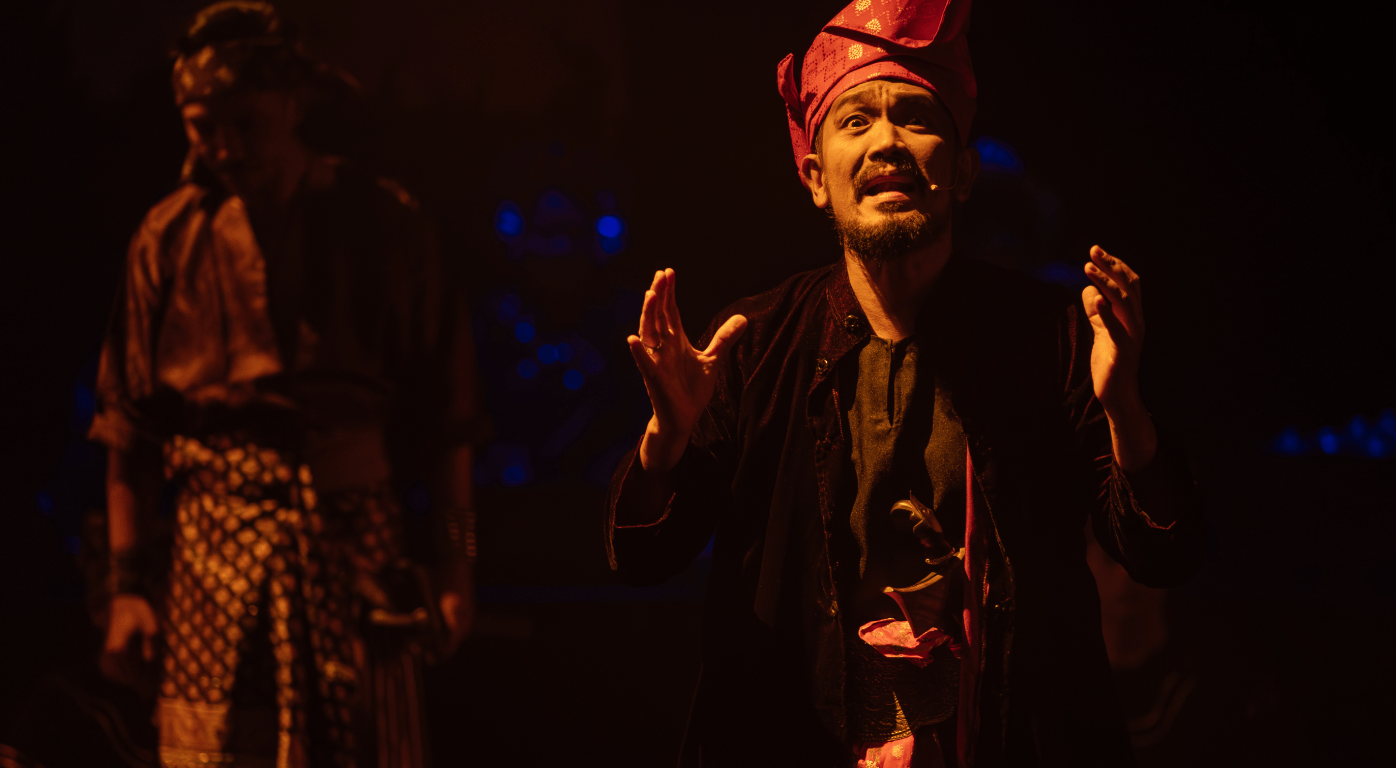
Shakespeare meets the Nusantara in a bold, visceral Macbeth reborn through randai.
It’s no small feat to make a 400-year-old play feel fresh, but Randai Macbeth achieves exactly that, and then some. Presented by Malaysia’s ASWARA and directed by Dr Norzizi Zulkifli, this bold adaptation reimagines Macbeth through the cultural lens of the Nusantara, transforming Shakespeare’s tale of ambition and moral decay into something visceral, ritualistic, and deeply rooted in Malay tradition.
Here, Macbeth is re-envisioned as a Malayan warrior, whose fateful encounter with three witches, and the manipulations of his equally ambitious wife, set him on a path toward power, guilt, and ruin. While the narrative remains faithful at its core, the production’s use of randai, a traditional Minangkabau theatre form, gives the story a renewed sense of urgency and meaning.

Staged at the Esplanade Theatre Studio as part of the Pesta Raya – Malay Festival of Arts, the production immediately transforms the performance space into something sacred. True to randai tradition, the show opens with ritualistic formality, after an eerie, atmospheric witches’ scene in thunder, lightning and rain, the anak randai (ensemble) enters with a striking display of silat and martial movement. It feels ceremonial, almost as if the performance is being offered to royalty or the divine. In that moment, Shakespeare’s text is elevated into something mythic.

The staging is richly atmospheric. A live band sits upstage, while overhead hangs a wooden roof-like structure, and the stage itself adorned with long, frayed white banners, suggestive of a palace, a temple, or perhaps something more ominous. Even before the action begins, the soundscape unsettles: whispers, water, and haunting strings conjure images of black magic and the supernatural. Throughout the performance, projections are used sparingly and flicker subtly across the banners, with lightning, shadows, fragments of a larger world, never overwhelming, but always enhancing. The production excels in its theatrical imagery and innovation too; when Duncan is murdered, the overhead structure opens, releasing bloodied cloths that cascade downward, an abstract yet deeply affecting visual that ripples through the ensemble’s collective horror. It’s moments like these that reveal the production’s confidence in blending symbolism with spectacle.

Music plays a central role. Under the direction of Muhammad Azril Yeop, traditional Malay instruments blend seamlessly with vocal performances that soar, wail, and ache with emotion. From time to time there is a song interlude, and singers Dr. Nor Azura Abu Bakar and Ezdianie Hayatie Omar’s voices cut through the space with a haunting clarity, underscoring the production’s themes of dread, grief, and inevitability. Visually, the production is stunning. Costumes by Nur Afifi Mohamed Taib are intricate and regal, traditional Malay garments worn barefoot, adorned with elaborate headpieces and jewellery. The palette of deep maroon, black, and gold reinforces both the gravity of the narrative and the majesty of its royal setting.

What truly drives Randai Macbeth, however, is its sheer energy. The performance is relentlessly dynamic, powered by the ensemble’s precision and intensity. The production amakes effective use of its anak randai ensemble, who are not simply supporting performers but an ever-present force shaping the world of the play. They form arches, processions, symbolic pathways, and even abstract extensions of Macbeth’s psychological descent. In one striking moment, they create a maze-like structure for Macbeth to navigate when he sees a vision of the infamous dagger (now a lethal kris knife), and at the climax, they erupt into a full-scale battle sequence. Their presence is constant, cohesive, and utterly mesmerising. In the opening, their presence is framed with humility, an early acknowledgment asking for forgiveness for any shortcomings as students, but what follows is anything but tentative. The cast performs with remarkable discipline, pride, and cohesion. Every movement feels rehearsed yet alive, every gesture intentional, and there is a palpable sense of a company deeply connected to both the material and the tradition it embodies. Their energy carries the production, giving it structure, rhythm, and a constant sense of ritual momentum.

As for the rest of the lead actors, they too deliver spectacular performances. Yusmar Afeendi Yusof’s Macduff is resolute and heroic, while Muhamad Amir Ameezan Md Din’s Banquo transitions convincingly from warmth to dread. Mohd Adika Zainal’s Duncan is charming and deeply likeable, making his fate all the more tragic, and the witches, played by Eliza Mustafa, Rosman Ishak, and Mohd Shahrul Mizad Asaari, are wonderfully unhinged, embodying chaos and prophecy in equal measure.

But most of all, Macbeth is anchored by its two leads. Mohd Kamarulzaman Taib’s Macbeth is captivating and charismatic yet deeply tormented. His descent into madness is visceral, his face contorting with guilt and desperation after Duncan’s murder, before giving way to a chilling, power-hungry instability. Juhara Ayob commands the stage as Lady Macbeth, delivering a performance that is both controlled and terrifying. In one unforgettable moment, she turns from the audience, laughing in cold triumph, only to snap instantly into feigned grief when others approach, chilling in its precision, yet still able to wring sympathy from us in her ‘out, damned spot’ scene later on.

The text, performed entirely in Malay with English surtitles, feels unexpectedly immediate. The language lends a sharp, percussive quality to the dialogue, making even familiar monologues feel urgent and alive, with more space to emote. This is also a streamlined adaptation, focusing on key characters and moments, which gives the production a brisk pace while allowing emotional beats to land with force. This carries through to the final moments of the play, where the production diverges notably from Shakespeare, removing the scene for Malcolm ascends the throne. Macbeth’s death is staged with melodramatic finality, but instead of restoring order, the world is left stark and unresolved, with no clear successor and no sense of closure. Rather than resolution, the ending offers rupture. It is a darker conclusion than the original, one that lingers uncomfortably in its silence and absence of restoration.

Ultimately, Randai Macbeth is a powerful testament to the possibilities of intercultural theatre. By weaving Shakespearean drama with the traditions of randai, ASWARA has created a production that feels both timeless and immediate. This is a work that respects the source material while adding its own spin to it, reclaiming and revitalising Shakespeare, and proving that traditional art forms are not relics of the past, but living, evolving practices with the power to transform how we experience even the most familiar stories. A phenomenal, unforgettable production, and easily one of the most refreshing interpretations of Macbeth to date.
Photo Credit: Crispian Chan, courtesy of Esplanade – Theatres on the Bay
Randai Macbeth played from 16th to 19th April 2026 at the Esplanade Theatre Studio. More information available here
Pesta Raya – Malay Festival of Arts 2026 runs from 16th to 19th April 2026 at the Esplanade. More information and tickets available here
Production Credits
| Director Dr. Norzizi Zulkafli Artistic Director Hamzah Tahir Cast Mohd Kamarulzaman Taib, Juhara Ayob, Yusmar Afeendi Yusof, Eliza Mustafa, Muhamad Amir Ameezan Md Din, Rosman Ishaq, Mohd Shahrul Mizad Asaari, Mohd Adika Zainal Anak Randai Amer Ariff Alwira (Lead), Amirah Nabilah Zulkifli, Muhammad Hafizam Md Kamar Zaman, Muhammad Danish Miqhail Mohd Tarmizie, Nik Muhammad Dani Afique Mohamed Daud, Harry Shahar, Muhammad Naqiib Saharuddin, Izzah Hannani Mohd Mohyiddin, Samzoui, Muhammad Aziman Bin Effendy Music Director Muhammad Azril Yeop Assistant Music Director Muhammad Haidi Hykal Singers Dr. Nor Azura Abu Bakar, Ezdianie Hayatie Omar Musicians Mel Lupin, Muhd Akhmal Daniel Mohd Azlan, Muhamad Farish Nazhan B. Azrul Affendi, Nur Sabrina Bt. Shahrul Azman Choreographer Yusmar Afeendi Yusof Lighting Designer Mohamed Yusman Mokhtar Set Designer/Technical Manger Mohd Nurul Hazirin, Shamsul Kamar Costume, Styling And Make Up Designer Nur Afifi Mohamed Taib Production Manager Eliza Mustafa Production Crew Naque Ariffin, Zahari Hamzah Stage Manager Mya Aisya Izzabelle Binti Abdullah Set Crew Arham Fitri Hamden |

