
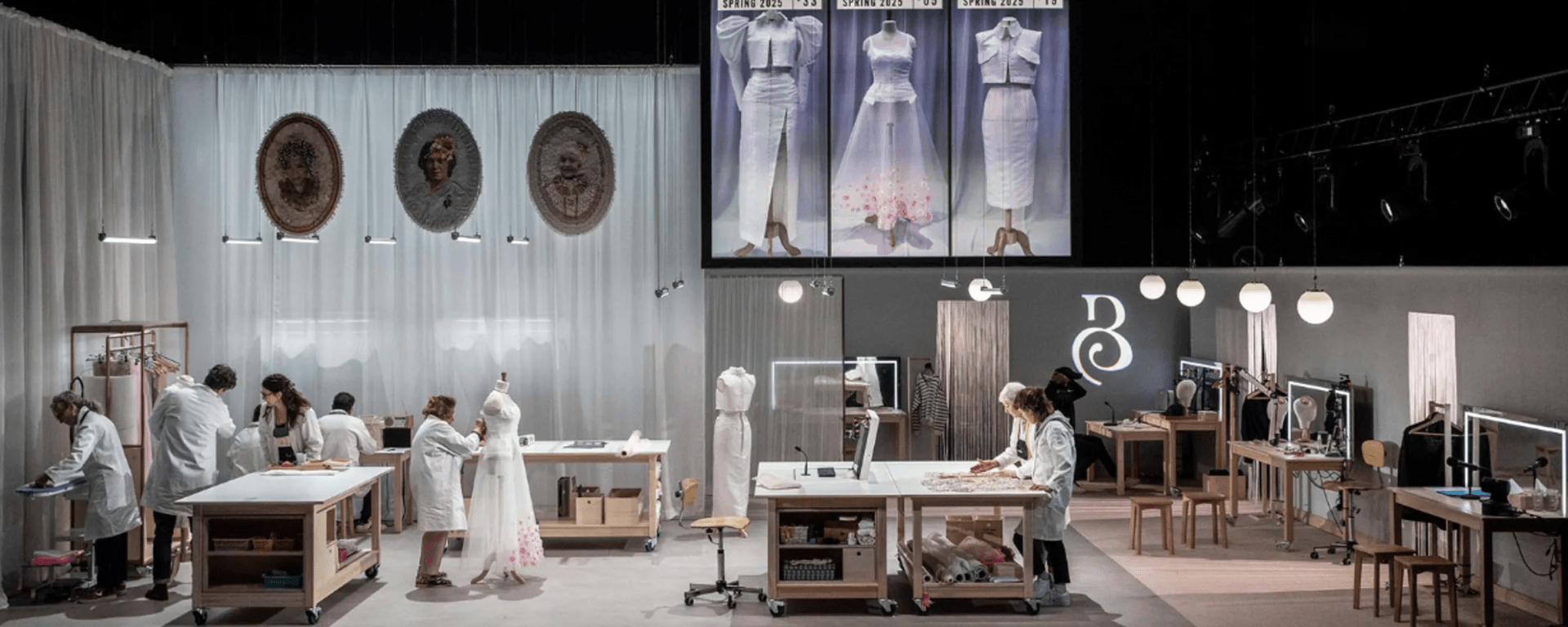
What fascinated French artist Caroline Guiela Nguyen about the fashion world was never the glamour of haute couture itself, but the invisible human machinery that sustains it. LACRIMA, which comes to Singapore this week as one of the opening shows of the 2026 Singapore International Festival of Arts (SIFA), may begin with the commission of a royal wedding dress, the kind of object typically associated with luxury, prestige and fantasy, but Nguyen’s play deliberately turns its gaze away from the finished spectacle and toward the people whose labour disappears behind it.
“This is not a production about haute couture, nor is it about luxury,” she says. “It’s really about creation, and about these people we never talk about.” The seamstresses, lacemakers and embroiderers of LACRIMA are not simply supporting characters orbiting a glamorous industry; they are the emotional and moral centre of the work. Nguyen is interested in the artistry of their hands, the generational knowledge embedded in their craft, and the personal sacrifices hidden within objects society learns only to consume and admire.
That tension between beauty and erasure became the emotional engine of the production. During her research, Nguyen immersed herself in the hidden economies and rituals of haute couture craftsmanship, spending months interviewing artisans across France and India. What emerged was a world governed as much by silence as by skill. “I wanted to work on secrets and violence,” she explains. “And I realised the secret and the violence are linked.”
In couture houses, secrecy is not merely professional etiquette but a structure of power. Laceworkers are forbidden from discussing their methods; embroiderers protect techniques that have been passed down for generations; entire ateliers disappear behind the polished mythology of luxury brands. Nguyen became fascinated by how these systems both preserve artistry and obscure the people who sustain it. Even the fictional royal wedding at the heart of LACRIMA echoes real anxieties around Princess Diana’s dress, the fear of leaks, the obsession with exclusivity, the policing of information. “So this became my story,” Nguyen says. “To tell the story of these people and their invisible work and craft.”
The result is a play deeply concerned with labour: the labour of making, of repetition, of perfectionism, and of self-erasure. Across continents, Nguyen traces the lives of workers whose identities become consumed by the demands of excellence. Marion, the head seamstress at Maison Beliana, struggles to balance the emotional demands of motherhood with the impossible pressure of delivering perfection on time. Thérése, an Alençon lacemaker, is forced to confront painful family histories embedded within her craft. In Mumbai, master embroiderer Abdul painstakingly fastens one thousand roses onto duchesse satin even as his eyesight deteriorates.
These are not abstract symbols of exploitation, but fully realised individuals whose devotion to their work exists in constant tension with exhaustion, precarity and sacrifice. The violence in LACRIMA is rarely explicit; instead, it accumulates quietly through the body, through failing eyesight, overworked hands, emotional isolation and inherited burdens. Yet Nguyen resists reducing her characters to victims. “Of course, there is not just suffering and violence,” she says. “There is also a lot of joy and laughter in the show.” The work honours not only what labour extracts from people, but also the dignity, intimacy and meaning they derive from creation itself.
That idea extends beyond fashion and into Nguyen’s own understanding of theatre-making. In many ways, LACRIMA becomes a reflection on artistic production itself: on the invisible workers behind any finished work of art, and on the emotional, physical and collective labour required to make beauty appear effortless. Nguyen speaks about the rehearsal process with the same exacting commitment as the artisans in her play. Real lacemakers were brought in to train actors in authentic gestures and techniques so audiences would believe they were witnessing actual craftsmanship unfold live onstage.
“I don’t want people to think they’re just watching a show,” she says. “I want people to believe they are really inside a haute couture workshop.” Her theatre rejects distance and artificiality; instead, she pursues a kind of immersive emotional realism that collapses the barrier between spectator and worker, audience and artisan. “When spectators are watching, I don’t want them to feel ‘protected’ by the show being ‘staged’,” she explains. “I want them to feel things are really happening.”
In that sense, LACRIMA becomes more than a story about couture. It is a meditation on all art forms that rely on invisible labour while celebrating visible beauty. Just as audiences admire a wedding dress without considering the exhaustion stitched into its seams, theatre audiences often consume performance without seeing the immense labour beneath it, the rehearsal hours, technical precision, emotional exposure and collective sacrifice that make live art possible. Nguyen thus rejects romantic notions of artistic genius in favour of something far more rigorous and communal. “I don’t believe in the genius of artists,” she says. “I believe in hard work.”
That ethos pulses through every layer of LACRIMA: a monumental work about labour made through labour itself. Promising spectacle and revelation through its invitation to look beyond surfaces, it is itself a work of intricate, finely-crafted refinery that allows us a rare behind-the-scenes glimpse at the fashion realm, and recognise the human hands, bodies and lives hidden inside beauty and behind luxury.
Photos Courtesy of The Arts House Group
LACRIMA plays from 15th to 17th May 2026 at the Singtel Waterfront Theatre. Tickets available here
SIFA 2026 runs from 15th to 30th May 2026. More information and tickets available here

