
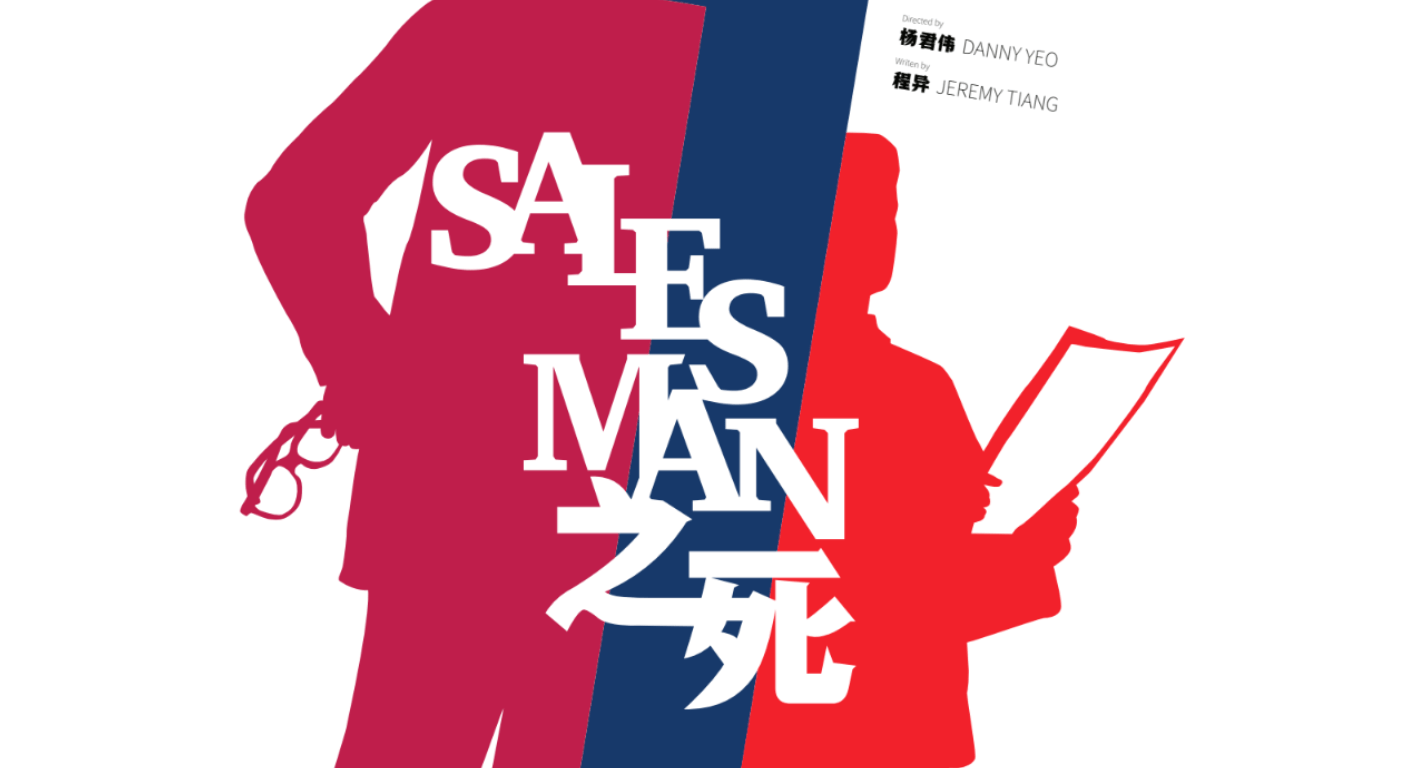
In the spring of 1983, despite not speaking a word of Mandarin, Arthur Miller travelled to Beijing to direct Death of a Salesman with an all-Chinese cast. The encounter, later documented in his memoir Salesman in Beijing, has since become a touchstone of cross-cultural theatre-making.
More than two decades later, that improbable collaboration now finds new life in Salesman之死, a multilingual, documentary-inflected work that traces the fragile, often comic process of translation across language, culture, and lived experience. Directed by Danny Yeo, this reimagining centres on the interpreter tasked with bridging Miller and his Chinese ensemble, artists who, famously, had never encountered the concept of a “salesman.” Warm, playful, and quietly probing, the production unfolds as both theatrical reconstruction and meditation on meaning-making itself. As Yeo reflects, “the script offers a strong premise. From there, we can build something new. It’s challenging, yes, but a worthwhile experiment.”
For Yeo, the impulse to revisit Death of a Salesman was not about fidelity, but possibility. “What interested me was the journey that the text took, from page to stage, from stage to film,” he explains, tracing its movement from Miller’s 1949 original to Ying Ruocheng’s translation and subsequent stagings in Beijing and Singapore. This layered history became less a constraint than an invitation: “I realised the script offers a strong premise, and from there, we could build something new.”
Crucially, Yeo resists the idea that audiences must arrive equipped with prior knowledge. “This is still a play at the end of the day. It’s entertaining, even funny at times,” he says. “There’s a behind-the-scenes look at theatre-making, which audiences today are very drawn to.” At the same time, he is acutely aware of the work’s local resonance. The 1986 Beijing production’s visit to Singapore, he notes, “influenced an entire generation of Singapore theatre practitioners. So there’s a lineage there, and I wanted to respond to it.”
If there was a central theme to Salesman之死, it would be the instability of meaning. Speaking with Shen Huihui, the real-life interpreter who inspired the play, Yeo encountered a definition that anchors his approach: translation as “桥梁,” or bridge. “That stayed with me,” he says. “Because we are always translating between languages, cultures, even within ourselves.”
This idea permeates the production. “I may think in Chinese and speak in English, or vice versa. Actors translate characters. Directors translate texts. We are constantly building bridges.” Meaning, in this framework, is never fixed. Instead, it shifts with context. A “salesman,” for instance, becomes “做小买卖的” in 1980s Beijing: “That’s not wrong, but incomplete.” Likewise, even a word like “liberation” fractures across geographies: “for Americans, for Beijing in 1980, and for Singaporeans today.”
Working with playwright Jeremy Tiang, Yeo undertook an extensive process of adaptation. “I spent a year researching, because I wanted to understand,” he says. Their collaboration unfolded through long conversations about bilingualism, education, and identity, but also through a fundamental question: “Why stage this in Singapore?”
The answer led to structural transformation. A workshop process, interviews with veteran practitioners, and iterative revisions culminated in a significantly reshaped script. “Jeremy wrote a new ending,” Yeo reveals. “We also restructured scenes, where some were removed, others added.” While the original New York staging was “very episodic,” Yeo found that “what matters is relevance. I’m not concerned with what happened in New York: I care about what works here.”
One of the production’s most striking features is its staging. A limited number of audience members will be seated onstage at Victoria Theatre, embedded within the mechanics of the performance. “They see backstage: lighting, sound, even the stage manager calling cues behind them,” Yeo explains.
This creates what he describes as a “mirroring effect”: “they watch the show, while the theatre audience watches them.” The result is a subtle but radical shift in spectatorship. “It makes the audience aware of their role. They are not passive, they shape the performance.”
Yeo frames the production as both continuation and rupture within his practice. “I’ve been given the freedom to take risks. I can experiment. I can fail.” That freedom, however, is not without cost. “At the start of 2026, I had nightmares every night,” he admits, citing challenges ranging from rights to logistics. The eventual breakthrough came with a decisive shift in mindset: “we said: just do it our way.”
At its core, the work is driven by a simple but urgent question: “what is the lifespan of a show?” For Yeo, value lies in the singularity of experience. “If audiences remember something unique, something they’ve never experienced before, then it has value.” That ethos extends to tone as well. “I like humour that leads to reflection,” he says. “You laugh, but then you ask why. Behind every joke, there is truth.”
For Yeo, Salesman之死 is a threshold. In a work preoccupied with translation, perhaps that is its most resonant gesture: not just bridging worlds, but opening the possibility of what comes next. “This is a very personal project,” he reflects. “It feels like a turning point, a 强心针 (shot of adrenaline) and a stepping stone.” More than anything, it signals momentum: “it gives us confidence to move forward, to take on bigger things.”
Photos Courtesy of The Arts House Group
Salesman之死 plays from 15th to 16th May 2026 at the Victoria Theatre. Tickets available here
SIFA 2026 runs from 15th to 30th May 2026. More information and tickets available here
 Bakchormeeboy
One thought on “SIFA 2026: Salesman之死 – An interview with director Danny Yeo on translating and adapting Arthur Miller”