

A love letter to theatre, translation, and humanity itself. Salesman之死 understands that sometimes the hardest thing to translate is not language; it’s culture, emotion, and perspective.
Even someone like Miller, a playwright of immense stature, struggles to grasp even a fraction of the Chinese dialogue — a quiet but telling reminder of how language itself resists ownership, even by those who write it.
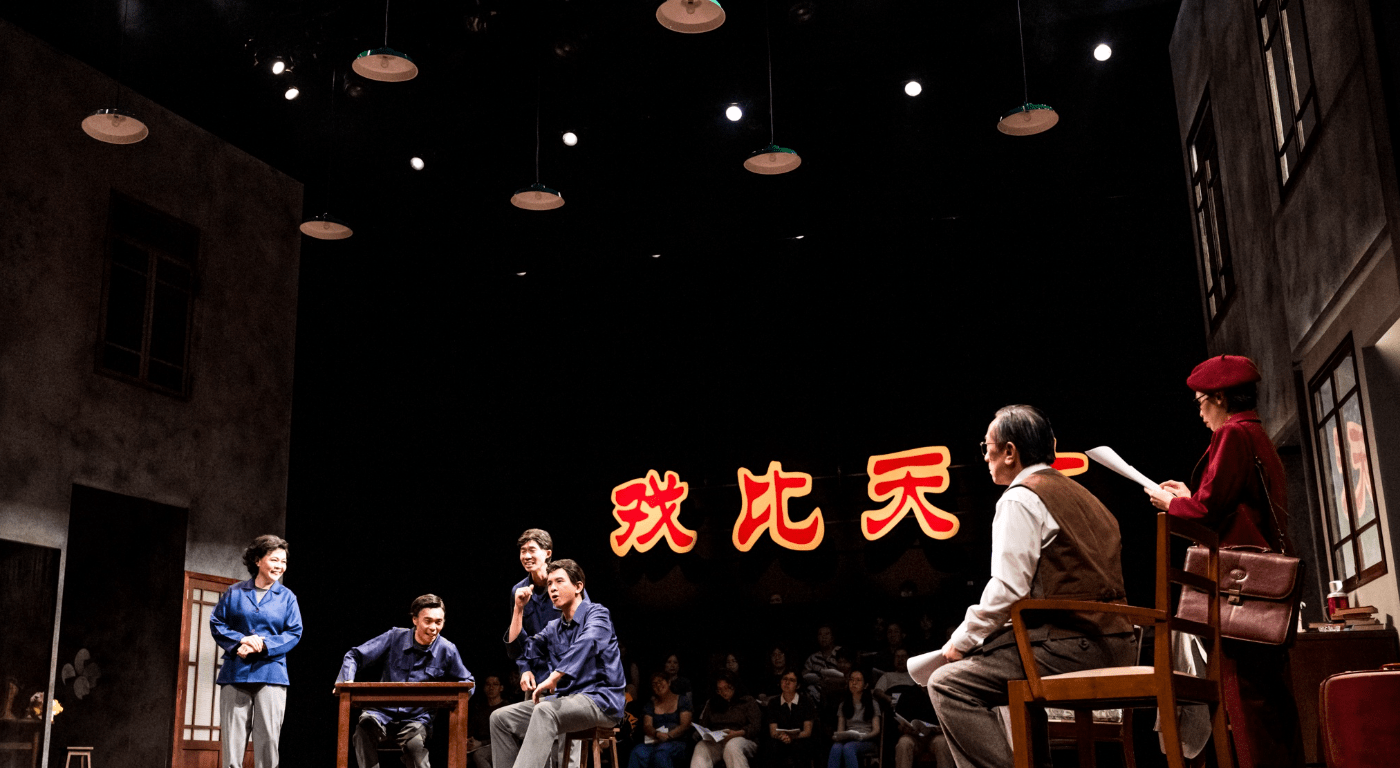
This becomes especially apparent in the rehearsal’s rhythm, where Miller repeatedly pushes for faster pacing and sharper delivery. As scenes are run again and again at increasing speed, Hang Qian Chou, as Biff, stands out with striking clarity. In these accelerated exchanges, he excels — responding instantly, maintaining emotional precision even as articulation is pushed to its limits. It is a performance that feels both technically agile and emotionally grounded, capturing the pressure of translation not just as linguistic work, but as embodied performance under constraint.

In 1983, American playwright Arthur Miller travelled to Beijing to direct Death of a Salesman with an all-Chinese cast despite not speaking a word of Mandarin. China was only just emerging from the isolation of the Cultural Revolution, and the collaboration itself seemed almost impossible: a quintessentially American play staged in Mandarin for audiences who had never even encountered the concept of a “salesman” in the Western capitalist sense. Yet against all odds, the production became a historic success, later immortalised in Miller’s memoir Salesman in Beijing.
More than forty years later, that extraordinary cultural encounter returns in Salesman之死, playwright Jeremy Tiang’s deeply intelligent and emotionally resonant reimagining of the event, directed by Danny Yeo as one of the opening productions of the 2026 Singapore International Festival of Arts.

What makes this staging especially resonant is its home ground: Victoria Theatre — the very same venue where the original 1983 Beijing production toured in 1986. Salesman之死 thus becomes more than historical reconstruction. It becomes a dialogue across time, memory, and geography. In a multilingual country like Singapore, and within a festival like SIFA that thrives on questions of identity and exchange, the production feels almost inevitable in its relevance.
Yet despite its rich historical and political scaffolding, the work never feels academic. It is instead warm, funny, and deeply human theatre. Even before the performance formally begins, the production is already in motion. Actors roam through the theatre space as audiences settle in. Some spectators are seated on stage itself, laughing and observing from within the performance environment. The boundary between audience and performer is immediately blurred, creating the sense that we are entering not a finished show, but a living rehearsal still forming itself.

One of the earliest striking images comes through lighting. Designed by Gabriel Chan, light spills across the stage and casts shifting architectural shadows across the floor. Time is not marked by clocks but by atmosphere, via the light changing across surfaces, as if we are watching days pass inside a space where theatre itself slowly consumes everything within it.
From the outset, director Danny Yeo establishes a production deeply concerned with perspective, not only linguistic translation, but emotional and cultural translation. This is made clear immediately when two actors enter as a mother and daughter, the latter swearing never to see the Zhou family again. At the same time, thunder is produced manually through a sheet of aluminium, foregrounding theatre’s constructed nature. Illusion is never hidden; it is exposed as labour.

We are then introduced to Ying Laoshi, played with quiet authority and warmth by Tay Kong Hui, who brings both intelligence and melancholy to the role. He introduces Shen Huihui, an American literature professor from Peking University tasked with assisting the translation of Arthur Miller’s arrival in Beijing. Played with remarkable sensitivity by Jodi Chan, Shen becomes the emotional axis of the production. Her excitement at Miller’s impending arrival borders on awe, she is not merely academically familiar with him, but personally invested in his work. Chan captures this blend of intellectual admiration and human vulnerability with precision.
The ensemble around her is equally grounded. Johnny Ng’s Huang Shifu lends the world a sense of theatrical lineage and lived experience, while younger performers such as Neo Hai Bin and Hang Qian Chou bring an energised volatility to the rehearsal space, embodying the urgency and ambition of a generation eager to prove themselves within a historic production like this. Hang Qian Chou, in particular, stands out later in the rehearsal sequences as Biff, especially when the pace of translation accelerates and dialogue is pushed into rapid exchange. Hang responds with striking precision and clarity, maintaining emotional control even under pressure, capturing the intensity of performance under linguistic strain.

One early sequence crystallises the production’s central concern: Shen translating an American film in real time as the ensemble watches The Godfather. As she attempts instantaneous translation from English into Mandarin, meaning begins to fracture. The translation is technically correct but tonally unstable. Rhythm, humour, and emotional inflection shift or collapse entirely. From this moment, the production quietly establishes its thesis: understanding is never clean. What begins playfully deepens into something more layered. A banner reading “Welcom Miller” appears, its literal translation both charming and revealing. The ensemble is instructed to clap enthusiastically for Miller’s arrival, echoing choreographed political ceremony as much as theatrical performance. The line between state ritual and stagecraft subtly dissolves.

And then Arthur Miller arrives. Gerald Chew delivers a superbly controlled performance. Rather than mimic an external idea of Miller, he embodies intellectual precision, impatience, and artistic exactitude with clarity and authority. His presence is restless, and presents Miller as observant, slightly uncomfortable, constantly recalibrating. During the extended script-reading sequence, Miller grows increasingly unsettled as the rehearsal stretches on for nearly four hours. To him, the pace feels unbearable. Yet for the Chinese ensemble, duration itself carries meaning: longer equates to grandeur, seriousness, and artistic weight. The production carefully reveals how differing theatrical traditions produce entirely different assumptions about time, value, and expression.
This is where Salesman之死 excels. Cultural difference is never reduced to comedy, and every misunderstanding opens into a deeper logic beneath it. Set designer Wong Chee Wai intensifies this idea through a constantly shifting theatrical architecture. At one point, audience members seated on stage become part of the world being watched, while Miller and Ying sit among them. The remaining audience members in the Victoria Theatre, in turn, watch from another perspective entirely. Theatre becomes recursive, audiences observing audiences observing performance.

Translation continues not only in language but also in everyday gestures. A shared fruit becomes a lesson in etiquette and unfamiliar bodily practice. Even ordinary acts such as eating, speaking, and observing become sites of negotiation. In one moment, cultural difference is distilled into something deceptively simple: how “football” means entirely different sports depending on geography, small words but vast misunderstandings. Gradually, these accumulations reveal a larger truth: translation is not an event, but a constant condition.
Rehearsal tensions deepen as Miller insists on precise measurements with a ruler while the Chinese crew relies on embodied spatial intuition. He imagines fluid theatrical spaces where walls are metaphorical; the ensemble responds from a tradition rooted in physical clarity and literal staging. Even emotional expression becomes a site of translation. The production reflects on how Chinese theatre historically used stylised wigs and visual codes to represent foreignness as inherited theatrical language shaped by different historical needs.
Suspicion briefly fractures the ensemble when Miller drops his voice recorder, triggering fears of surveillance. The misunderstanding escalates quickly, revealing how fragile trust becomes when communication is uncertain. Yet gradually, connection re-emerges, integral to the arrival of opening night. The cast gathers informally while Miller shares stories of America through a map. Most are indifferent, but Shen is transfixed, the scale of the country opening itself up as endless possibilities rather than geography alone. When Miller offers her the map, she accepts it with quiet intensity. It is one of the production’s most understated emotional pivots. Shen increasingly finds herself suspended between worlds, juggling translator, mediator, and emotional bridge. Her longing for America becomes more visible, while Ying Laoshi quietly confronts the sense of a life shaped by missed or deferred possibility. These quieter threads give the production its emotional depth.

The work also reflects sharply on material realities of theatre-making in 1980s Beijing. When Miller requests brighter lights, he learns that daytime electricity demand reduces voltage across the city. What appears to be limitation is in fact infrastructural reality. Once again, expectation meets constraint, and neither side is entirely “wrong.” The ritual of Bai Tai, blessing the stage before opening, marks another turning point. Miller’s confusion is gently held within the production’s respect for tradition, a need for ritual to craft continuity.

In the final emotional turn, Shen refuses Miller’s offer of a testimonial letter for her future travel to America. She wants to leave on her own terms. It is a small decision, but one that crystallises her autonomy and self-definition. The production then shifts again. The onstage audience is screened off. Time leaps forward into contemporary reflections on Singapore theatre to reflect its growth, its changing ambitions, its evolving artistic landscape. What once felt impossible is now remembered as foundational. Archival footage and filmed interviews, including material connected to the real Shen Huihui, are integrated with restraint. Danny Yeo allows these moments to appear only when necessary, ensuring they deepen rather than overwhelm the live performance.

Visually, the final sequences are striking. Performers move between translucent screens as layered projections by producer Belinda Ang and sound design by Guo Ning Ru create an atmosphere that is both immediate and distant, like memory unfolding in real time. At points, surtitles disappear entirely, yet we understand, because the production has already taught its audience how to read beyond translation. Salesman之死 has expanded far beyond its historical premise, and becomes a meditation on the impossibility and necessity of understanding across difference.
Every translation is incomplete. Every exchange leaves residue. And every attempt to communicate carries distortion. Yet the production insists that meaning does not lie in perfection; it lies in effort. That idea resonates especially powerfully within the context of opening the Singapore International Festival of Arts. Rather than functioning as a showcase, the festival becomes a site of encounter where languages, histories, and artistic traditions meet without guarantee of resolution.

There is perhaps no more fitting place for this work than Singapore itself. A society built on multilingual negotiation, where code-switching is daily practice and identity is constantly translated between contexts. In many ways, Singapore itself is an ongoing act of translation. In this sense, the production feels deeply attuned to its setting at Victoria Theatre, a space already layered with performance histories. The past is not simply remembered here; it is reactivated, reinterpreted, and quietly re-encountered.

What remains most striking is not the reconstruction of a historical event, but the recognition of theatre’s fragility: its ephemerality, its labour, its constant disappearance into memory. Rehearsals end, sets are dismantled, languages shift, and people forget. And yet stories continue to travel across time and space. Across all its remarkable performances, intelligent staging, and finely tuned technical work, what lingers most is not any single theatrical effect, but the image of people persistently trying to reach one another. Even when understanding is incomplete, even when language fails, and even when meaning slips away. It is a process that is messy and imperfect, but it is above all, sincere.
Photos Courtesy of The Arts House Group
Salesman之死 played from 15th to 16th May 2026 at the Victoria Theatre. More information available here
SIFA 2026 runs from 15th to 30th May 2026. More information and tickets available here
Production Credits:
| Playwright Jeremy Tiang Director Danny Yeo Cast Gerald Chew, Tay Kong Hui, Jodi Chan, Li Xie, Jo Kwek, Johnny Ng, Neo Hai Bin, Hang Qian Chou, Goh HuiTing Set Designer Wong Chee Wai Lighting Designer Gabriel Chan Sound Designer Guo Ning Ru Costume Designer Tan Jia Hui Props Master & Set Dresser Rainie C. Hair Artist Ashley Lim Make-up Artist Bobbie Ng Graphics Art Designer Ang Lee Ming Producer Belinda Ang Production Manager James Jordan Tay Technical Manager Terence Lau Stage Manager Tennie Su Assistant Stage Manager Cristabel Ng Assistant Stage Manager Kareen Low Set Draftsman AK (Kumarran) Dresser Dilys Ang Surtitle Operator Chen Jing En Sound Assistant Tan Tian Le & Cameron Ethan ZiWei Mckee Technical Assistant Anabelle Heng Wei Qi Make-up Assistant Zheng Ke Xin & Chan Wai Leong Production Assistant Sydney Celiina Helmy, Reanne Mak & Claire Bernadette Photographer / Videographer Amos Poh, Aston Long and Adi Soon |


One thought on “★★★★★ Theatre Review: Salesman之死 by Jeremy Tiang and Danny Yeo (SIFA 2026)”