
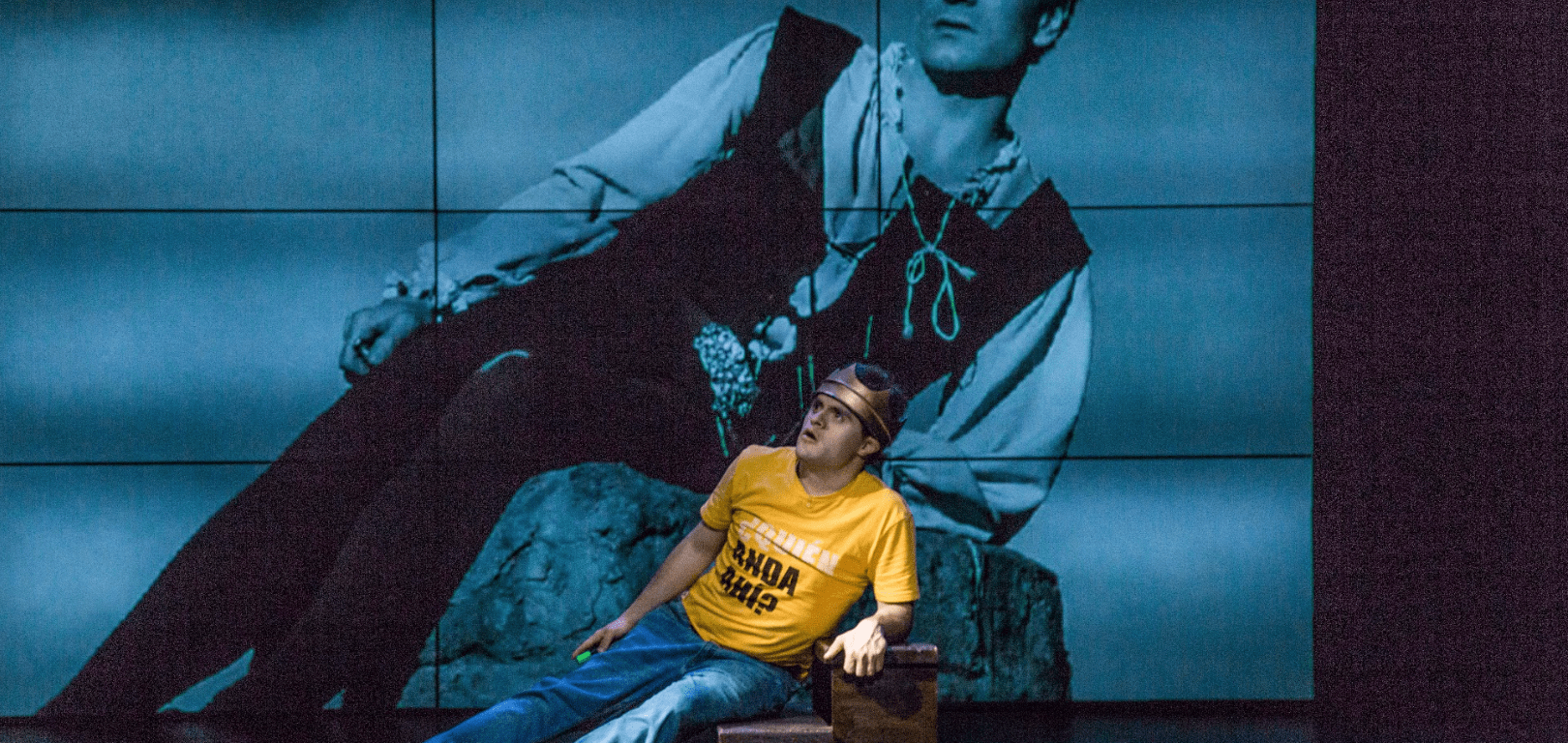
At the heart of Hamlet lies one of the most enduring questions in Western theatre: who has the right to exist, to speak, to be seen. In her radical reimagining of the play, Peruvian director Chela De Ferrari shifts that question off the page and into the bodies of her performers: actors with Down syndrome who take centre stage in a work that refuses both sentimentality and concession. Rather than adapting Shakespeare to fit its cast, De Ferrari places the canonical text itself under pressure, transforming it into a site of confrontation where assumptions about ability, authorship, and value begin to unravel.
Presented by Teatro La Plaza and staged at the Singapore International Festival of Arts, this Hamlet is not framed as an exercise in inclusion, but as a rigorous artistic intervention. Drawing from both Shakespeare’s language and the lived experiences of its performers, the work challenges audiences to reconsider not only who belongs on stage, but how deeply ingrained hierarchies continue to shape what we recognise as “serious” theatre. In this conversation, De Ferrari speaks candidly about authorship, bias, resistance, and why the most radical shift may not lie in representation alone, but in dismantling the structures that define it.
Bakchormeeboy: Your Hamlet places actors with Down syndrome at the center of one of the most renowned texts in Western theatre canon. Why was it important to claim this space, rather than create an original work specifically for them?
Chela De Ferrari: Hamlet is not just a text, it is a symbolic territory within the Western canon, historically reserved for certain bodies, certain voices, certain ideas of “ability.” Working with this material was a way of intervening in that territory. Not adapting it for them but allowing them to transform it through their presence. There is something very powerful in placing an iconic text, one that carries such cultural value, into the hands of people who are not usually granted that same value. It creates a kind of tension. The text is no longer something fixed or protected; it becomes something that can be re-signified. In that encounter, it shifts how we see both the performers and the values behind the canon itself.
Bakchormeeboy: The play asks questions of existence and legitimacy, primarily around the quote ‘to be, or not to be?’How does this question resonate differently when voiced by performers who are often denied space in society?
Chela: In our version, the play does not begin with “To be or not to be”, but as in Shakespeare, with “Who’s there?” And that question is not only textual but also embodied. Jaime Cruz, who is the first to appear on stage, enters wearing a T-shirt that reads, in Spanish, “¿Quién anda ahí?” So, before anything is said, the question is already present, visible on his body. “Who’s there?” places the audience in a position of responsibility. It asks them not only to watch, but to recognize who is in front of them. And that recognition is not neutral, it is shaped by all the assumptions, expectations, and biases they bring with them. Within that frame, when “to be or not to be” eventually appears, it is no longer an abstract philosophical dilemma, but something that emerges from a prior experience of visibility, or the lack of it. In their voices, it becomes a question not only of existence, but of the right to exist in public space.
Bakchormeeboy: Historically around the world, people with Down syndrome have been marginalized or perceived through a lens of limitation. How does your work confront or dismantle these deeply ingrained perceptions both within theatre and beyond it?
Chela: It does so through experience. By placing actors with Down syndrome on stage within a text like Hamlet, holding complexity, humour, contradiction, and emotion, what begins to unravel is not only an idea about the condition, but a broader assumption about who is capable of inhabiting complexity, uncertainty, doubt. The audience arrives with certain expectations, often unconscious ones, and the work gradually displaces them. Not because it tells them they are wrong, but because what they are witnessing no longer fits within those pre-existing categories.
Bakchormeeboy: There is often a tendency to frame such work in terms of inclusion or social good. How do you resist your production being read as “charitable” rather than as rigorous, high-quality theatre?
Chela: It´s very difficult. The moment people know that it is performed by actors with Down syndrome, there is an immediate prejudice. It is often assumed that it will be something naïve, simple, perhaps even infantilised, something that does not belong to the realm of rigorous, high-quality theatre. So, part of the work also lies in how it is communicated. Through conversations like this, and through very carefully chosen images, we try to open a different entry point. Because those initial assumptions are very strong, and they tend to position the work as something that could never be fully professional. Another thing that has helped a lot is word of mouth. When audiences share the experience, they do so with a kind of conviction and emotion that shifts perception. The work begins to grow through that, more spectators come, more functions are added, and that growth is not driven by a discourse of inclusion, but by the value of the theatrical experience itself. The audience becomes an essential part of how the work is re-framed.
After working on Hamlet I later created a piece at the Centro Dramático Nacional in Spain with ten blind actors, based on Chekhov’s The Seagull. After that production, a journalist asked me: “Chela, you first worked with actors with Down syndrome, and now with blind actors, are you a good Samaritan?” The question made me a bit uncomfortable, but I also understood it as an opportunity to clarify something important. My motivation is not to create inclusive work. My motivation is deeply artistic. What interests me is to see on stage other forms of representation, other bodies, other voices. And I think what is powerful is how audiences begin to find beauty where they are not used to looking for it. That shift does not come from charity; it comes from an encounter with something that expands their perception of what theatre can be
Bakchormeeboy: Your staging draws from both Shakespeare’s text and the lived experiences of the performers. How did you navigate authorship in the room, and how did it shape the form of the Hamlet we as the audience ultimately gets to see staged?
Chela: They were not only performers, but they were also fundamental to the authorship of the work. From the beginning, the process was conceived as a dialogue between Hamlet and the people inhabiting it. Their ideas, their rhythms, their ways of relating to language and even their resistances, shaped the piece. And in that process, I also had to learn to direct differently: to allow myself to be directed by them. Authorship became something shared. This also has a direct impact on how the audience experiences the piece. What emerges is a sense of authenticity that is very difficult to construct artificially. The actors are not simply interpreting the material; they have appropriated it. They believe in it, they inhabit it, and that generates a kind of truth on stage that is disarming.
Bakchormeeboy: You’ve worked extensively with classical texts. What did working with this particular group of actors reveal to you about Hamlet that more conventional productions might overlook?
Chela: It brought out a Hamlet less concerned with intelligence and more connected to urgency: the urgency of wanting to be heard, of trying to understand one’s place in the world. At the same time, working with actors with Down syndrome opened the possibility of encountering other forms of representation on stage: an actor with a pronounced stutter, or someone who might lose the text for a few seconds, or who relates to language in a different way. Forms that are usually corrected, hidden, or not allowed within conventional acting standards. Here, instead of being erased, those elements are present. And what happens is that the audience begins to perceive them differently. What is normally rejected starts to open the possibility of recognizing other forms of presence, other forms of beauty, other ways of being on stage that are not based on control or perfection. I think more conventional productions can sometimes become trapped in the brilliance of the play, its rhetoric, its philosophy, its complexity, and in doing so, they can lose touch with its vulnerability. What these actors brought me back to was precisely that vulnerability. They stripped away a certain theatrical prestige that often surrounds Hamlet, and what remained was something rawer, more human. What they revealed to me was not only something about Hamlet, but something about theatre itself: that sometimes what we call interpretation can become a form of distancing, and that truth on stage often appears when those protective layers fall away.
Bakchormeeboy: In Peru, what has been the response to actors with Down syndrome taking on Shakespeare and the arts in general? Has this challenged prevailing attitudes within the arts community or the public?
Chela: The response has been complex and revealing. At the beginning, there was a very enthusiastic reaction on social media. People celebrated the project, congratulated us for its diversity and inclusion, and expressed strong support. But that enthusiasm did not translate into ticket sales. So, we had to research and rethink our strategy. What we found was that, while people valued the idea of the work, they also had reservations. There was a certain discomfort, even nervousness, around the idea of watching actors with Down syndrome on stage. And many did not believe it would be a professional production, comparable to the work we had previously presented at our theatre, La Plaza. In response, we shifted our approach. We communicated differently and began working more closely with the Peruvian Down Syndrome Society, as well as with the actors’ families. The first weeks were difficult in terms of attendance, but around the third week the audience started to grow, and by the end of the run we were playing to very strong houses. Word of mouth became fundamental, people who had seen the work shared it with conviction, and that began to transform perception. The president of the Peruvian Down Syndrome Society at the time, Pablo Gómez, told us: “You have achieved with one play what we have not been able to achieve in 25 years of work.”
Bakchormeeboy: As this work is presented on an international platform like the Singapore International Festival of Arts, what do you hope it demands, in terms of change or in terms of what it wants audiences to see, in global theatre ecosystems?
Chela: It demands us to reconsider who is inside and who is outside the spaces of creation. But it also insists that this reconsideration cannot remain at the level of inclusion as a gesture it has to affect structures. In an international context, I am interested in it not being read as an exception or a “special case,” but as a concrete possibility of how theatre can expand when it stops protecting its own boundaries. At the same time, I think there is a significant value in the fact that the work has been presented in some of the most important theatres and festivals in the world. This invitation to the Singapore International Festival of Arts becomes part of that trajectory. It is significant to present it in spaces that hold a certain leadership within the global theatre ecosystem. When institutions with that kind of visibility and influence choose to include works where actors with Down syndrome or cognitive disabilities are at the center, it adds another layer of meaning. It is not only about the work itself, but about what those programming decisions signal. They open the possibility for other works, other artists, other bodies and voices to enter those spaces. And in that sense, the impact goes beyond a single production, it begins to shift the landscape of what is considered central, visible, and valuable.
Photos Courtesy of The Arts House Group
Hamlet plays from 21st to 23rd May 2026 at the Drama Centre Theatre. Tickets available here
SIFA 2026 runs from 15th to 30th May 2026. More information and tickets available here

