
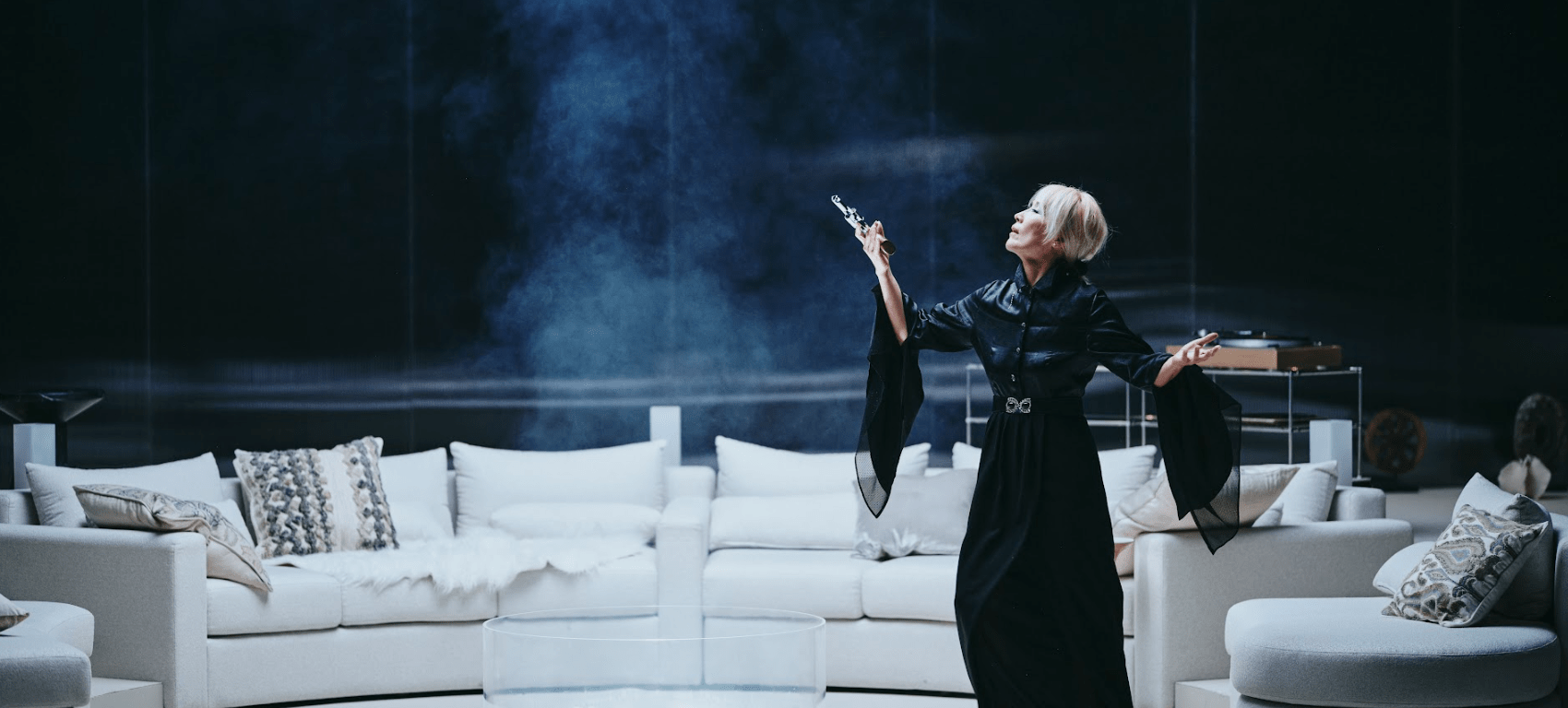
Few characters in modern theatre are as enduringly enigmatic as Hedda Gabler, a figure suspended between control and chaos, desire and restraint. In this latest staging by Park Jung-hee, Artistic Director of the National Theater Company of Korea, the question is not how to modernise Hedda Gabler, but how to encounter it anew. Rather than imposing a contemporary veneer, Park approaches the work as a living text—one that continues to ask urgent questions about agency, constraint, and the uneasy distance between what is felt and what is permitted.
Presented at the 2026 Singapore International Festival of Arts, this production resists both radical reinvention and strict preservation, instead stripping the play back to its emotional and structural core. Through a restrained visual language and a focus on rhythm, silence, and the actor’s presence, Park draws Hedda closer to the present, less a figure of the past than a disquieting reflection of contemporary life. In this conversation, she reflects on navigating cultural sensibilities, working with a masterful cast, and why Hedda’s contradictions continue to resonate across time and borders.
Bakchormeeboy: As both the director of Hedda Gabler and Artistic Director of the National Theater Company of Korea, how do you approach reinterpreting a canonical work like Henrik Ibsen’s play for contemporary audiences?
Park Jung-hee: For me, reinterpreting a canonical work is not about updating its outward form, but about rediscovering the questions it poses to us today. Hedda Gabler is not a fixed text; it is a work that comes alive anew in each time and context. As both director and Artistic Director, I considered how Hedda might exist within contemporary Korean society. Rather than maintaining a historical distance, I sought to bring the work into the present, so that audiences encounter Hedda not as a figure of the past, but as someone uncomfortably close to us now.
Bakchormeeboy: Many directors take bold liberties with Hedda Gabler, while others favour restraint. How did you determine the boundaries of your interpretation in this production, in terms of characterisation and staging? Was there anything quintessentially ‘Korean’ about this version?
Park Jung-hee: I was neither interested in pursuing radical reinterpretation for its own sake, nor in preserving the work in a fixed, museum-like form. Instead, I focused on stripping away unnecessary elements to reveal the immediacy of the character. The “Korean-ness” of this production does not emerge through external devices, but through sensibility. It resides in how emotions are expressed and restrained, in the tensions within relationships, and in the gap between what is spoken and unspoken—embedded in rhythm and silence.
Bakchormeeboy: Ibsen’s work is rooted in a specific social and cultural context. How do you navigate the balance between staying true to the original text and allowing space for a distinctly Korean sensibility? Was there a specific approach to space, scenography, and visual composition that shaped the undercurrents of emotion in Hedda Gabler?
Park Jung-hee: Rather than directly translating the original social context, I focused on the emotional and structural core of the text. Although time and environment have changed, the tensions within it remain valid and resonant. In staging, I aimed to create a space that is both concrete and abstract—at once the environment of Hedda and the other characters, and a space of abstraction. This allows the actor’s body and presence to become the central site of meaning. The visual composition is deliberately restrained, so that subtle emotional shifts can emerge with greater clarity.
Bakchormeeboy: Hedda Gabler is often seen as a deeply psychological portrait of repression and desire. What aspects of Hedda’s inner world felt most urgent or relevant to you in this production? What is the most important aspect of this often complex and even contradictory character that this production seeks to challenge?
Park Jung-hee: What felt most important in this production was the question of Hedda’s agency. I saw as central her desire to secure a sense of control within conditions where she is unable to make her own choices. Hedda is often described in terms of repression and desire, but I focused more on her instability, her contradictions, and her inability to fully coincide with herself. This production does not attempt to resolve those contradictions; rather, it invites the audience to remain within them.
Bakchormeeboy: This production brings together a highly experienced cast, including Lee Hyeyoung in a defining role. What has been most important for you in guiding the actors through the emotional and psychological precision that Hedda Gabler demands?
Park Jung-hee: What mattered most was not to predetermine emotions, but to allow the characters’ individual desires and mutual influences to arise organically through the actor’s body and in the moment. Rather than directing outcomes, I focused on creating conditions in which actors could respond truthfully to one another. Working with an actor like Lee Hyeyoung was, in particular, a process of finely calibrating rhythm, timing, and the smallest shifts of energy.
Bakchormeeboy: Hedda’s dissatisfaction and sense of confinement remain striking today. In your view, what aspects of her struggle speak most powerfully to contemporary society?
Park Jung-hee: I see Hedda’s conflict as arising from the gap between what is possible and what is permitted, as well as from the constraints imposed both externally and internally. Even today, many people experience a similar tension: having choices, yet feeling unable to act freely. In that sense, her dissatisfaction, ennui, and sense of emptiness resonate not as conditions of the past, but as sensations that persist in the present.
Bakchormeeboy: NTCK has played a significant role in shaping Korea’s theatrical landscape over the past 70 years. How do you see this production of Hedda Gabler contributing to that ongoing legacy?
Park Jung-hee: I believe the role of a national theatre is not only to preserve tradition, but to continuously question and renew it. This production is an attempt to revisit a canonical work not as heritage, but as a living dialogue with the present. In that sense, it contributes to the legacy of the National Theater Company of Korea by proposing new ways of experiencing and engaging with classical texts.
Bakchormeeboy: As this work travels to international platforms such as the Singapore International Festival of Arts, what conversations or reflections do you hope it will spark among audiences beyond Korea?
Park Jung-hee: While this production begins from a Korean context, I believe the questions it raises are universal. I hope that audiences, regardless of where they are from, encounter Hedda not merely as a cultural figure, but as a human presence—and that, through her and the network of relationships surrounding her, they are led to reflect on their own conditions, desires, and limitations.
Photos Courtesy of The Arts House Group
Hedda Gabler plays from 28th to 30th May 2026 at the Drama Centre Theatre. Tickets available here
SIFA 2026 runs from 15th to 30th May 2026. More information and tickets available here

