
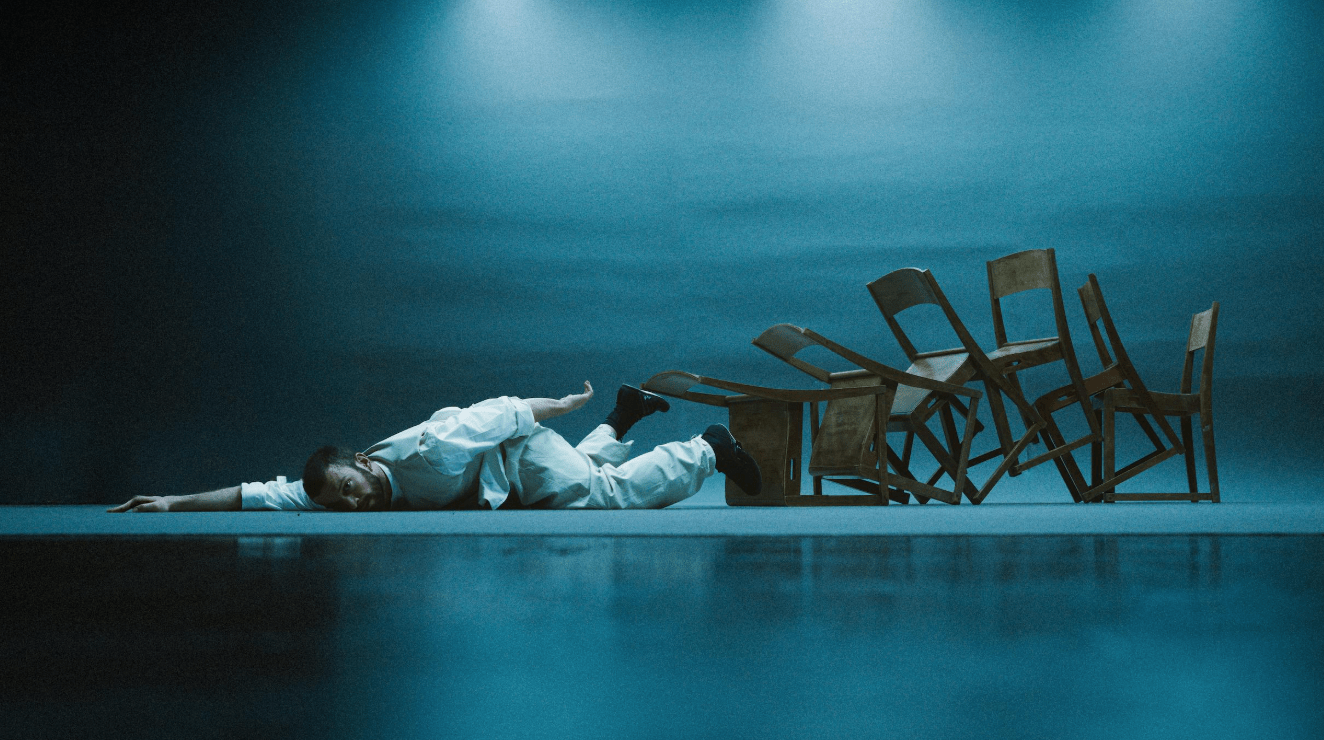
Time slips, stretches, and occasionally seems to stand still in Tempo, a dreamlike work presented at the Singapore International Festival of Arts. In this collaboration between director Kalle Nio and choreographer Fernando Melo, falling bodies hover mid-air, actions reverse, and the ordinary becomes quietly uncanny.
Rather than treating illusion as spectacle, Melo approaches it as a byproduct of attention, of bodies, space, and time aligning with near-impossible precision. We speak to him about shaping perception, embracing failure, and why the smallest moments often hold the greatest weight.
Bakchormeeboy: Tempo centres on the elasticity of time, such as acceleration, suspension, and stillness. What drew you personally to this theme at this moment in your career?
Fernando Melo: Time—and especially how we perceive it—has always been a central ingredient in my work. As a creator, I’m in the rare position of having an audience sit in the dark, with their phones off, fully present and attentive to what I choose to show. That creates a kind of responsibility, but also a powerful opportunity. I’m very interested in how performance can stretch, compress, or suspend time—how a moment can feel endless, or disappear almost before we grasp it. In Tempo, I wanted to lean into that more consciously: to shape not only what the audience sees, but how they experience duration itself. It’s also a reflection on time more broadly—how we live it, how it can expand or collapse depending on our attention or emotion, and ultimately how everything moves toward an end. There’s something both fragile and inevitable in that, which I find very compelling to work with.
Bakchormeeboy: The piece transforms everyday moments such as falling, stumbling, near-accidents into something poetic. What interests you about these fragile, almost-missed instants?
Fernando: I’m very interested in these small, almost unnoticed moments—falling, stumbling, nearly losing control—because they sit on the edge between intention and accident. They are extremely human moments, where something slips, and for a brief instant, time feels different. In daily life, these moments pass very quickly. We correct them, we move on, sometimes we don’t even register them. But when you isolate them, stretch them, or look at them more closely, they reveal a kind of vulnerability and precision at the same time. In Tempo, we wanted to stay with those instants a little longer—to give them space. By slowing them down or suspending them, they become almost sculptural. A fall is no longer just a fall; it becomes a suspended decision, a moment of imbalance that hasn’t yet resolved.
Bakchormeeboy: You often integrate stage illusion and magic into your work. In Tempo, what possibilities did illusion open up for choreography that movement alone could not achieve?
Fernando: As a choreographer, I never begin with the intention of creating an illusion. What interests me much more is how the bodies of the performers interact with scenography, light, and sound to create a new perspective on very human experiences. The process is very much based on experimentation—trial and error, testing ideas, adjusting, and often failing. Through that, certain moments emerge that feel almost magical. They are not designed as tricks, but rather discovered. And sometimes, those moments are perceived by the audience as illusions.
In Tempo, illusion became a natural extension of this way of working. Movement alone can suggest shifts in time—slowing down, accelerating, suspending—but when combined with scenography and light, those shifts can become much more precise and tangible. A fall can be prolonged beyond what feels physically possible, an action can appear to reverse, or gravity can seem to loosen its hold. What matters to me is not the illusion itself, but how it affects perception. It creates a small rupture between what we expect and what we see, and in that space, time becomes unstable. Illusion, in that sense, is not an added layer, but a consequence of a deeper integration between choreography and the stage elements—a way of expanding what choreography can do.
Bakchormeeboy: Working closely with director Kalle Nio, how did you negotiate the balance between choreography and illusion so that neither element dominates the other? How different is the director’s role from the choreographer’s in Tempo?
Fernando: Kalle is a visual artist, magician, and stage director, and his practice brings together many different influences. What we strongly share is an interest in how the relationship between the performers and the scenography can completely shift the audience’s perception. The collaboration was very fluid—to the point where it’s often difficult to say where an idea began, who initiated it, or how exactly it evolved. We were both continuously responding to what was in the room, proposing solutions, testing ideas, and building on each other’s instincts. It was less about dividing roles and more about working within a shared space of curiosity.
Because of that, the balance between choreography and illusion was never something we had to “negotiate” in a traditional sense. Illusion didn’t come in as an added layer, and choreography wasn’t something to be protected. Instead, both emerged together through the process. We were equally interested in how the performers’ actions interact with light, objects, and space, and how that interaction could reshape perception. So the roles of director and choreographer became quite porous. Kalle would think choreographically, and I would think scenographically or in terms of illusion. The result is something very integrated, where it’s hard to separate what belongs to movement and what belongs to illusion—they function together as one language.
Bakchormeeboy: Tempo disrupts physical laws where gravity vanishes, time reverses. How did these ideas shape the movement vocabulary, and what kinds of physical or mental demands does this place on the dancers?
Fernando: In Tempo, the idea of disrupting physical laws—gravity disappearing, time reversing, skipping in time—directly shaped the movement vocabulary. Instead of working with movement that follows a natural flow or cause and effect, we often approached actions as if they could be paused, looped, or suspended midway. For the dancers, this creates very specific physical and mental demands. They need a high level of control and precision to achieve the exact timing so that they align with light, scenography, or illusion. Often, what looks effortless or impossible is actually extremely detailed and controlled. Mentally, it also requires a different kind of focus. The dancers are not only executing movement, but constantly negotiating their relationship to the space and the stage elements.
Bakchormeeboy: Having created works for major institutions like GöteborgsOperans Danskompani and the Royal Danish Opera, how did the creative constraints or freedoms of Tempo differ from those contexts?
Fernando: When working with large cultural institutions, you have access to a wide range of resources—highly skilled set builders, carpenters, ironworkers, costume departments, and a large technical team. That allows for a certain scale and level of production support. With Tempo, the context was quite different. We worked with fewer resources and took a much more hands-on approach. Many practical aspects—taping the floor, adjusting props, fixing elements of the set—were done directly by the team: the performers, technicians, Kalle, and myself. Rather than feeling like a limitation, this created a different kind of intimacy with the material. The process became more immediate and collaborative, and everyone was closely connected to how the piece was built. It was a very different way of working, but also a very rewarding one.
Bakchormeeboy: What was the most challenging idea in Tempo to realise on stage, and did anything evolve or fail in ways you didn’t initially expect? How did you convey your ideas and concept to the performers and creative team to realise?
Fernando: The most challenging part of Tempo was not a single effect or moment, but the level of precision required to make everything function as one. What might appear as “magic” on stage is actually not a trick at all—it’s precision. You can arrive at maybe 90% of an idea quite quickly, but those last 10% are where the real work begins. That’s where timing, alignment, and detail need to be exact. It requires a huge amount of focus, repetition, and problem-solving. So in a way, the real “secret” behind the piece is not illusion, but dedication, precision, and a strong attention to dramaturgy.
The process itself involved a lot of trial and error—mostly error. But by surrendering to that process, you begin to arrive at places you couldn’t have anticipated. We developed the material step by step, one experiment at a time, building both the movement and the illusions together with the team. In terms of communication, it was less about explaining fixed ideas and more about sharing a direction. We worked very concretely in the studio, testing, adjusting, and refining, always keeping the overall concept and dramaturgy in mind. Through that, the performers and creative team became deeply involved in shaping the work, and the piece grew out of that shared, detailed process.
Bakchormeeboy: In a work that invites audiences to pause and experience time differently, what kind of shift or thoughts do you hope they carry with them after leaving the theatre?
Fernando: I don’t try to impose a specific interpretation, but I hope the work creates a small shift in how the audience experiences time. We are used to moving very quickly, constantly processing and anticipating what comes next. If Tempo can create a moment where people become more aware of duration—of how time can stretch, slow down, or feel suspended—then something has already changed. It’s also wonderful, as an artist, to be able to share this work with audiences in Singapore, especially at SIFA — a festival that brings together works of real importance on the global arts scene. And hopefully, there will be as many interpretations as there are people in the audience. If each person leaves with a slightly different perception or reflection, then the piece continues to exist beyond the stage.
Photos Courtesy of The Arts House Group
Tempo plays from 15th to 17th May 2026 at the Drama Centre Theatre. Tickets available here
SIFA 2026 runs from 15th to 30th May 2026. More information and tickets available here

