
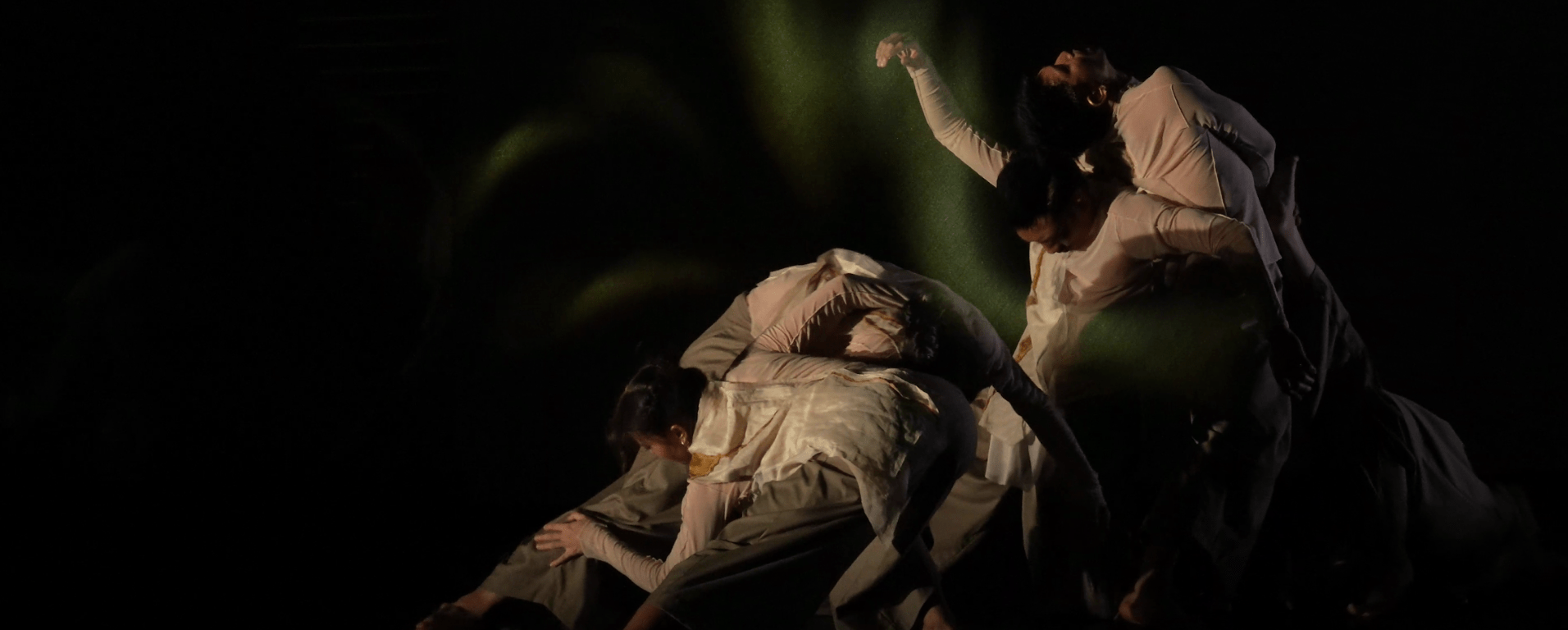
In Strangely Familiar, the stage becomes a meeting ground between worlds. A shifting digital presence, neither fully human nor entirely machine, moves alongside five dancers, blurring the boundaries between body and projection, instinct and invention. Created by Kuik Swee Boon, founding artistic director of T.H.E Dance Company, the work unfolds less as a linear narrative than as an evolving encounter: a space where the human body listens, adapts, and responds to what it cannot fully understand.
Premiering as part of the Singapore International Festival of Arts, the piece arrives with an impressive technological apparatus, including holographic projections and digital avatars. Yet for Swee Boon, technology is not the point, it is simply part of a larger inquiry. “This was originally created in a purpose-built theatre in Hong Kong that could really showcase technology,” he explains. “But the work is not about showing off effects. It’s really about humanity, and about how culture, the body, and technology come together.”
At the core of Strangely Familiar lies T.H.E’s long-evolving HollowBody methodology, which Swee Boon describes as both a philosophy and a practice. “HollowBody is the heart and soul of the company,” he says. “It’s about openness and about finding a way for the self to merge with the other.” Rather than focusing on form or technique alone, the work centres on a state of being: a heightened awareness of the body as something porous, receptive, and constantly shifting. “I’m interested in how the human form can experience other ‘lifeforms’ within itself,” he adds. “That’s what keeps me going: the idea of coexistence.”
This notion of coexistence extends directly into the relationship between dancers and technology onstage. The digital presence is not treated as an external force to be mastered or resisted, but as something to encounter and negotiate. “Technology is an extension of ourselves,” Swee Boon reflects. “There’s an anxiety around AI it’s a reflection of our own creativity, and what we’ve chosen to pursue.” For him, the deeper question is not whether technology will overtake us, but how we choose to live with it. “What this piece made me realise is that the fundamental question is about how we understand ourselves, and the choices we make for civilisation.”
In movement terms, this translates into a choreography that resists fixed boundaries. Instead of imposing a rigid vocabulary, HollowBody allows dancers to access multiple states within a single body, shifting between textures, impulses, and energies that feel at once human and other. “It happens quite naturally,” he says. “When you open the body in this way, different experiences can emerge.” The result is a physical language that feels fluid and adaptive, as though constantly recalibrating itself in response to the environment.
That environment, however, is not always stable. Projection, light, and mechanical elements introduce a level of unpredictability that challenges both performers and audience. “When projection first came out, people were afraid it would overwhelm performance,” Swee Boon notes. “But we learn to adapt. As humans, we’re very creative and we find ways to integrate.” What he resists, instead, is the desire for total control. “The problem is that we always want control. And when things become uncertain, that’s when we struggle.” In Strangely Familiar, uncertainty is not something to eliminate, but something to embrace. “It’s constant. So we have to accept it and find ways to coexist with it.”
This ethos carries into the collaborative process behind the work, which brings together artists from across different regions and backgrounds. For Swee Boon, these differences are not obstacles but essential sources of energy. “Everyone comes with a different perspective,” he says. “Different lives, different ways of understanding. To work together, you have to be willing to let go, and to really see from another point of view.” Collaboration, in this sense, becomes another form of coexistence: an ongoing negotiation between identities, ideas, and ways of being.
At the same time, Swee Boon is acutely aware of the balance between openness and structure. While he encourages artistic freedom among his collaborators, he maintains a strong focus on rigour and clarity. “What I must control is the production quality,” he says. “The standard has to be there. But within that, artists need the freedom to speak for themselves.” It is a delicate balance between holding a vision and allowing it to evolve, that mirrors the work’s broader themes.
Presented within the context of SIFA, Strangely Familiar also marks another step in T.H.E’s ongoing journey as a Singapore-based company engaging with international audiences. “We’re always happy when new audiences come in,” Swee Boon says. “SIFA is important because it allows people to see our work, and to understand that we’ve carved out a unique identity in dance.” That identity, he suggests, is rooted not in spectacle or trend, but in sincerity. “T.H.E is about authenticity and respect. We are all different, but we all breathe the same air.”
That sentiment feels especially resonant in a work that grapples with futures shaped by both technological acceleration and cultural fragmentation. While Strangely Familiar engages with digital forms and speculative possibilities, its concerns remain deeply human: how we relate to one another, how we navigate difference, and how we make space for what we do not yet understand. For Swee Boon, these questions are ongoing rather than resolved. “I don’t know what lies ahead,” he admits. “I just follow my heart, and this philosophy of coexistence.”
In that sense, the work does not offer answers so much as an invitation: to sit with uncertainty, to encounter the unfamiliar, and perhaps to recognise something of ourselves within it.
Photos Courtesy of The Arts House Group
Strangely Familiar 《熟悉的陌生》plays from 22nd to 24th May 2026 at Victoria Theatre. Tickets and more information available here
SIFA 2026 runs from 15th to 30th May 2026. More information and tickets available here

