
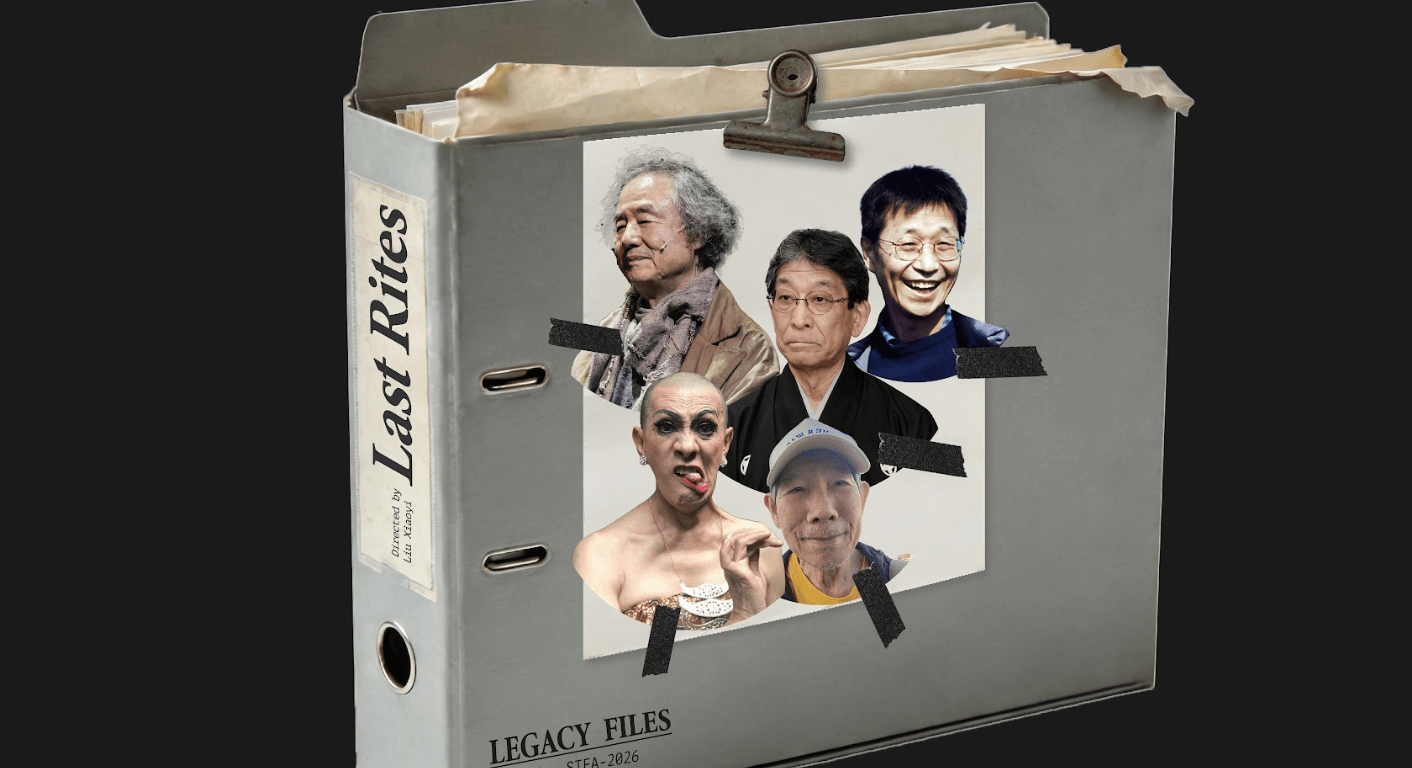
What would it mean to stage your final act, not as a last bow, but as a reflection of everything that came before? In Last Rites, Liu Xiaoyi brings together five veteran performers from across Asia to confront this question, weaving their personal histories into a meditation on life, art, and what remains after both have passed.
Presented at the 2026 Singapore International Festival of Arts, the work resists a singular language, instead holding multiple traditions, philosophies, and bodies in dialogue. Moving between the virtual and the real, memory and imagination, Last Rites asks not how we end, but how we continue, through influence, through traces, and through the fragile, unrepeatable act of performance. Director Liu Xiaoyi talks us through the process of gathering his team, the use of the virtual, and the immortality of the ephemeral in this interview:
Bakchormeeboy: Last Rites begins with a striking question: “If you could envision your last performance, what would it look like?” What drew you to this question, and why frame the work around imagined endings rather than death itself?
Liu Xiaoyi: In 2022, the pioneering dancer Mrs. Santha Bhaskar passed away on the very night she was celebrating the 70th anniversary of Bhaskar’s Arts Academy. This event led Tze Chien and me into deep discussions about this subject. As practitioners in the performing arts, we often joke that “the stage is the best place to die”—as if it were our ultimate sanctuary. However, death is often sudden; we rarely have the luxury to plan or curate our final exit. We became curious: for the senior artists around us who remain active on stage, have they ever contemplated this? Framing the work around an “imagined ending” allows us to explore the agency of the artist in their final act, rather than the finality of death itself.
Bakchormeeboy: The piece brings together five senior artists, each with decades of lived and artistic experience. What guided your selection of these particular collaborators, and what kinds of conversations emerged during your interviews with them?
Xiaoyi: The selection was guided by a desire for diverse discourse and cultural exchange. Because the topic is deeply personal, it was essential to work with people where a foundation of mutual trust already existed. Several of these artists are my long-time collaborators. Didik Nini Thowok and Kanji Shimizu have been my friends for nearly 15 years. Didik has performed in twelve of my productions across Singapore, Hong Kong, Tokyo, Jakarta, and other cities. Yang Shi Bin, whom I affectionately call “Shu Shu” (Uncle), is a senior I deeply respect. In 2015, I invited him to return to the stage for Struggle—Kuo Pao Kun’s only unproduced script—and that process forged a profound bond between us. Jung Dong-hwan and Nam Keung-ho are new friends recommended by Singaporean actor Tan Wan Sze, who is based in Korea. Through our interviews in Korea and the first phase of creation in Singapore in 2024, we have built a strong sense of friendship and trust. In 2024, Tze Chien and I traveled to the various cities where these artists are based to conduct a series of interviews with them. While our conversations always began with the subject of “death,” all five artists invariably shifted toward narrating their life journeys. Life and death are inseparable; we cannot speak of one without the other.
Bakchormeeboy: Much of your practice engages with intercultural exchange across Asia. In Last Rites, how do you navigate the tension between preserving cultural specificity and creating a shared, cross-cultural dialogue?
Xiaoyi: As mentioned, the dialogue between different languages is central to my work. Dialogue is never a monologue; even when the audience sees what appears to be a soliloquy on stage, it is in fact a product of extensive dialogues behind the scenes. It is not just about preserving one’s own culture or speaking in isolation. It is about my collaborators knowing, observing, and learning from each other. I believe dialogue prompts us to reflect on our own cultures, perhaps even leading us to think about how they might evolve. My rehearsal rooms are often full of challenge and tension, but also laughter. I always start by “making friends.” We don’t just work; we eat, drink, chat, and learn together. I strive to create a “safe space” where different people and cultures can meet—not just with surface-level politeness, but in an environment where it is safe to take risks and challenge oneself through the act of knowing another.
Bakchormeeboy: Your collaborators come from very different performance traditions, such as Noh, mime, theatre, dance. How did you approach weaving such distinct vocabularies into a coherent theatrical language? How do the artists end up in conversation with each other, whether subtly, thematically or literally?
Xiaoyi: I see my creative process as “hosting a dialogue” rather than “producing a show.” This dialogue happens first between me and my collaborators, then among the collaborators themselves, and finally between us and the audience. It is actually more exciting when the participants speak different “languages”—whether linguistic, cultural, or media-based. It offers us a chance to understand cultures vastly different from our own. My job is to construct a platform or structure that can hold these various vocabularies simultaneously. Therefore, my goal is not to create a “coherent theatrical language” in the conventional sense, but to create a space that can hold and carry these differences. For the artists, being “in conversation” with each other is not about a typical exchange of dialogue; it is, more importantly, about the act of coexisting.
Bakchormeeboy: The work sits between the virtual and the real, the body and the soul. How are you using technology or theatrical devices to create this “boundary space” on stage?
Xiaoyi: The “virtual and the real” in this work exists across several layers: Past vs. Future; Life vs. Death; Theatre vs. Technology. First, as these artists look toward an imagined end, they instinctively look back at their real past. Second, while life is real, for the living to discuss death is an exercise in illusory prospect. Third, Theatre occupies real time and space, whereas technology and media bring in illusory dimensions. Perhaps only the “now” is real—the past exists in memory, and the future exists in the imagination. On stage, I aim to create this “boundary space” through various theatrical design elements. I envision the stage as a museum installation; it is a mirror in which to see oneself, a window onto others and the world beyond, and a time machine that bridges the past and the future—all at once.
Bakchormeeboy: The performers speak about legacy, perseverance, and artistic calling. Did anything in their reflections challenge or shift your own understanding of what it means to be an artist?
Xiaoyi: Live art is ephemeral, and so is life. In the stories of these artists, I don’t just see a list of works they’ve produced; I see the “traces” these creations have left on their bodies. I see the influence of their mentors on them, and their own influence on the next generation and the wider artistic ecosystem. I often imagine what I will be doing or thinking when I reach their age. In recent years, my focus has shifted from “creating works” to “creating platforms and networks,” especially for the youth. This is my own ongoing experiment in understanding what it truly means to be an artist.
Bakchormeeboy: There appears to be an absence of female artists among the five collaborators – was this a deliberate choice? Could you share more about how the group was formed, and whether questions of representation shaped or complicated this process?
Xiaoyi: I was aware of this from the very beginning. Both during the initial development in 2024 and for this final production, I made efforts to invite female artists, but unfortunately, several were unable to join due to various reasons. I sometimes joke that “with an artist like Didik (who has a background in cross-gender performance), the ensemble is already diverse.” While gender is an important lens, it is one of many— alongside language, culture, artistic medium and more. This omission, however, gives us a compelling reason to create an all-female version in the future.
Bakchormeeboy: Last Rites asks whether an artist’s spiritual legacy can achieve a kind of immortality through performance. Where do you personally stand on that question after creating this work?
Xiaoyi: I believe the immortality of theater lies in its ephemerality. It is precisely this transience that makes theater a microcosm of our lives and the universe. Live art deals with real time, real space, and the real body—none of which can be replicated by any form of recording. If an object is easily copied, the copy eventually replaces the original. The “DNA” of theater is its inability to be preserved, and it is precisely this quality that grants it immortality.
Photos Courtesy of The Arts House Group
Last Rites plays from 22nd to 23rd May 2026 at the SOTA Studio Theatre. Tickets available here
SIFA 2026 runs from 15th to 30th May 2026. More information and tickets available here

