
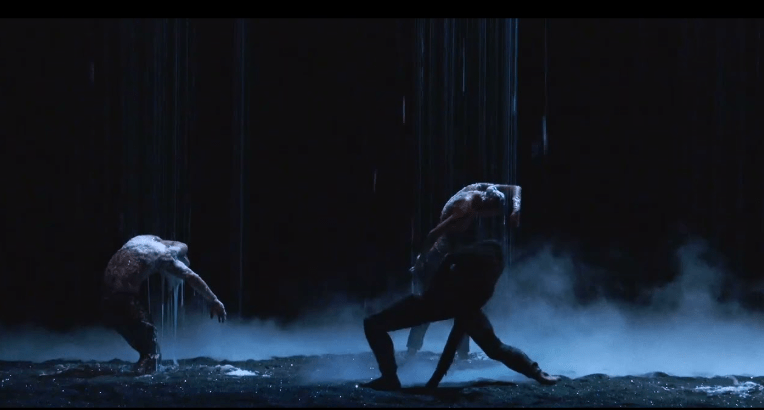
Strange and bewitching, Planet [wanderer] is a rare theatre production that unfolds like a dream one cannot quite hold onto. Created by choreographer Damien Jalet and visual artist Kohei Nawa, the work brings eight dancers into a shifting terrain of textures and matter, where bodies bend, sway, and reorganise themselves like reeds in the wind, caught in a fragile balance between “power and vulnerability, harmony and survival, destruction and evolution.”
Yet to understand Planet [wanderer] is to begin not with its imagery, but with Jalet’s persistent return to something more fundamental: the body itself. “It’s interesting how the internet suddenly decides to highlight certain things and not others,” he reflects, thinking back to the viral afterlife of his choreography for STORM by GENER8ION. “I loved working on that video, but I feel like I’ve done more complex things before.”
What struck him instead was its simplicity: “a long shot, no editing, just a group of people dancing.” In an era where, as he puts it, “everything is dematerialised, where AI reshapes our perception of reality,” that simplicity takes on a different weight. “Going back to the body, to a very honest way of doing things is a great reminder. There’s something raw and real about it.”
For Jalet, dance retains a power that feels increasingly rare: “to bring people together, to share something, to transform each other.” What resonates in STORM, and carries through into Planet [wanderer], is a kind of elemental force. “There’s something primal that connects us, something that feels missing when everything is manipulated, retouched, artificial.” It is this impulse that drives him to strip things back. “Sometimes the minimalism of things, if it’s done with the right intensity, with something genuine, you can touch much deeper than relying on things that feel perfect, edited, or sleek.”
This search for something elemental actually did not begin in dance. Jalet started in theatre, drawn first to language, character, and transformation. “I was fascinated by shifts in identity,” he recalls. But over time, words began to fall away. “Words can lie. The body doesn’t, in the same way.” Movement, bound to gravity and intention, offered something more concrete, “maybe the only tangible proof of our existence.”
From there, choreography became less about representation and more about material. “It’s a lot like sculpting,” he says. “You organise bodies, you shape them, you put physical energy into matter.”
For Nawa, whose practice has long explored the instability of perception through sculpture, this understanding of the body as matter became a natural point of convergence. “My sculptures have consistently aimed to use materials as a point of entry to establish a particular ‘sensory field’ within the viewer,” he explains. “Through the physical properties of materials, they unsettle perception and invite transformation.”
In Planet [wanderer], this philosophy expands beyond the isolated object and into the entire stage environment. “The objects on stage exist in a constant state of flux through the interplay of light, gravity, and the body,” Nawa says. “Rather than fixed works, they evolve into a kind of phenomenon.” The stage, then, is not passive scenery but an active system, “continuously generating relationships between the body, matter, and environment.”
What fascinates Jalet most is not simply the body as form, but as archive: “the body carries a knowledge that is so ancestral, all the way from when we lived under the sea.” The more one works with it, the more it reveals. “Every body is different. And limits, mental or physical, are very interesting. If you work with limits, imagination can take over, what feels like a handicap can become something incredibly beautiful and poetic.”
That same logic of transformation shapes the world of Planet [wanderer] itself. The stage is unstable: sandy, uneven, resistant. “It’s not a friendly space to dance on,” Jalet admits. “It’s like walking on a desert, moving ground.” Choreography emerges not despite restriction, but because of it. “We developed the physical language based on the restrictions, movement comes from that.”
Nawa describes the work in similarly fluid terms, as an exploration of thresholds rather than fixed forms. “It is perhaps the boundary where the ‘body’ and the ‘stage’ merge,” he says. “Conceptually, it also reflects the friction that arises between life and the environment.” In his earlier PixCell works, transparent spheres refracted and transformed familiar objects; here, meteor dust, fog, and liquid perform a similar function upon living bodies. “A body whose texture shifts through sparkling particles settling onto the skin or through a milky liquid becomes something oscillating between object and life.”
What emerges is less a choreography imposed upon bodies than a continuous process of transformation between bodies and materials. For Nawa, the distinction between sculpture and choreography ultimately begins to collapse. “Performance can perhaps be understood as a time-based, amorphous sculpture, or as multiple installations unfolding sequentially within a specific duration.”
The title itself became central to this conceptual terrain. Though it originated with Nawa, Jalet initially resisted it. “‘Planet’ initially felt overwhelmingly big,” he admits. “So I looked into its etymology, it actually comes from a Greek word meaning ‘to wander’, and that was what ended up shaping the work.”
That discovery reframed the work entirely. “Humans are wanderers. We migrate, we move. We all have a centre of gravity, but we are constantly in motion.” Nawa, too, was drawn to this duality. “The ancient Greek root of the word refers both to a ‘planet’ and a ‘wanderer,’” he explains. “This duality, the imagination of a solitary celestial body moving through the cosmos and the wandering of life unfolding across its surface, became a starting point for the work.”
The environment of the piece is not abstract. It carries traces of lived catastrophe, particularly the landscapes of Ishinomaki following the 2011 tsunami. Both artists were profoundly marked by what they encountered there. “We saw trees uprooted, objects transformed by the sea,” Jalet recalls. “It felt like encountering artefacts from the past.”
For Nawa, the images left an equally lasting imprint. “The landscapes I witnessed in Ishinomaki, marked by traces of the tsunami, fallen trees and man-made objects carried deep into the forest, left a strong impression on me,” he says. “There, the collapse of civilization and the resilience of life coexisted simultaneously.”
Those impressions linger throughout Planet [wanderer], not as narrative but as atmosphere: erosion, adaptation, survival. “Natural forms and man-made structures are not presented as a simple binary opposition,” Nawa explains, “but as fluctuating systems that constantly destabilize that distinction.” In a time marked by environmental instability and fragmentation, “life nevertheless continues to transform and endure.”
One of the work’s most striking images sees dancers swaying with their feet submerged in water, and that emerged from this idea. “The scene embodies a form of unstable life repeatedly adapting and resisting within a harsh environment.”
If Jalet approaches dance as choreography, Nawa approaches the stage as a living installation. “I see the dancers’ bodies, enveloped in materials, as sculptural forms, and the phenomena unfolding throughout the stage space as installations,” he says. Materials themselves become performers with their own agencies and resistances. “Meteor dust, viscous white liquid, fog…these are not simply background elements, but entities with their own physical behaviours and properties that influence, induce, or constrain movement.”
The process of creation became one of negotiation with these materials rather than mastery over them. “Many of the materials I work with could be described as ‘responsive substances,’” Nawa explains. Mist rose unexpectedly from the dancers’ skin as it absorbed body heat, then dissolved and reformed according to subtle shifts in air currents. Viscous liquid had to be endlessly reformulated according to different climates and theatre environments. “These fluctuations, emerging between control and resistance, brought richness to the performance.”
That tension between control and surrender resonates deeply with Jalet’s understanding of dance itself. “Dance is always the fruit of tension,” he says. In Planet [wanderer], the dancers remain caught between grounding and collapse, fluidity and exhaustion. “In one hour, you have a condensation of the human experience, we are here for a very brief time.”
Underlying all this is a quieter but persistent spirituality. “If you’re an artist, especially in performing arts, you are a spiritual person,” Jalet reflects. Performance, for him, remains inseparable from ritual. “It’s ephemeral. If it doesn’t speak to something beyond us, what does it speak to?” His travels across Asia only deepened this perspective. “In some cultures, dance is a ritual and way to connect with gods, to enter altered states, to connect with the land, with the invisible.”
Nawa’s own perspective similarly resists rigid disciplinary boundaries. His collaboration with Jalet has become, he says, “a continuous feedback loop” between sculpture and performance. “Together, we have developed methods that transform the dancers’ physicality and movement into sculptural forms, while also allowing what emerges on stage to circulate back into sculpture.”
This exchange extends beyond artistic form into ways of thinking altogether. “I believe this kind of interdisciplinary thinking around transformation will become increasingly important,” Nawa says. At Kyoto University of the Arts, where he teaches, he recently launched a shared studio bringing together students from multiple disciplines to collaborate through “discussions, performances, and installations together.”
That openness to exchange also shapes how both artists think about the work’s journey across cultures. “It is important today to engage with art beyond disciplinary and national boundaries,” Nawa reflects. “That is one reason I am particularly pleased that Planet [wanderer] will be presented in Asia, a region where diverse cultures and histories have long intersected.”
Rather than explain these ideas outright, however, Jalet prefers to leave room for uncertainty. “I love to work with mystery,” he says simply. That mystery extends to the experience of watching the work itself. Jalet’s parallel work in cinema, including Suspiria, sharpened his awareness of framing and perception. But where film fixes an image, performance resists permanence. “On stage, it’s like one long shot,” he says. “You have to recreate it every night. It’s exhausting, but also very special.”
More importantly, it remains unstable. Each audience member experiences something different depending on where they sit, what they notice, what they carry into the theatre. “There is no single reality,” Jalet insists. “Only your point of view.”
In this way, Planet [wanderer] becomes less a performance to be understood than an environment to be entered, one that shifts as much within the viewer as it does on stage. Bodies emerge and disappear through fog, skin glimmers beneath meteor dust, reeds of human limbs sway ankle-deep in water as if adapting to some unfamiliar planet.
And through it all runs a quiet insistence: that beneath the noise, beneath the technologies increasingly mediating contemporary life, something irreducibly human still persists. As Jalet says: “Art reminds us of what is human,”
In Planet [wanderer], that reminder takes the form of a sensation, fleetingly felt in the movement of bodies through space, and in matter itself learning, once again, how to breathe.
Photos Courtesy of The Arts House Group
Planet [wanderer] plays from 29th to 30th May 2026 at the Esplanade Theatre. Tickets and more information available here
SIFA 2026 runs from 15th to 30th May 2026. More information and tickets available here

