
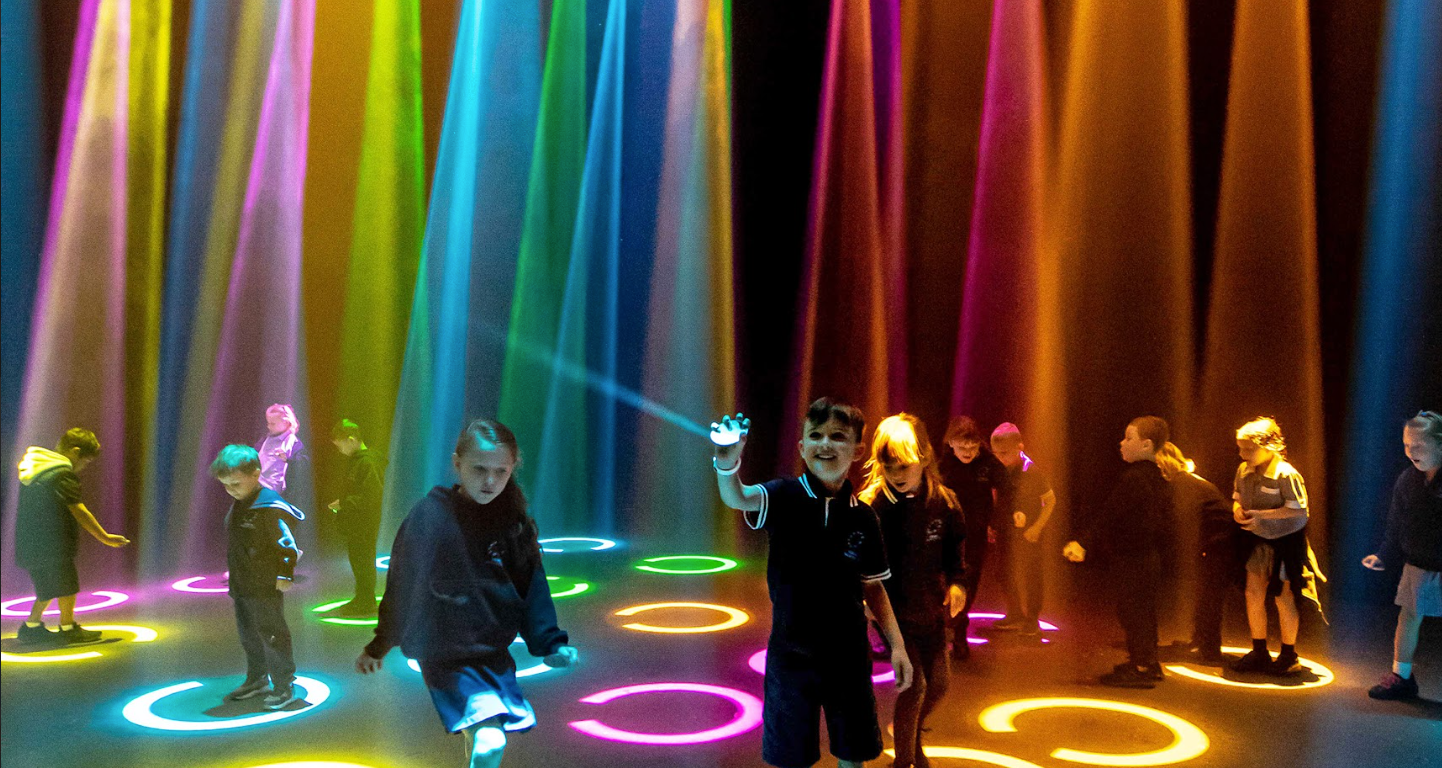
In The Lighthouse, light isn’t something you simply watch, but something you step into. Created by Geoff Cobham for Patch Theatre, the work invites audiences, both young and the young-at-heart, to move through a glowing landscape of shifting rooms, reflections, and surprises, where curiosity leads the way.
Presented as part of the 2026 Singapore International Festival of Arts, this immersive experience rethinks what theatre for young audiences can be. There are no fixed narratives, no single way through—only the freedom to explore. For Cobham, it’s a culmination of decades of working with light, distilled into a space where science, art, and play collide. We speak to him about creating wonder, designing for children, and why the best theatre might begin with not knowing.
Bakchormeeboy: The Lighthouse invites children and adults to explore light through an immersive, promenade experience. What sparked the initial idea for this work, and why light as the central theme?
Geoff Cobham: I discovered early on that children love light as much as I do — and, importantly, they don’t want to sit passively in theatre seats; they want to play. So the idea of creating a grand, immersive “palace of light” felt both obvious and exciting. In some ways, it was the culmination of 30 years of ideas, realised with a brilliant team of like-minded designers during an intensive six-week development in a warehouse in Adelaide. Light became the central theme because it is endlessly fascinating — it’s both a scientific phenomenon and a deeply emotional medium. It invites curiosity, experimentation, and wonder across all ages.
Bakchormeeboy: You’ve spent decades as a lighting designer as well as a director. How does your relationship with light shape the way you approach storytelling in this piece and the way you conceptualise theatre?
Geoff: The Lighthouse has been described as my “love letter to light,” and that feels accurate. Light isn’t just a tool for revealing a story — it is the story. It has its own language, its own emotional resonance, and its own capacity to surprise. As both a lighting designer and director, I tend to think spatially and atmospherically. I’m interested in how an audience feels their way through an experience, rather than simply following a narrative. In this work, light becomes the primary storyteller — shaping mood, guiding attention, and inviting discovery.
Bakchormeeboy: The Lighthouse sits at the intersection of science and art. How did you approach translating scientific ideas about light into something intuitive, sensory, and emotionally engaging?
Geoff: For me, science and art are fundamentally the same thing — both are ways of exploring and understanding the world. Rather than explaining scientific principles, we embody them. We create environments where audiences can feel how light behaves — how it reflects, refracts, diffuses, and transforms space. The goal is not intellectual understanding, but intuitive, sensory engagement that sparks curiosity.
Bakchormeeboy: The work blends installation, performance, and even elements of a “rave,” which seems unusual for theatre for young audiences. How did you arrive at this hybrid form, and what does it allow you to do that traditional theatre cannot?
“Sitting still for 45 minutes is not a four-year-old’s happy place.” That was our starting point. From there, we developed a set of guiding principles that shaped the work:
• Focus on the questions, not the answers
• Prioritise audience agency — we’re not telling them what to think
• Seek surprise and uniqueness over cleverness
• Avoid a single, fixed interpretation — the worst outcome is everyone leaving with the same story
• Let the audience tell us what the work is about
• Ensure performers are not “ahead” of the audience — we discover things together
• Apply child logic
• Seek simplicity
• Remain non-verbal, but deeply human and real
• Recognise that many of our audience cannot yet read or write
• Avoid pretence
• Be open to humour without defaulting to it
• Acknowledge that children can sense when adults want something from them
• Embrace abstraction — we are making abstract art for children, with genuine agency This hybrid form allows us to move beyond the limitations of traditional theatre. Instead of presenting a fixed narrative, we create an environment where experience, interaction, and interpretation are unique to each audience member.
Bakchormeeboy: Patch Theatre is known for placing children at the centre of its work. How did you design The Lighthouse to be experienced differently through a child’s eyes versus an adult’s?
Geoff: People often talk about giving children agency in immersive work — I wanted to see if we could genuinely achieve it. That meant creating a large-scale play space that wasn’t “dumbed down” or overly constrained by risk aversion, but still full of wonder and possibility. It needed to feel like something children could explore, influence, and partially own. A key strategy was intimacy. We work with small groups — 30 children at a time — moving through five chambers of light, each lasting around 10 minutes. Every 20 minutes, another group enters, so up to 90 children can be in the space at once, yet they rarely encounter each other. It’s a carefully choreographed system that maintains a sense of discovery and personal experience. Equally important is involving children in the creation process. They are central to our testing and devising phases. Their feedback is vital and always respected — they are, after all, the true experts in play.
Bakchormeeboy: The piece encourages hands-on exploration and curiosity. How do you balance open-ended play with a sense of structure or narrative across the different rooms?
Geoff: We allow children to create their own narratives — they are rarely linear, and that’s part of the richness of the experience. At the same time, the structure of the installation provides a gentle framework. Each chamber offers a distinct environment or idea, guiding the journey without dictating it. The balance lies in designing spaces that suggest possibilities rather than impose meaning.
Bakchormeeboy: Across your career, from large festivals to intimate theatre, what have you learned about creating wonder, and how is that distilled in The Lighthouse?
Geoff: At the heart of profound artistic experiences is their ability to connect with our personal stories. The moments that have stayed with me most are those where I felt physically connected to what was happening — where I was inside the mechanics of the experience, or standing in the presence of something vast and beyond my immediate understanding. That feeling of awe — of encountering something bigger than yourself — is what we aim to create in The Lighthouse. It’s about placing the audience at the centre of wonder, not just showing it to them.
Bakchormeeboy: In a world where children are often surrounded by screens, what kind of experience or feeling do you hope they take away from encountering light in such a physical, immersive way?
Geoff: I hope they feel empowered to keep exploring — across light, science, and art. One of the most rewarding outcomes is seeing how the experience ripples outward. I often receive videos of children recreating what they’ve encountered — making their own “shows” at home using torches, mirrors, and whatever they can find. That continuation of play, curiosity, and creativity beyond the theatre is incredibly satisfying. It suggests the work has stayed with them — and become something of their own.
Photos Courtesy of The Arts House Group
The Lighthouse plays from 15th to 24th May 2026 at The Arts House. Tickets available here
SIFA 2026 runs from 15th to 30th May 2026. More information and tickets available here

